Introduction
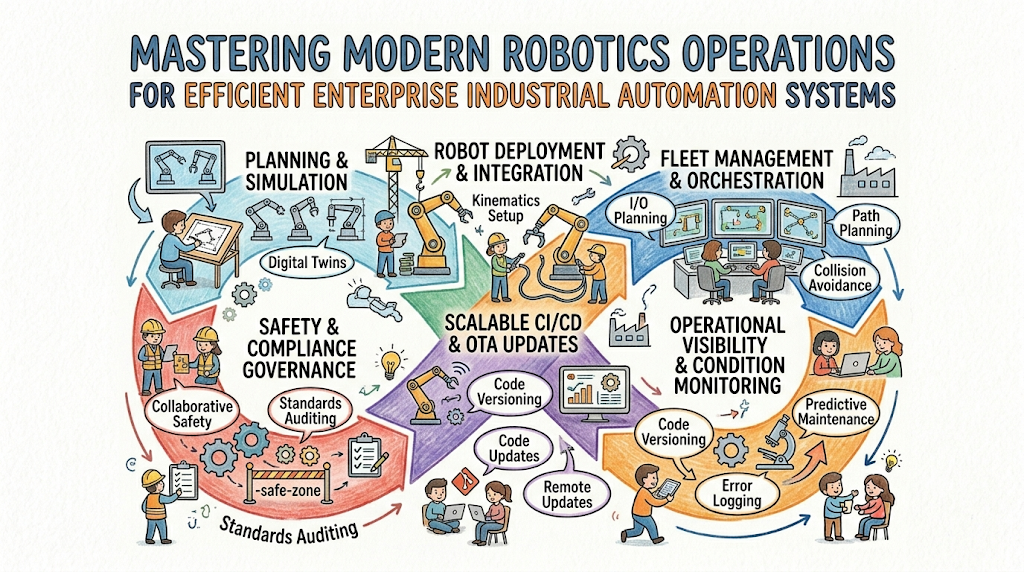
Robotics Operations, frequently referred to as RobotsOps, is the systematic practice of deploying, monitoring, scaling, and maintaining physical robotic assets alongside their digital software infrastructure. It bridges the gap between traditional engineering, software development, and day-to-day industrial operations.In modern industries, this discipline matters because it transforms isolated, manual machines into cohesive, intelligent fleets. Without structured operations, scaling an automated workforce becomes virtually impossible.In this comprehensive guide, you will learn the foundational components, core principles, and career pathways that define this rapidly growing field. If you want to master these modern workflows, explore the foundational educational resources available at RobotsOps to jumpstart your technical journey.
Evolution of Robotics Operations
Traditional Industrial Automation Challenges
For decades, factory automation relied on rigid, hardcoded machinery designed to perform one repetitive task endlessly. These traditional systems lacked flexibility and required extensive manual reprogramming whenever a product design changed.
Furthermore, diagnosing hardware failures required physical inspections, leading to lengthy periods of unexpected downtime. These legacy setups operated in silos, isolated from broader enterprise digital networks and real-time data streaming.
Rise of Intelligent Robotics Systems
The integration of advanced microprocessors, low-cost sensors, and internet connectivity sparked a massive shift in factory environments. Robotic assets evolved from blind executioners into perceptive machines capable of understanding their immediate surroundings.This technological leap allowed equipment to adapt to minor environmental variations without human intervention. Consequently, businesses began deploying autonomous fleets capable of navigating complex, dynamic spaces dynamically.
Shift Toward AI-Driven Robotics Operations
Today, the industry is transitioning into an era dominated by AI robotics and cognitive automation platforms. Modern operations leverage advanced software models to process massive streams of data directly at the edge or via cloud environments.This evolution shifts the operational paradigm from reactive troubleshooting to proactive optimization. Systems can now learn from past experiences, share operational insights across entire fleets, and continuously improve their own performance.
Core Components of Robotics Operations
Robotics Control Systems
Control systems serve as the centralized brain of any individual automated asset, executing precise commands for movement and task management. These systems process instructional algorithms and translate them into physical physical actions via motors and actuators.Within a comprehensive operations framework, control architectures must be standardized to allow distinct machine models to communicate seamlessly. Effective control ensures that physical movements remain safe, predictable, and highly repeatable across varying workloads.
Sensors & Machine Vision
Sensors act as the eyes and ears of modern autonomous hardware, gathering vital environmental data in real time. Advanced machine vision technology utilizes specialized cameras and processing algorithms to identify, classify, and locate objects accurately. This sensory input allows machines to navigate dynamic workspaces, inspect product quality, and avoid obstacles safely. Without robust vision systems, machines remain incapable of interacting intelligently with changing surroundings.
Robotics Software & Platforms
The modern operational ecosystem relies heavily on specialized software layers that abstract complex underlying hardware interfaces. These platforms provide standardized libraries, driver configurations, and communication protocols that simplify application development. They allow engineers to write unified code that runs across diverse hardware fleets regardless of the manufacturer. Additionally, these platforms facilitate smooth software updates and configuration management across hundreds of remote devices simultaneously.
Automation Workflows
An automation workflow defines the exact sequence of tasks, conditions, and business rules that a machine fleet must execute. These digital pipelines orchestrate how individual units interact with conveyor systems, enterprise software, and human workers. Optimizing these workflows ensures that assets do not idle or bottleneck during complex industrial procedures. Well-designed workflows make it easy for operators to modify business logic without rewriting low-level hardware code.
Robotics Monitoring & Analytics
Continuous data collection is fundamental to maintaining high availability across enterprise automation deployments. Specialized robotics monitoring solutions track critical hardware metrics, including internal component temperatures, power draw, and joint strain.
Simultaneously, robotics analytics platforms aggregate this data to reveal high-level performance trends and operational bottlenecks. This deep visibility helps management make data-driven decisions to boost overall system efficiency.
Key Principles of Robotics Operations
Intelligent Automation
- Context Awareness: Systems utilize environmental data to make smart operational decisions without human intervention.
- Dynamic Adaptation: Fleets adjust their paths, speeds, and tasks automatically based on real-time workplace changes.
- Self-Correction: Algorithms detect minor errors or misalignments and fix them instantly to prevent process interruptions.
Real-Time Monitoring
- Live Telemetry Tracking: Continuous streaming of velocity, battery levels, and error codes directly to a central dashboard.
- Instant Alerting: Automated notifications are dispatched to operations teams the moment a metric crosses a safe threshold.
- Remote Diagnostic Capabilities: Engineers inspect internal software states from anywhere in the world without visiting the physical floor.
Predictive Maintenance
- Early Anomaly Detection: Machine learning algorithms identify subtle patterns that signal an impending component failure.
- Scheduled Downtime Optimization: Repair tasks are planned during natural operational lulls rather than during peak production.
- Extended Asset Lifespans: Proactive care reduces catastrophic wear and tear, maximizing the return on hardware investments.
System Reliability
- Fail-Safe Configurations: Hardware enters a secure, immobilized state immediately if a critical software error occurs.
- Redundant Architecture: Secondary sensors or backup communication channels activate instantly if primary systems fail.
- Consistent Performance: Standardized configurations ensure uniform behavior across the entire fleet regardless of location.
Workflow Optimization
- Throughput Maximization: Eliminating idle time by balancing tasks dynamically across available hardware units.
- Resource Allocation: Assigning specific robots to tasks that perfectly match their physical capabilities and battery levels.
- Cycle Time Reduction: Streamlining paths and sorting logic to complete industrial processes as quickly as possible.
Essential Robotics Concepts Beginners Must Know
Robotics vs Automation vs AI Robotics
It is common for beginners to confuse these three distinct yet interconnected technological domains. Traditional automation refers broadly to using software or machinery to complete repetitive, structured tasks without human effort.
Robotics involves physical machines designed to perform specific manual actions automatically. Meanwhile, AI robotics combines physical hardware with advanced intelligence, enabling machines to perceive, learn, and make complex decisions in unpredictable environments.
| Concept | Primary Focus | Environment Style | Example |
| Automation | Eliminating repetitive tasks | Highly structured | Software macros or fixed conveyor belts |
| Robotics | Executing physical actions | Semi-structured | Industrial welding arms |
| AI Robotics | Dynamic decision making | Unstructured | Self-navigating warehouse picking units |
Robotics Lifecycle Management
Managing autonomous assets involves a structured lifecycle that extends far beyond the initial deployment phase. It begins with architectural design and virtual simulation to test operational concepts thoroughly before hardware acquisition. Next comes physical deployment, configuration setup, and integration into existing workspace networks. The longest phase involves continuous monitoring, optimization, and software patching, eventually leading to safe decommissioning and asset recycling.
Robotics Monitoring Systems
A monitoring system acts as an ongoing health check for complex, distributed hardware fleets. It collects low-level data points from internal buses, operating systems, and external environmental sensors.
This continuous stream of telemetry is compiled into accessible visual dashboards for operations teams. Effective monitoring ensures that minor software bugs or sensor drifts are caught before they cascade into complete system failures.
Autonomous Systems Basics
Autonomous systems are designed to operate independently within defined parameters without requiring continuous human guidance. They rely on a continuous loop of perceiving their environment, planning an optimal path or action, and executing that plan safely.
This autonomy requires a robust blend of localization algorithms, mapping software, and collision avoidance protocols. Understanding this loop is essential for anyone looking to manage modern industrial fleets successfully.
Robotics Analytics Importance
Data without analysis is simply noise, which is why specialized analytics are vital to modern operational strategy. Analytics platforms process historic fleet data to identify hidden inefficiencies that are impossible to spot in real time.
For instance, analytics can reveal that specific hardware models fail more frequently in hotter areas of a facility. These long-term insights guide future purchasing decisions, layout adjustments, and process improvements.
Real-World Robotics Operations Use Cases
Manufacturing Automation
Modern automotive and electronics factories rely on operational frameworks to synchronize hundreds of robotic welding, painting, and assembly arms. These systems ensure that hardware components move in perfect harmony, avoiding costly collisions on crowded production floors.
Real-time monitoring alerts engineers the moment an arm drifts even a fraction of a millimeter out of alignment. This extreme precision maintains strict product quality standards while maximizing daily production yields.
Warehouse Robotics Systems
E-commerce fulfillment centers utilize vast fleets of mobile units to transport heavy inventory shelves directly to human packing stations. Operational software dynamically routes these vehicles through crowded aisles, preventing traffic jams and collisions.The system monitors battery levels automatically, sending units to charging stations during low-activity periods. This automated optimization ensures that customer orders are processed rapidly around the clock.
Healthcare Robotics Applications
In modern medical facilities, autonomous transport units safely deliver medication, meals, and linens to various hospital departments. Operational frameworks ensure these machines navigate crowded hallways smoothly while prioritizing human safety above all else.
Additionally, specialized sterilization robots use ultraviolet light to disinfect operating rooms independently. Operations platforms track these disinfection cycles precisely to maintain verifiable compliance with strict healthcare cleanliness standards.
Logistics & Delivery Robotics
The logistics sector uses autonomous vehicles and localized delivery rovers to streamline sorting yards and last-mile distribution networks. Operations management platforms track these assets via GPS and cellular networks, ensuring they follow optimal delivery paths.
Centralized command centers monitor fleet safety parameters continuously, allowing human operators to take remote control if a rover encounters an unexpected obstacle. This blend of autonomy and oversight drastically reduces delivery overhead.
Smart Factory Operations
Smart factories represent the pinnacle of integrated automation, where all physical assets and enterprise software networks communicate seamlessly. In these environments, machines adjust their production speeds dynamically based on real-time inventory levels and incoming customer orders.
Operational frameworks oversee this massive orchestration, ensuring that power usage, material handling, and hardware maintenance are perfectly balanced. This holistic optimization creates an incredibly agile manufacturing ecosystem.
Common Mistakes in Robotics Operations
Treating Robotics Only as Hardware
Many organizations focus exclusively on physical specifications like payload capacity and speed, ignoring the critical software layer. A robot is only as capable as the operational software running it.
Neglecting software architecture leads to fragmented systems that are difficult to update, scale, or integrate with other tools. Successful deployments treat hardware and software as a single, unified operational ecosystem.
Ignoring Monitoring Systems
Deploying an automated fleet without setting up comprehensive monitoring tools is a recipe for operational disaster. Teams remain completely blind to minor sensor degradations, slowly overheating motors, or intermittent network drops.
This lack of visibility turns minor, easily fixable glitches into catastrophic failures that halt production unexpectedly. Continuous tracking is mandatory for maintaining high system uptime.
Poor Maintenance Strategy
Relying solely on reactive maintenance—fixing equipment only after it breaks—creates unpredictable operational environments and expensive downtime. Conversely, purely calendar-based maintenance often leads to unnecessary work on perfectly functioning machines.
The mistake lies in ignoring the real-time health data generated by the machines themselves. Transitioning to data-driven predictive maintenance prevents unexpected failures while optimizing service schedules.
Lack of Scalability Planning
A framework that works beautifully for two prototype units often falls apart completely when expanding to fifty machines. Organizations frequently build custom, ad-hoc management scripts that cannot handle the data loads or security needs of a large fleet.
Failing to plan for centralized configuration management, bulk software updates, and unified access control severely bottlenecks organizational growth. Operational scaling requires specialized, enterprise-grade platforms designed from day one for large-scale management.
Weak Integration Between Systems
Robots do not operate in a vacuum; they must interact with warehouse management systems, enterprise databases, and safety networks. Creating isolated automation silos prevents data from flowing freely across the organization.
This lack of integration forces human workers to manually enter data between different software platforms, introducing errors and delays. Seamless system integration is vital to achieving true operational efficiency.
Essential Tools & Technologies in Robotics Operations
To build a reliable operational framework, teams leverage a mix of open-source libraries, simulation environments, and advanced enterprise platforms. Understanding these tools conceptually is key to navigating the modern technical landscape.
- ROS (Robot Operating System): The industry-standard open-source framework providing libraries, drivers, and message-passing capabilities to build complex applications.
- OpenCV: A powerful real-time computer vision library used to give machines the ability to process, analyze, and understand visual data.
- Gazebo Simulation: A robust 3D simulation tool that allows engineers to test software configurations safely in a virtual environment before physical deployment.
- NVIDIA Isaac: An advanced platform accelerated by specialized hardware, designed for developing, training, and deploying AI-driven robotics applications.
- AWS RoboMaker: A cloud-based service that simplifies running large-scale simulations and managing containerized software deployments to remote fleets.
- Industrial Robotics Platforms: Proprietary software suites provided by major manufacturers to program and optimize heavy factory machinery.
- Machine Vision Systems: Specialized hardware and software combinations engineered for high-speed industrial inspection and part location.
- AI/ML Frameworks: Computational libraries used to train neural networks for advanced tasks like predictive maintenance and object classification.
Career Path in Robotics Operations
Key Skills Required
- Programming Basics (Python): Essential for writing operational scripts, modifying automation configurations, and analyzing fleet performance data.
- Robotics Fundamentals: A solid grasp of kinematics, coordinate frames, control loops, and hardware-software interfaces.
- Machine Vision: Understanding image processing concepts, camera calibration, and how machines interpret environmental imagery.
- AI Basics: Familiarity with neural networks, data preprocessing, and training models used for predictive maintenance.
- Automation Systems: Knowledge of industrial networks, programmable logic controllers (PLCs), and standard factory communication protocols.
- Cloud Robotics: Understanding how to connect physical fleets to cloud storage, centralized databases, and distributed computing services.
Learning Roadmap
Starting a career in this field begins with mastering fundamental computer science and basic engineering principles. Next, specialize in a standard robotic framework like ROS while experimenting with virtual simulations to build practical confidence safely.
From there, learn how to manage data streams by exploring basic monitoring tools, database architectures, and cloud deployment techniques. Finally, apply these skills to physical hardware projects, focusing on fleet optimization and real-world troubleshooting scenarios.
Certifications & Learning Paths
Professional certifications are an excellent way to validate your skills to potential employers in the industrial automation sector. Pursuing formal training pathways in Linux administration, cloud infrastructure, and specific automation platforms adds immense value to your resume.
Many engineers also seek out specialized credentials focused on popular open-source software tools and core agile methodologies. These structured programs ensure you possess the practical, standardized knowledge needed to manage complex enterprise deployments.
Learning Resources from RobotsOps
Navigating the educational landscape can feel overwhelming for beginners due to the sheer volume of fragmented technical documentation online. For a structured, cohesive learning experience, aspiring engineers should utilize the specialized training paths provided by industry leaders.
By engaging with the educational guides, career mentorship programs, and curated learning tracks available at [PROVIDER_NAME], you can rapidly bridge the gap between theoretical robotics engineering and practical enterprise operations.
Future of Robotics Operations
AI-Driven Robotics Systems
The future of operations will be defined by systems that can dynamically reprogram themselves to handle novel tasks without human intervention. Advanced language and vision models are allowing machines to understand nuanced human instructions naturally.
As these AI systems become more refined, deployment timelines will drop from weeks to minutes. This evolution will make automation accessible to small and medium-sized enterprises that lack dedicated engineering teams.
Autonomous Industrial Systems
We are moving toward environments where entire industrial parks operate as single, fully integrated autonomous systems. In these spaces, aerial drones, mobile ground units, and static machinery coordinate their actions completely independently.
These facilities will balance their own power usage, order their own replacement components, and manage internal logistics flawlessly. Humans will shift from active operators to high-level strategic supervisors.
Cloud Robotics Evolution
As high-speed, low-latency wireless networks continue to expand globally, heavy computational tasks will shift off physical machines and into the cloud. This change allows individual units to become lighter, more energy-efficient, and significantly less expensive.Cloud-connected hardware can instantly share learning models and operational data, meaning an improvement discovered by one machine is immediately adopted by thousands of others worldwide.
Human-Robot Collaboration
The next decade will see a dramatic increase in collaborative workspaces where humans and intelligent machines work side-by-side safely. Next-generation safety sensors and machine learning models allow robots to predict human movements and react instantly to prevent accidents.
This close collaboration combines human problem-solving agility with robotic precision and strength. Operations frameworks will focus heavily on optimizing these hybrid team dynamics for maximum productivity.
Smart Manufacturing Future
The ultimate goal of modern operational methodology is the realization of highly resilient, fully optimized smart manufacturing networks. These future factories will adapt instantly to global supply chain disruptions, changing consumer demands, and resource scarcity.
By leverage deep data analytics, autonomous decision-making, and self-healing infrastructure, production ecosystems will achieve unprecedented levels of sustainability and efficiency. It represents a complete revolution in how humanity creates physical goods.
FAQs
- What is robotics operations or RobotsOps?Robotics operations is the comprehensive practice of deploying, scaling, monitoring, and maintaining physical robotic fleets alongside their digital software infrastructure.
- How does AI robotics differ from traditional industrial automation?Traditional automation relies on fixed, repetitive, hardcoded tasks, whereas AI robotics combines physical hardware with intelligence to adapt dynamically to changing environments.
- Why is real-time monitoring critical for automated systems?Real-time monitoring allows operations teams to track continuous telemetry, catch subtle system deviations early, and prevent unexpected, costly production downtime.
- What are the core components of a robotics operations platform?The core components include control systems, sensors and machine vision, specialized operating software, structured automation workflows, and centralized analytics dashboards.
- What is predictive maintenance in industrial automation?Predictive maintenance uses machine learning algorithms to analyze real-time hardware data, identifying potential component failures before they actually occur.
- What programming languages are most important for beginners in this field?Python is highly recommended for beginners due to its simplicity in data analysis and scripting, alongside C++ for low-level hardware control.
- What is the purpose of the Robot Operating System (ROS)?ROS is an open-source framework that provides standard operating system services, hardware abstraction, and message-passing libraries to simplify robot software development.
- How does machine vision assist autonomous warehouse fleets?Machine vision utilizes cameras and processing algorithms to help vehicles identify objects, navigate dynamic spaces, and avoid collisions safely.
- What career opportunities exist within the field of robotics operations?Professionals can pursue rewarding roles as automation engineers, robotics fleet managers, operations analysts, systems integration specialists, and deployment technicians.
- How will cloud robotics change the future of manufacturing?Cloud robotics offloads heavy data processing from physical machines to the cloud, lowering hardware costs while enabling instant fleet-wide learning updates.
Final Summary
Robotics Operations (RobotsOps) represents a fundamental shift in how modern enterprises manage, scale, and optimize physical automation assets. Moving beyond isolated hardware deployments, it establishes a unified approach that blends advanced software practices with real-world industrial machinery. By focusing on critical components like machine vision, real-time monitoring, and predictive maintenance, organizations can eliminate costly downtime and achieve true operational resilience.
