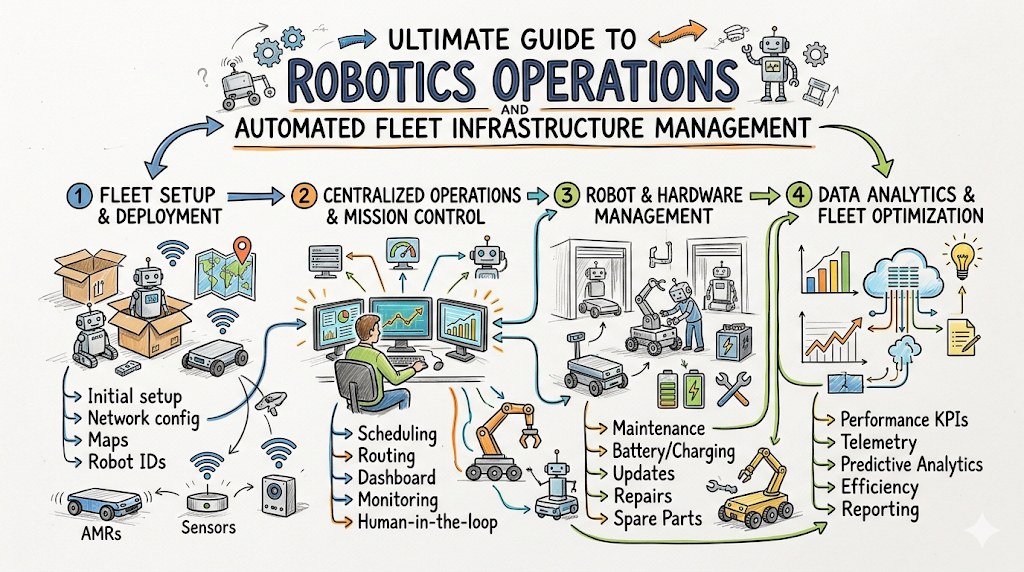
While understanding the historical shift to intelligent systems is important, the real challenge begins when you deploy these assets into a live production environment. This is exactly where the practice of robotics operations becomes necessary. You are no longer just supervising a standalone machine; instead, you are orchestrating an entire data-driven ecosystem that requires continuous optimization. Most beginners get confused at this stage because they try to manage these adaptive devices using old-school IT monitoring scripts.
By focusing heavily on system observability and proactive telemetry tracking, you learn to treat dynamic machines as reliable computing assets. To master these live deployment pipelines and fast-track your technical skills, you can explore hands-on labs through the specialized learning programs at RobotsOps. Now, let’s understand the essential tools and technologies that engineers use to keep these modern fleets perfectly synchronized.
The Evolution of Robotics Operations
Traditional Industrial Automation Challenges
Historically, traditional manufacturing automation relied heavily on rigid, static machinery that operated in isolation. These early industrial systems executed repetitive, hard-coded instructions without any real awareness of their surrounding environment. Furthermore, because these isolated machines lacked unified networking capabilities, maintenance teams faced massive challenges when gathering diagnostic data.
Consequently, if a mechanical arm drifted out of alignment, the system would continue operating blindly, which resulted in defective products and severe mechanical wear. Monitoring remained a purely reactive process, meaning that engineers only intervened after a catastrophic component failure stopped the entire production line. This lack of centralized coordination created huge operational bottlenecks, forcing businesses to maintain costly teams of on-site technicians just to handle emergency repairs.
The Rise of Intelligent Robotics Systems
As digital technology advanced, the convergence of high-speed networking, artificial intelligence, and sophisticated sensor arrays completely transformed industrial workflows. Mechanical arms evolved into autonomous systems capable of perceiving changes in their workspaces and making real-time operational adjustments.
Now, through the integration of AI-powered robotics, machinery can identify misaligned parts, adjust its grip pressure automatically, and communicate status updates directly to centralized management panels. This shift introduced robotic orchestration, a practice where multiple independent machines collaborate smoothly to achieve shared operational goals. Consequently, factories turned into highly dynamic ecosystems that optimize their own performance with minimal human intervention.
Expansion Across Modern Industries
Today, the adoption of advanced robotic infrastructure is rapidly expanding far beyond traditional automotive assembly lines into nearly every major global economic sector.
- Manufacturing: Heavy industrial arms utilize machine vision to weld, paint, and assemble complex machinery with sub-millimeter precision.
- Logistics: Autonomous mobile robots navigate warehouse floors to transport heavy pallets, which drastically speeds up order fulfillment times.
- Healthcare: Precise robotic surgical systems assist medical professionals, while autonomous disinfection units maintain sanitary conditions across hospitals.
- Warehousing: Smart sorting mechanisms analyze package dimensions instantaneously to streamline global supply chain distribution networks.
- Automotive: Self-navigating automated guided vehicles transport raw materials across factories, keeping production schedules perfectly synchronized.
- Retail: Automated inventory scanning systems roam store aisles to detect out-of-stock items and verify shelf pricing accuracy.
- Aerospace: Specialized robotic riveters construct aircraft fuselages, ensuring absolute structural integrity under extreme stress conditions.
Understanding Robotics Operations in Simple Terms
The Core Architecture of Robotics Operations
To manage a robotic fleet effectively, you must first understand the interconnected layers that form a modern operational architecture. In simple terms, this framework functions like a biological organism, combining physical senses with digital intelligence.
- Sensors: These components act as the eyes and ears of the machine, gathering critical data through LiDAR, radar, ultrasonic sensors, and thermal cameras.
- Controllers: Operating as the physical nervous system, controllers process sensor inputs and distribute precise electrical commands to motors and actuators.
- Robotic Software: This layer runs localized algorithms for path planning, localization, and safety management, allowing the machine to navigate safely.
- Machine Vision: Utilizing advanced camera feeds, this software identifies objects, detects surface anomalies, and guides mechanical movements accurately.
- Automation Workflows: These digital instructions map out the exact sequences a robot must follow to complete complex industrial tasks.
- Analytics Engines: Centralized systems process massive streams of telemetry data to identify long-term performance trends and operational bottlenecks.
- Monitoring Systems: These dashboards provide operators with real-time visibility into machine status, error codes, and battery health levels.
Daily Responsibilities of Robotics Operations Engineers
A robotics operations engineer focuses entirely on maximizing the reliability and throughput of automated fleets. On any given day, these professionals analyze performance metrics, configure centralized monitoring dashboards, and investigate unexpected system alerts.
When a mobile robot strays from its planned route or throws a hardware exception, the operations engineer conducts remote diagnostics to resolve the software conflict. Furthermore, they collaborate closely with maintenance crews to schedule physical repairs before a worn component causes an unscheduled shutdown. They also deploy over-the-air software updates, ensuring that security patches and performance optimizations roll out safely without interrupting active production schedules.
Manual Robotics Control vs Intelligent Automation
In traditional settings, operators managed machinery through direct manual control, using physical teach pendants or local control panels to program every single movement. This approach required significant human labor, as any change in production design demanded hours of manual reprogramming.
Conversely, intelligent automation introduces self-optimizing software layers that allow machines to dynamically calculate their own optimal movements based on real-time task definitions. Instead of manually moving a robotic arm through a sequence, engineers simply define the desired end state, and the AI-driven system determines the safest, most efficient path forward. This transition drastically reduces setup times and allows production facilities to switch between completely different product configurations almost instantaneously.
The Operational Efficiency Mindset
Transitioning into this domain requires a fundamental shift toward an operational efficiency mindset. Instead of viewing a robot as an isolated mechanical tool, you must view it as an active data source within a larger computing network.
Every joint movement, temperature fluctuation, and battery cycle provides valuable telemetry that can be utilized to optimize the broader factory floor. By focusing heavily on robotics observability, operations teams transform their workflows from reactive firefighting into predictive, data-driven system management. This mental shift is what ultimately allows modern enterprises to scale their automated infrastructure from a few test units into thousands of highly coordinated machines.
The 7 Core Principles of Robotics Operations
1. Intelligent Automation
Intelligent automation combines physical execution with contextual decision-making. Instead of repeating a blind loop, a robotic system uses machine learning algorithms to evaluate its current situation and modify its behavior accordingly. For example, if a robotic packing arm encounters an item that is upside down, it uses computer vision to detect the orientation, rotates its gripper, and picks up the object safely. This capability eliminates the need for human intervention when minor variations occur on the factory floor, significantly reducing operational downtime.
2. Real-Time Monitoring
Real-time monitoring provides continuous visibility into the exact operational state of every machine in a fleet. By streaming telemetry data over high-speed networks, centralized monitoring systems track critical metrics such as motor current, joint temperatures, and Wi-Fi signal strength. Imagine managing an autonomous delivery fleet across a multi-story warehouse; real-time monitoring alerts you the moment a bot encounters a blocked aisle, allowing you to reroute the rest of the fleet instantly. This immediate feedback loop keeps industrial workflows moving without costly delays.
3. Predictive Maintenance
Predictive maintenance uses historical data and machine learning to forecast physical component failures before they actually happen. By analyzing subtle variations in acoustic sensors or tracking gradual increases in motor temperature, analytics engines can identify bearing wear long before a mechanical breakdown occurs. For instance, an automated system can flag a specific joint on a welding robot for inspection during a scheduled weekend shift, completely preventing a catastrophic failure during mid-week production. This approach maximizes the lifespan of expensive hardware while minimizing maintenance expenses.
4. Robotics Observability
Observability goes deeper than simple monitoring by helping engineers understand why a complex, distributed robotic system is behaving abnormally. It involves aggregating logs, metrics, and trace data from both the physical hardware and the underlying cloud software layers to provide a complete picture of system health. If an autonomous forklift consistently slows down in a specific corner of a factory, observability tools help you determine whether the issue stems from a localized sensor calibration error, a spotty wireless network connection, or a physical flooring defect. This deep insight enables rapid troubleshooting of complex operational anomalies.
5. Workflow Optimization
Workflow optimization focuses on maximizing the collective throughput of a robotic ecosystem by eliminating idle time and balancing workloads. Orchestration software dynamically assigns tasks to the closest available machine based on real-time battery levels, current payload capacity, and spatial proximity. In a smart factory, this means that material transport bots are continuously rerouted to areas experiencing high production volumes, ensuring that assembly lines never sit idle waiting for parts. This continuous balancing act dramatically improves overall equipment effectiveness across the enterprise.
6. Safety and Reliability
Safety and reliability are non-negotiable principles when dealing with heavy, fast-moving autonomous systems. Modern operations require multi-layered safety architectures that combine physical emergency stops with digital guardrails, such as virtual geofencing and laser-based collision avoidance fields. For example, cobots (collaborative robots) utilize force-torque sensors to instantly halt all movement the moment they touch a human worker, ensuring a safe shared environment. Maintaining these safety systems through regular software validation and sensor testing is critical to protecting human lives and expensive company assets.
7. Continuous Operational Improvement
Continuous operational improvement involves analyzing long-term historical data to refine software configurations, update physical path plans, and improve employee training protocols. By studying weeks of operational analytics, management teams can identify systemic inefficiencies, such as recurring algorithmic path conflicts or specific sensor errors caused by seasonal lighting changes. This ongoing optimization cycle ensures that the entire robotics infrastructure grows more efficient, reliable, and cost-effective over time, allowing the business to stay highly competitive in the global market.
Essential Robotics Operations Concepts Every Professional Must Understand
Robotics vs Automation vs AI Robotics
Understanding the clear distinctions between these three related fields is essential for anyone entering the modern industrial landscape.
- Traditional Automation: Focuses on fixed software code and rigid physical machinery designed to perform highly repetitive, unvarying tasks without modification.
- Robotics: Combines reprogrammable mechanical hardware with software control to physically manipulate objects or navigate through environments.
- AI Robotics: Integrates advanced machine learning algorithms with physical robots, allowing them to learn from experience, adapt to new environments, and handle complex variations autonomously.
Robotics Monitoring & Observability
Maintaining visibility into modern robotics automation requires a clear understanding of the difference between monitoring and observability. Monitoring tells you when a machine has failed by triggering an alert based on a predefined threshold, such as a battery dropping below twenty percent.
Conversely, observability allows you to understand the internal state of a complex system by analyzing its external outputs, helping you diagnose why a group of robots suddenly lost localization data simultaneously in a newly configured section of a warehouse. This deeper level of insight is absolutely vital when managing intelligent robotics systems that interact with unpredictable environments.
Predictive Maintenance
Predictive maintenance is a proactive operations strategy that stands in stark contrast to old-fashioned run-to-failure approaches. By embedding specialized vibration, thermal, and acoustic sensors directly into robotic joints, infrastructure systems constantly stream health data to cloud analytics platforms.
This continuous oversight allows automation teams to move away from rigid, calendar-based maintenance schedules and instead perform physical service only when the data indicates real mechanical degradation. Consequently, companies save thousands of dollars on unnecessary parts replacements while maximizing overall production uptime.
Intelligent Incident Management
When dealing with hundreds of autonomous systems operating across a vast facility, human operators cannot manually manage every minor software glitch or sensor error. Intelligent incident management systems automatically categorize, prioritize, and respond to incoming hardware and software exceptions based on operational severity.
For example, if a delivery robot encounters a temporary obstacle, the incident system might grant the machine thirty seconds to calculate an alternative path independently. If the robot remains stuck, the system automatically escalates the issue by notifying a remote operator and providing a diagnostic packet that includes camera feeds and localized error logs.
Robotics Analytics & Capacity Planning
Long-term operational success requires deep historical tracking of fleet metrics to guide future capital investments and infrastructure modifications. Robotics analytics platforms aggregate data across months of production to calculate exact utilization rates, average cycle times, and energy consumption patterns.
This data becomes incredibly important when scaling robotic infrastructure, as it allows operations managers to accurately project how many additional units will be required to handle upcoming seasonal demand increases. Capacity planning ensures that enterprises optimize their hardware investments, preventing over-purchasing while guaranteeing that production targets are met comfortably.
Operational Metrics That Matter Most
To keep an automated facility running smoothly, operations teams must track specific key performance indicators that accurately reflect the health of their fleet.
- Uptime: The exact percentage of time a robot is physically healthy and available to execute operational workflows.
- Latency: The time delay between a centralized command being issued and the physical machine initiating the movement.
- Accuracy: A measurement of how precisely a robotic arm or vehicle executes a commanded movement relative to its target destination.
- Throughput: The total volume of tasks, cycles, or material movements completed by a robot within a specific timeframe.
- Error Rates: The frequency of software exceptions, sensor drops, or manual interventions required per operating hour.
- Battery Performance: Tracking charging efficiency, discharge rates, and total degradation over hundreds of operating cycles.
- System Availability: The ratio of operational, un-booked machines relative to the total number of units deployed in the fleet.
Robotics Operations vs Traditional Automation
Core Philosophy Differences
The core philosophy difference between traditional industrial automation and modern robotics operations lies in how they handle environmental change. Traditional automation is built around the concept of total control; engineers design an environment to be perfectly predictable so that a dumb machine can repeat the exact same movement forever.
Conversely, modern robotics operations accept environmental unpredictability as a baseline reality. This modern approach focuses on building resilient infrastructure, advanced observability paths, and intelligent software layers that empower machines to perceive, analyze, and safely navigate changing workspaces without human hand-holding.
Roles & Responsibilities Compared
The evolution of automated systems has fundamentally shifted the day-to-day work profiles of industrial technology professionals.
- Traditional Automation Engineer:
- Focuses on writing local Programmable Logic Controller (PLC) code using ladder logic.
- Manages physical, hard-wired connections between localized sensors and control panels.
- Conducts manual, on-site troubleshooting using physical multimeters and local diagnostic ports.
- Designs fixed mechanical fixtures to ensure parts arrive in identical orientations.
- Robotics Operations Engineer:
- Manages distributed cloud-to-edge communication networks and software containers.
- Configures centralized observability platforms to track fleet-wide health metrics.
- Builds automated incident response paths and remote over-the-air deployment pipelines.
- Optimizes algorithmic path-planning systems and fleet orchestration configurations.
Can Both Models Coexist?
Yes, and in fact, they must coexist within nearly every modern industrial environment. Traditional PLC-driven automation systems excel at high-speed, localized tasks such as running main conveyor belts, safety interlocks, and heavy stamping presses.
Meanwhile, intelligent robotics systems handle the flexible tasks that require spatial navigation and object manipulation, such as loading materials onto those conveyors or sorting finished goods into delivery bins. The modern challenge is ensuring these two distinct operational models communicate cleanly with one another, bridging traditional industrial protocols with modern cloud networks to create a single unified smart factory ecosystem.
Choosing the Right Operational Model
Selecting the appropriate management approach depends heavily on the scale of your business, the variability of your products, and your technical team’s current capabilities.
- Startups: Should focus on highly flexible, cloud-managed robotic solutions that require minimal upfront capital investment in fixed infrastructure, allowing for rapid business pivots.
- Mid-Sized Manufacturers: Benefit from a hybrid approach, using traditional automation for their core production steps while introducing flexible robotics for end-of-line packaging and material transport.
- Large Enterprises: Must invest heavily in dedicated robotics operations frameworks, building centralized command centers and deep observability pipelines to manage thousands of automated assets across global locations.
Real-World Robotics Operations Use Cases
Smart Manufacturing Operations
In modern automotive assembly facilities, teams use robotics operations to coordinate hundreds of specialized welding, painting, and riveting robots working on a single production line. These intelligent systems pull real-time manufacturing specifications from centralized databases, allowing them to automatically adjust their movements based on whether a sedan, an SUV, or an electric truck is arriving next on the line. Observability tools continuously track the electrical current drawn by each joint motor, allowing engineers to identify a failing gearbox before it can cause an expensive assembly line shutdown.
Warehouse Robotics Automation
Global e-commerce fulfillment centers utilize fleet orchestration software to manage hundreds of autonomous mobile robots that move inventory pods directly to human picking stations. The centralized control platform maps out optimal, collision-free paths across millions of square feet of warehouse space, continuously recalculating routes when traffic congestion occurs. By monitoring battery health profiles in real time, the system automatically routes individual bots to rapid-charging stations during natural dips in order volume, ensuring maximum fleet availability during peak operational hours.
Healthcare Robotics Systems
Modern medical centers deploy autonomous transport robots to deliver sensitive medications, laboratory samples, and surgical tools across multi-building hospital campuses. These systems interface directly with electronic door controls and elevator networks, allowing them to navigate complex public spaces safely while avoiding patients and staff. Operations teams track these machines via high-security encrypted dashboards, ensuring that valuable payloads arrive at their correct destinations while maintaining strict compliance with medical privacy and safety regulations.
Autonomous Logistics & Delivery Systems
Logistics enterprises use autonomous delivery drones and sidewalk rovers to optimize last-mile delivery workflows across urban and corporate campuses. These intelligent vehicles use advanced computer vision and localized machine learning models to detect pedestrians, avoid temporary construction hazards, and safely cross busy streets. Remote operations centers track the location and sensor status of every drone, allowing a single human supervisor to oversee up to fifty autonomous units simultaneously and take remote control if a vehicle encounters an unresolvable obstacle.
AI-Powered Industrial Robotics
Heavy metal casting and recycling facilities deploy AI-powered robots equipped with thermal cameras and advanced force sensors to handle extreme materials that are dangerous for human workers. These machines use deep learning models to identify, sort, and process irregularly shaped pieces of scrap metal arriving on high-speed conveyor belts. The operational framework constantly analyzes the wear patterns on the robot’s protective shielding, allowing the maintenance team to track degradation and schedule service during planned factory shutdowns.
Robotics in Automotive Manufacturing
Advanced automotive paint shops use highly coordinated teams of robotic sprayers that operate with absolute synchronization to apply uniform coatings to vehicle bodies. The operational software monitors ambient humidity, temperature, and paint viscosity in real time, automatically adjusting the atomization pressure to maintain a perfect finish. This continuous tuning reduces material waste by up to twenty percent while completely eliminating the need for manual touch-ups, demonstrating the immense value of data-driven process monitoring.
Startup Robotics Automation Strategies
Emerging agricultural startups deploy small, autonomous weeding and harvesting rovers across large commercial crop fields to reduce reliance on manual labor. Because these startups operate on limited budgets, their operations teams use cloud-based simulation platforms to thoroughly test software updates before deploying them over cellular networks to the physical rovers. By tracking location-specific sensor data, these agricultural teams can map out exact crop health profiles, transforming their simple hardware assets into incredibly valuable data-gathering tools.
Common Mistakes in Robotics Operations
Mistake 1 — Treating Robotics as Only Hardware
Many organizations make the critical error of viewing a robot as a simple, standalone piece of mechanical machinery. They focus entirely on the physical build quality, lifting capacity, and motor torque while completely ignoring the complex software stack that controls the device. This narrow view leads to a total lack of investment in modern software deployment tools, network infrastructure, and centralized configuration management. Consequently, when the organization needs to update a simple operational parameter, technicians are forced to travel to each physical machine with a laptop, which wastes days of valuable engineering time.
Operational Solution: You must treat every robotic asset as an edge-computing server with wheels or arms, investing equally in hardware maintenance and software infrastructure pipelines.
Mistake 2 — Ignoring Monitoring and Analytics
Deploying an automated fleet without comprehensive telemetry monitoring is like driving a vehicle with a completely blacked-out dashboard. Many teams launch robotic systems and simply assume they will work perfectly until something breaks. When a failure inevitably occurs, the engineering team has zero historical log data to analyze, forcing them to guess at the root cause of the issue. This lack of visibility prolongs repair times, increases production backlogs, and prevents the company from identifying systemic engineering defects.
Operational Solution: Establish robust logging frameworks and centralized dashboards using tools like Grafana or specialized robotic observability suites before deploying hardware to production floors.
Mistake 3 — Poor Robotics Maintenance Planning
Relying entirely on reactive, run-to-failure maintenance models is incredibly costly in a high-volume industrial environment. Some organizations wait until a major mechanical joint snaps or a vital sensor fails completely before calling out a repair technician. This approach leads to extended periods of unplanned downtime, expensive rush-shipping fees for replacement parts, and severe stress on production schedules. Furthermore, a single catastrophic component failure often damages surrounding mechanical parts, dramatically increasing total repair costs.
Operational Solution: Implement data-driven predictive maintenance programs that track actual operating hours, motor currents, and acoustic signatures to guide service schedules.
Mistake 4 — Weak Operational Safety Standards
Underestimating the physical danger of heavy, fast-moving autonomous machinery can lead to catastrophic workplace accidents and severe legal liabilities. Some companies configure their robotic cells with inadequate physical fencing, unmapped safety zones, or poorly calibrated proximity sensors in an attempt to save space or cut initial setup costs. This negligence puts human workers at extreme risk, as autonomous systems cannot naturally differentiate between a piece of raw material and a human limb without properly configured safety layers.
Operational Solution: Enforce strict adherence to international safety standards, utilizing certified safety PLCs, dual-channel emergency stop circuits, and modern laser scanners with dynamic slowdown fields.
Mistake 5 — Lack of Workflow Optimization
Simply placing a fast robot onto a factory floor will not improve efficiency if the surrounding material workflows are poorly designed. A common mistake is deploying a high-speed packing arm into an area where the incoming conveyor belts are slow and uncoordinated. The expensive robot ends up sitting completely idle for forty percent of its shift, waiting for materials to arrive. This mismatch represents a massive waste of capital and prevents the business from ever achieving a meaningful return on its automation investment.
Operational Solution: Use advanced fleet orchestration and simulation tools to model entire material paths, ensuring that hardware capacities match surrounding industrial workflows perfectly.
Mistake 6 — Over-Automation Without Human Oversight
In a rush to cut labor costs, some management teams attempt to remove human workers completely from complex industrial processes. They build overly intricate systems that try to automate every single edge case, variation, and unexpected error condition. This over-engineering results in a brittle system that breaks down frequently, as software algorithms often struggle to resolve unique, real-world anomalies that a human operator could fix in seconds. The organization ends up spending more money maintaining complex code than they save on floor labor.
Operational Solution: Focus on building collaborative automation models (Human-in-the-Loop) where robots handle the dangerous, repetitive work, and human supervisors manage complex exceptions remotely.
Mistake 7 — No Long-Term Scalability Planning
Many automation projects begin as small, isolated proof-of-concept tests managed by a single enthusiastic engineer. A common pitfall is failing to consider what will happen when the business needs to expand that fleet from two units to two hundred. Without standardized software environments, centralized asset tracking, and uniform network architectures, scaling up becomes an absolute nightmare. Every new robot requires custom, manual configuration, leading to a chaotic mix of software versions and unmanageable maintenance needs.
Operational Solution: Build your initial robotics operations architecture with scalability in mind from day one, utilizing containerization, standardized APIs, and structured configuration playbooks.
Essential Robotics Operations Tools & Technologies
Robotics Operating Systems
The foundational layer of modern robotics software engineering is dominated by open-source and specialized operating frameworks that abstract low-level hardware controls. The Robot Operating System (ROS) serves as the global standard for building complex robotic software, providing standard packages for hardware abstraction, device drivers, message-passing, and package management.
Additionally, advanced platforms like NVIDIA Isaac leverage powerful GPU acceleration to provide cutting-edge capabilities for autonomous navigation, machine learning, and high-fidelity sensor processing, allowing engineers to build highly responsive autonomous systems.
Monitoring & Observability Platforms
To keep track of distributed fleets, operations teams rely on centralized dashboards that gather and visualize massive streams of physical telemetry data. Engineers use open-source stacks like Prometheus and Grafana to build custom performance tracking panels, while enterprise cloud systems like AWS RoboMaker offer built-in fleet management tools that streamline remote monitoring. These platforms collect real-time data on battery temperatures, network latency, and software exception codes, allowing command center operators to track the health of multiple facilities from a single screen.
AI & Machine Learning Frameworks
Intelligent robotics systems require powerful software libraries to process visual data and execute complex decision-making models at the edge. Tools like OpenCV provide the fundamental algorithms needed for real-time computer vision, enabling robots to detect edges, track objects, and read barcodes with absolute reliability. Meanwhile, deep learning libraries like TensorFlow Robotics allow engineers to train neural networks for advanced tasks such as autonomous object classification, semantic segmentation, and predictive trajectory planning in complex environments.
Industrial Automation Platforms
Bridging the gap between modern cloud software and traditional factory hardware requires robust industrial control systems. Enterprise platforms from industry leaders like Siemens Industrial Automation, ABB Robotics, and FANUC provide the ultra-reliable, deterministic hardware needed to run assembly line machinery safely. These systems support traditional industrial communication protocols while increasingly offering modern APIs that allow operations teams to stream factory-floor data directly into cloud-based analytics engines for processing.
Simulation & Testing Tools
Validating software updates on a live, multi-million dollar production floor is incredibly dangerous and impractical. Therefore, operations teams use high-fidelity simulation environments like Gazebo to thoroughly test new code configurations in a safe virtual world before deployment. Simulation tools replicate physical factors like gravity, surface friction, and sensor noise with incredible accuracy, allowing engineers to verify that an autonomous forklift will behave safely when encountering a new intersecting aisle layout.
Cloud Robotics Platforms
Modern robotic workflows increasingly rely on cloud-connected software suites to manage orchestration, scale computing power, and automate business processes. Specialized tools like UiPath extend the principles of robotic process automation from digital screens down to physical warehouse management systems, coordinating tasks between software bots and physical machinery. These cloud environments allow enterprises to build unified automation pipelines that connect enterprise resource planning software directly to physical autonomous delivery rovers on the ground.
Career Roadmap to Becoming a Robotics Operations Professional
Technical Skills You Must Learn
To build a successful career in this highly interdisciplinary field, you must develop a balanced mix of software engineering capabilities and practical hardware understanding.
- Linux Fundamentals: Master command-line navigation, shell scripting, user permissions, and network configuration, as nearly all advanced robotics software runs on Linux environments.
- Python Programming: Develop strong proficiency in Python for writing automation scripts, processing sensor data streams, and interacting with modern web APIs.
- Sensors and Controllers: Understand the physical operating principles of LiDAR, ultrasonic sensors, encoders, and Programmable Logic Controllers (PLCs).
- AI/ML Basics: Learn how to deploy, evaluate, and fine-tune pre-trained machine learning models for computer vision and anomaly detection.
- Industrial Automation: Familiarize yourself with standard factory communication protocols such as Modbus, OPC UA, and EtherCAT.
- Computer Vision: Study image processing techniques, camera calibration patterns, and coordinate system transformations.
- Networking Fundamentals: Master TCP/IP routing, Wi-Fi optimization strategies, and edge-to-cloud security practices to ensure reliable fleet connectivity.
Step-by-Step Learning Roadmap
1. Beginner Stage
Focus entirely on core computational and engineering fundamentals. Learn to navigate the Linux terminal comfortably, write clean scripts in Python, and study basic electrical circuit principles. Build simple hobbyist projects using open-source microcontrollers, focusing on reading data from ultrasonic distance sensors and controlling small servo motors safely.
2. Intermediate Stage
Dive deeply into specialized robotics software architectures and system tracking paradigms. Learn the fundamentals of ROS, focusing on how nodes publish and subscribe to data topics. Study the basics of system observability by setting up a local Prometheus and Grafana stack to monitor performance metrics on a single remote computer.
3. Advanced Robotics Operations Stage
Transition into managing distributed fleets and complex, real-world industrial systems. Master the implementation of high-fidelity simulation tools like Gazebo to validate path-planning algorithms. Learn how to design automated incident response frameworks and write configuration scripts that handle software error codes across a cluster of simulated autonomous vehicles.
4. Enterprise Automation Architecture Stage
At this highest tier, you learn to design and manage global-scale automation infrastructure for multinational enterprises. Focus on integrating cloud platforms like AWS RoboMaker with traditional factory systems from Siemens or ABB. Study long-term capacity planning, design fault-tolerant edge networks, and build over-the-air deployment pipelines that securely update software across thousands of physical machines worldwide.
Certifications Worth Pursuing
Earning recognized industry credentials can significantly boost your professional credibility and open doors to high-paying engineering roles. Look for certifications that cover cloud computing architecture, such as the AWS Certified Solutions Architect or Google Cloud Engineer designations, as modern fleet management relies heavily on cloud infrastructure.
Additionally, explore specialized training programs offered by major automation vendors like Siemens, Fanuc, or ABB, which validate your practical capability to configure and program industrial-grade production machinery safely.
Learning Resources from RobotsOps
Navigating this educational path can feel incredibly overwhelming due to the sheer volume of technologies involved. Fortunately, RobotsOps provides structured, mentor-led programs designed specifically to help engineers build real-world operational expertise.
Their practical curriculum bypasses abstract theoretical textbooks, focusing instead on hands-on labs where you configure live observability pipelines, troubleshoot simulated fleet failures, and manage real industrial workflows. This experience ensures you graduate with the exact skills modern employers are looking for.
The Future of Robotics Operations
Autonomous Robotics Infrastructure
The next major evolution in this field centers around the rise of self-healing, fully autonomous infrastructure frameworks. Future robotics operations environments will utilize advanced diagnostic layers that can independently detect mechanical anomalies, order their own replacement components through automated supply chains, and schedule low-priority maintenance windows without human input. This level of autonomy will transform factory floors from managed machine spaces into highly adaptive, resilient ecosystems that sustain their own operational health indefinitely.
AI-Driven Robotics Management
As generative AI and large multimodal models continue to advance, their integration into robotics operations will completely eliminate traditional programming bottlenecks. Future engineers will describe complex operational workflows in plain natural language, and the centralized management platform will automatically generate, simulate, and deploy the required low-level code to diverse robotic assets. Furthermore, AI-driven systems will continuously analyze global production metrics to discover hidden optimizations, automatically tuning pulse frequencies and path paths to unlock unprecedented levels of efficiency.
Human-Robot Collaboration
The industrial environments of tomorrow will not focus on replacing human workers, but rather on building highly synchronized collaborative workspaces where humans and intelligent machines work side-by-side. Advanced cobots equipped with high-density tactile sensors and contextual awareness will adapt to the exact pacing and physical needs of their human partners. Operations teams will focus heavily on managing these collaborative dynamics, optimizing software safety fields to ensure fluid, zero-accident workflows that combine human problem-solving agility with robotic precision.
Robotics in Smart Factories
As industrial enterprises embrace total digital transformation, robotics infrastructure will become deeply woven into the fabric of the smart factory. Every element of the production floor—from overhead lighting arrays and material storage racks to fast-moving delivery rovers—will communicate over ultra-low latency private 5G networks.
This total connectivity will allow for real-time spatial optimization; the factory floor layout will physically reconfigure itself automatically throughout the day to handle changing product designs, making rigid, unchangeable production lines a relic of the past.
Cloud Robotics & Edge Computing
The future of fleet management relies on a delicate balance between massive cloud analytics capability and split-second edge execution. High-density data processing will occur directly on the physical robot to ensure instant collision avoidance and path adjustments.
Meanwhile, long-term machine learning training and fleet-wide trend analysis will run in centralized cloud clusters. Managing this hybrid edge-to-cloud data pipeline will become a core responsibility for future operations professionals, requiring sophisticated networking strategies that maximize data security while minimizing bandwidth expenses.
Future Skills Robotics Professionals Must Build
To remain highly valuable in this evolving job market, engineers must intentionally expand their skill sets beyond basic mechanical repair and simple coding routines. The future belongs to professionals who understand cloud systems architecture, advanced data observability practices, and large-scale fleet orchestration methodologies. Developing a deep understanding of cyber-physical security will also be incredibly vital, as protecting connected industrial machinery from sophisticated digital threats will become a top priority for global enterprise leadership.
Frequently Asked Questions (FAQs)
1. What career opportunities are available for a professional specializing in robotics operations?
Professionals in this field can explore diverse roles such as Robotics Operations Engineer, Automation Infrastructure Specialist, Fleet Orchestration Manager, Site Reliability Engineer (Robotics), and Smart Factory Integration Consultant. These positions are opening rapidly across manufacturing, global logistics, aerospace, e-commerce fulfillment, and medical device management sectors worldwide.
2. How can a complete beginner start learning robotics operations from scratch?
A beginner should start by mastering Linux operating system fundamentals and developing solid scripting skills in Python. Once comfortable with these computational foundations, you should explore basic electronics, study how simple distance sensors interact with microcontrollers, and then dive into the foundational concepts of the open-source Robot Operating System (ROS).
3. What are the key operational skills required to manage a large robotic fleet effectively?
Effective fleet management requires deep proficiency in systems observability, automated incident response planning, edge-to-cloud networking architecture, and predictive maintenance data analysis. Additionally, engineers must understand how to configure centralized tracking dashboards, manage over-the-air software container updates, and navigate international industrial safety regulations.
4. Are certifications mandatory to secure a high-paying job in industrial automation?
While certifications are not always strictly mandatory, having recognized credentials from major cloud providers or leading automation vendors significantly improves your resume visibility. Certifications serve as verified proof to employers that you possess practical, hands-on capabilities in system configuration, cloud architecture, and safe hardware management.
5. What is the fundamental difference between traditional robotics and AI-powered robotics?
Traditional robotics relies entirely on hard-coded instructions to repeat pre-programmed movements within highly controlled, static spaces. Conversely, AI-powered robotics integrates advanced machine learning models and computer vision, allowing the machinery to interpret changing environments, learn from errors, adapt paths dynamically, and safely handle varied objects.
6. What tools are most commonly used by modern robotics operations teams for system monitoring?
Operations teams frequently utilize open-source telemetry stacks consisting of Prometheus for data collection and Grafana for dashboard visualization. For enterprise-scale cloud operations, engineers rely heavily on integrated platforms such as AWS RoboMaker, alongside specialized vendor dashboards provided by industrial hardware manufacturers like Siemens, ABB, and FANUC.
7. How does cloud robotics improve operational efficiency across multiple manufacturing plants?
Cloud robotics centralizes data gathering, software deployment, and fleet coordination by connecting physical edge devices to scalable cloud servers. This connectivity allows an enterprise to analyze performance data across global facilities simultaneously, roll out instant software updates to thousands of machines over-the-air, and share optimized machine learning models instantly across different fleets.
8. Why is predictive maintenance considered superior to traditional scheduled maintenance models?
Predictive maintenance uses real-time sensor data like vibration and temperature to predict when a specific component will fail, allowing for service only when actually needed. This data-driven approach eliminates the waste of calendar-based part replacements while completely preventing sudden, catastrophic hardware failures that cause expensive, unplanned production stoppages.
9. Can small startups implement advanced robotics operations without a massive capital budget?
Yes, small startups can successfully implement these strategies by leveraging open-source frameworks like ROS and utilizing cloud-based subscription models for fleet management. By focusing heavily on software automation and virtual simulation testing during early phases, emerging businesses can scale their physical hardware footprint efficiently without heavy upfront infrastructure costs.
10. What is the long-term outlook for job demand in the robotics operations sector?
The long-term outlook is incredibly strong as industries worldwide rapidly accelerate their automation initiatives to counter rising labor costs and supply chain disruptions. Companies need specialized operations professionals who understand how to maintain, orchestrate, and secure connected autonomous systems, making this field one of the most resilient engineering career choices.
11. How do remote operators safely take control of an autonomous vehicle that encounters an error?
When an autonomous vehicle flags an unresolvable obstacle, it securely streams its live camera feeds, LiDAR data, and internal error logs to a centralized command center via high-speed networks. A remote operator evaluates the diagnostic packet through an encrypted interface, uses software inputs to safely guide the vehicle around the hazard, and then returns the asset to autonomous mode.
12. What educational resources does RobotsOps provide to help engineers enter this industry?
RobotsOps offers structured, practical training tracks focused heavily on hands-on labs and real-world industrial scenarios. Their curriculum covers distributed fleet orchestration, containerized software deployment, cloud-edge networking, and the configuration of enterprise-grade observability pipelines, providing students with the exact skills required by top-tier global employers.
Conclusion
In conclusion, modern introduction to robotics operations represents a critical evolutionary leap in how humanity manages physical production, logistics, and industrial infrastructure. Moving away from the rigid, disconnected automation models of the past, modern industries are rapidly embracing intelligent robotics systems that communicate, adapt, and self-optimize in real time. Successful operational management requires a deep commitment to systems observability, proactive predictive maintenance, and scalable edge-to-cloud software pipelines.
As automation footprints expand globally, the organizations and engineering professionals who master the delicate art of robotic orchestration will lead the next industrial era. Building these complex, interdisciplinary capabilities requires structured, experience-driven learning that connects physical hardware realities with cutting-edge software paradigms. Take the next definitive step in your professional engineering journey by exploring the comprehensive training programs and expert-led labs available through RobotsOps.
