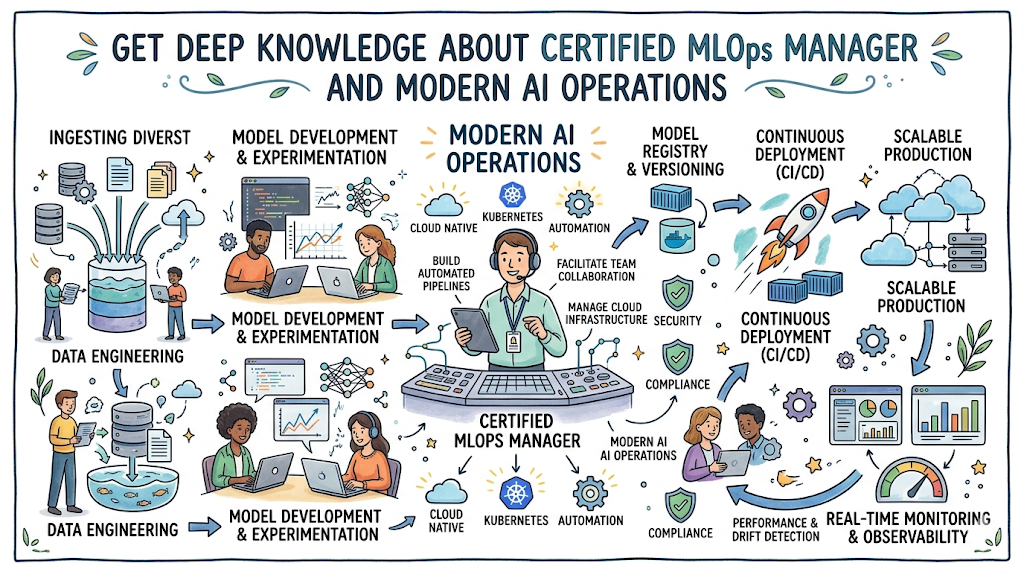
The intersection of machine learning and traditional IT operations has created a new standard for engineering excellence known as the Certified MLOps Manager. This guide is designed for software engineers, platform architects, and technical leaders who are looking to move beyond manual model deployments toward fully automated, production-grade ecosystems. By integrating the rigorous principles of DevOps with the unique requirements of data science, this certification program hosted on Aiopsschool provides a clear roadmap for professional growth. Whether you are managing large-scale cloud infrastructure or leading a specialized data team, understanding these operational frameworks is essential for making informed career decisions in the modern era of platform engineering.
What is the Certified MLOps Manager?
The Certified MLOps Manager is a professional designation that validates a practitioner’s ability to design, implement, and govern the machine learning lifecycle. It exists to solve the “last mile” problem in artificial intelligence, where models often fail to reach production due to a lack of operational discipline. This program emphasizes a shift from experimental data science to industrial-scale engineering.
It represents a production-focused approach to learning, prioritizing the stability and reproducibility of models over theoretical mathematical concepts. The certification aligns with modern enterprise practices by teaching candidates how to manage models as software assets within a standard CI/CD pipeline. It provides the framework necessary to bridge the gap between model development and actual business value.
Who Should Pursue Certified MLOps Manager?
This path is specifically built for experienced DevOps engineers, Site Reliability Engineers, and Cloud Architects who are increasingly responsible for AI infrastructure. Data engineers who want to automate their workflows and security professionals looking to specialize in ML security will also find it highly relevant. It serves as a vital credential for those moving into management roles where they must oversee complex cross-functional teams.
The certification has significant global relevance, particularly in major technology hubs where companies are scaling their AI initiatives. In regions like India, where the demand for specialized cloud engineers is at an all-time high, this designation provides a competitive edge. It is suitable for anyone from a senior individual contributor to an engineering director who needs to master the operational side of machine learning.
Why Certified MLOps Manager is Valuable and Beyond
The demand for professionals who can manage the operational complexities of machine learning is growing faster than the supply of talent. Enterprises are moving away from manual model handovers and are adopting automated platforms to ensure longevity and scalability. This certification ensures that your skills remain relevant regardless of the specific tools or libraries that come into fashion.
Investing in this credential provides a high return on career investment by positioning you in a high-impact, high-visibility role. It allows you to address the critical challenges of model decay and technical debt that often plague unmanaged ML projects. By mastering these principles, you become a key player in ensuring that an organization’s AI investments actually translate into sustainable production outcomes.
Certified MLOps Manager Certification Overview
The Certified MLOps Manager program is a comprehensive curriculum delivered through the Aiopsschool platform. It is structured to guide professionals through the nuances of model versioning, data lineage, and automated monitoring. The certification approach is practical, requiring candidates to demonstrate their ability to solve real-world infrastructure problems rather than just passing a multiple-choice test.
The program structure is designed to be rigorous and enterprise-aligned, focusing on the ownership of the entire model lifecycle. It covers the technical stack needed for distributed training and low-latency inference while also addressing the managerial aspects of team coordination. This holistic approach ensures that certified managers can lead both the technical and human elements of a modern ML organization.
Certified MLOps Manager Certification Tracks & Levels
The certification is organized into three distinct levels to support career progression at different stages. The Foundation level is aimed at establishing a common language and understanding of the MLOps lifecycle, making it ideal for those transitioning from traditional IT roles. It covers the basics of containerization, orchestration, and the fundamental differences between software and model pipelines.
The Professional level dives deeper into specialized technical tracks such as SRE for ML, security integration, and cost optimization. The Advanced level is reserved for those focused on enterprise-wide strategy, governance, and leadership. This tiered system allows professionals to build their expertise incrementally, ensuring that their learning always matches their current or target job responsibilities.
Complete Certified MLOps Manager Certification Table
| Track | Level | Who it’s for | Prerequisites | Skills Covered | Recommended Order |
| MLOps Core | Foundation | Junior Engineers, Managers | Basic Linux, Git | ML Lifecycle, Docker | 1 |
| ML Engineering | Professional | SREs, DevOps Engineers | Foundation Level | CI/CD, Kubernetes | 2 |
| ML Governance | Professional | Security, Compliance | Foundation Level | Auditing, Policy | 3 |
| ML Strategy | Advanced | Directors, Architects | Professional Level | Scaling, Strategy | 4 |
| ML FinOps | Professional | Cloud Architects | Cloud Billing Knowledge | GPU Cost Control | 5 |
Detailed Guide for Each Certified MLOps Manager Certification
Certified MLOps Manager – Foundation
What it is
The Foundation level validates a fundamental understanding of how machine learning models are managed in a professional IT environment. It ensures the candidate understands the terminology and the basic workflow of model deployment.
Who should take it
This is for IT professionals, junior engineers, or project managers who need to understand the lifecycle of an ML project. It is the perfect starting point for anyone new to the “Ops” side of machine learning.
Skills you’ll gain
- Understanding the MLOps lifecycle from data to deployment.
- Basic version control for machine learning experiments.
- Knowledge of containerization for model packaging.
- Ability to facilitate communication between data scientists and operations teams.
Real-world projects you should be able to do
- Set up a version-controlled repository for a machine learning codebase.
- Create a Dockerfile to containerize a basic Python model.
- Document the steps required for a manual model deployment.
Preparation plan
- 7–14 days: Review the core terminology and watch introductory videos on MLOps.
- 30 days: Practice basic Docker and Git commands focused on ML project structures.
- 60 days: Complete a full review of the foundation curriculum and pass the practice quizzes.
Common mistakes
- Ignoring the data versioning aspect and focusing only on the code.
- Confusing standard software CI/CD with the unique needs of ML pipelines.
Best next certification after this
- Same-track option: Certified MLOps Manager – Professional.
- Cross-track option: Certified DataOps Professional.
- Leadership option: Certified Engineering Manager.
Certified MLOps Manager – Professional
What it is
The Professional level validates the ability to build and maintain complex, automated machine learning pipelines. It proves that the engineer can handle the challenges of scale, monitoring, and infrastructure management.
Who should take it
This level is designed for mid-to-senior DevOps engineers and SREs who are responsible for production environments. It is for those who are doing the actual implementation of MLOps tools.
Skills you’ll gain
- Building automated CI/CD pipelines for ML models.
- Implementing monitoring for model drift and system health.
- Orchestrating ML workloads on Kubernetes clusters.
- Managing large-scale data ingestion and training pipelines.
Real-world projects you should be able to do
- Build a pipeline that automatically triggers a model retrain based on performance metrics.
- Design a monitoring dashboard that tracks model accuracy in real-time.
- Configure a multi-node Kubernetes cluster for distributed model training.
Preparation plan
- 7–14 days: Deep dive into Kubernetes and Helm charts for ML tools.
- 30 days: Build several end-to-end pipelines using open-source MLOps frameworks.
- 60 days: Focus on advanced monitoring and security hardening for ML services.
Common mistakes
- Over-complicating the toolchain before establishing the core process.
- Failing to account for the high costs of compute resources during training.
Best next certification after this
- Same-track option: Certified MLOps Manager – Advanced.
- Cross-track option: Certified AIOps Professional.
- Leadership option: Technical Program Manager.
Certified MLOps Manager – Advanced
What it is
The Advanced level validates the expertise required to lead an entire organization’s MLOps strategy. It focuses on the high-level architecture, governance frameworks, and long-term planning for AI infrastructure.
Who should take it
This is for Principal Engineers, CTOs, and Engineering Directors who are responsible for the overall success of an AI platform. It is a leadership-focused technical credential.
Skills you’ll gain
- Designing enterprise-wide MLOps platforms.
- Establishing governance for model ethics and compliance.
- Strategic planning for hardware procurement and cloud spend.
- Leading cross-functional teams to deliver AI products at scale.
Real-world projects you should be able to do
- Design a centralized feature store that serves multiple business units.
- Create a governance policy for model explainability and auditing.
- Architect a global model inference network with sub-second latency.
Preparation plan
- 7–14 days: Study enterprise case studies and industry standards for AI governance.
- 30 days: Review advanced architecture patterns for large-scale distributed systems.
- 60 days: Draft a comprehensive MLOps strategy for a hypothetical large-scale organization.
Common mistakes
- Focusing too much on technical tools and not enough on organizational culture.
- Building a platform that is too rigid for the fast-moving needs of data science.
Best next certification after this
- Same-track option: Post-Advanced Specialization.
- Cross-track option: Certified FinOps Director.
- Leadership option: Executive Leadership for Technology.
Choose Your Learning Path
DevOps Path
Professionals coming from a DevOps background will focus on extending their knowledge of CI/CD to handle model artifacts. You will learn how to treat a model as a versioned asset, just like a piece of compiled code. This path emphasizes the automation of the release process and the management of experimental environments. You will become the expert who enables data scientists to deploy their work with confidence and speed.
DevSecOps Path
The security path is focused on protecting the machine learning pipeline from end to end. You will learn about the unique threats facing ML models, such as data poisoning and adversarial attacks. This path ensures that security is baked into the model lifecycle from the start, rather than being added as an afterthought. You will implement automated security scans and access controls that protect sensitive data and proprietary models.
SRE Path
The SRE path focuses on the reliability and performance of machine learning services. You will learn how to set SLIs and SLOs for model inference and how to manage the “error budget” for automated retraining. This path is all about keeping the system up and running under high load and ensuring that the models remain accurate over time. You will build the resilient infrastructure that supports global AI applications.
AIOps Path
AIOps is about using machine learning to improve the way we manage traditional IT infrastructure. In this path, you will learn how to implement models that predict outages, automate root cause analysis, and manage logs. This is different from MLOps because the goal is to use AI as a tool for the operations team itself. It requires a deep understanding of system metrics and the ability to build predictive models for IT health.
MLOps Path
This is the core path for those dedicated to the operational side of the machine learning lifecycle. It covers everything from data engineering to model deployment and monitoring. You will focus on the specific tools and processes that allow for reproducible and scalable ML operations. This path is ideal for those who want to be the primary architect of an organization’s machine learning production environment.
DataOps Path
Data is the lifeblood of any ML project, and the DataOps path focuses on the reliability of that data. You will learn how to build automated data pipelines that ensure only high-quality, validated data reaches your models. This path emphasizes data versioning and the use of “Data-as-a-Code” principles. By mastering this path, you ensure that the machine learning models are built on a solid and trustworthy foundation.
FinOps Path
Managing the costs of machine learning can be a massive challenge due to the expensive nature of GPUs and cloud compute. The FinOps path teaches you how to track, manage, and optimize the spending associated with ML projects. You will learn how to implement cost-saving measures like spot instances and auto-scaling. This path is essential for ensuring that machine learning remains a financially viable part of the business.
Role → Recommended Certified MLOps Manager Certifications
| Role | Recommended Certifications |
| DevOps Engineer | Certified MLOps Manager – Foundation and Professional |
| SRE | Certified MLOps Manager – Professional (SRE Focus) |
| Platform Engineer | Certified MLOps Manager – Professional and Advanced |
| Cloud Engineer | Certified MLOps Manager – Professional (Cloud Track) |
| Security Engineer | Certified MLOps Manager – Professional (Security Track) |
| Data Engineer | Certified MLOps Manager – Foundation and DataOps Specialty |
| FinOps Practitioner | Certified MLOps Manager – Professional (FinOps Track) |
| Engineering Manager | Certified MLOps Manager – Advanced |
Next Certifications to Take After Certified MLOps Manager
Same Track Progression
After reaching the Advanced level, your next steps should involve deep specialization in specific cloud-native ML services or specialized hardware management. You might look into advanced certifications for specific orchestration tools or distributed computing frameworks. This ensures you remain the top technical authority in the MLOps space for your organization. Keeping up with the latest architectural changes in model serving is also vital for long-term growth.
Cross-Track Expansion
To become a more versatile architect, you should consider expanding into DataOps or FinOps. Understanding the entire data lifecycle or the financial side of cloud infrastructure allows you to solve broader business problems. This cross-training makes you a more valuable asset to the company because you can speak the language of multiple departments. It provides the holistic view necessary for designing truly enterprise-scale systems.
Leadership & Management Track
For those looking to move into executive roles, pairing your MLOps knowledge with general leadership training is the best path forward. This involves focusing on team building, strategic planning, and the business impact of technology. You will shift your focus from managing pipelines to managing the vision and the people who build them. This path is the bridge to becoming a CTO or a Head of AI Engineering in a major corporation.
Training & Certification Support Providers for Certified MLOps Manager
DevOpsSchool
DevOpsSchool is a leading provider of technical training that focuses on the practical application of modern engineering principles. They offer a vast library of resources and structured courses that help professionals master everything from basic automation to advanced cloud orchestration. Their teaching methodology is deeply rooted in real-world scenarios, ensuring that students can immediately apply what they learn in their professional roles. For MLOps, they provide the necessary background in CI/CD and infrastructure that forms the backbone of any model management system. Their global community offers a support network for continuous learning and career advancement long after the course is finished.
Cotocus
Cotocus is known for its boutique approach to engineering education, offering highly specialized training for advanced technical roles. They focus on hands-on labs and project-based learning to ensure that candidates can handle the complexities of high-end infrastructure. Their MLOps modules are designed to mirror the actual challenges faced by top-tier tech companies, focusing on the latest tools and architectural patterns. Cotocus is a preferred choice for senior professionals who want to skip the basics and dive straight into the most difficult aspects of model serving and monitoring. Their graduates are highly regarded for their practical problem-solving abilities and deep technical knowledge.
Scmgalaxy
Scmgalaxy serves as a comprehensive knowledge hub for the entire “Ops” community, offering a wealth of tutorials, articles, and training programs. They have been a fixture in the software configuration management space for years, providing a solid foundation for anyone entering the world of DevOps or MLOps. Their training emphasizes the “mechanics” of delivery, focusing on how artifacts move from a developer’s machine to a production server. For MLOps practitioners, Scmgalaxy provides critical insights into model versioning and the management of large-scale metadata. Their community-driven approach makes them an accessible and reliable resource for engineers at all levels.
BestDevOps
BestDevOps is a training organization that prioritizes high-quality, curated learning paths for the most in-demand tech roles. They filter out the noise and focus on the most impactful tools and strategies used in the industry today. Their philosophy is that learning should be efficient and directly tied to professional results. In the field of MLOps, they provide streamlined training that helps engineers quickly bridge the gap between traditional DevOps and specialized machine learning operations. BestDevOps is an ideal choice for busy professionals who need to upskill quickly without sacrificing the depth of their technical understanding.
Devsecopsschool.com
DevSecOpsSchool is a specialized provider that focuses entirely on integrating security into the modern engineering lifecycle. They teach practitioners how to automate security checks and maintain compliance in fast-moving development environments. Their MLOps-related content addresses the specific security risks associated with machine learning, such as data privacy and model integrity. By training with them, you learn how to build ML systems that are not only performant but also secure against modern cyber threats. This specialization is increasingly valuable for companies in highly regulated sectors like finance, insurance, and healthcare.
Sreschool.com
SRESchool focuses on the art and science of Site Reliability Engineering, teaching professionals how to keep large systems running smoothly. Their curriculum covers the essential pillars of SRE, including error budgets, incident management, and automated scaling. For MLOps, they provide the tools needed to manage the inherent instability of machine learning models in production. Their training helps you build systems that can automatically detect and respond to model performance issues. This focus on reliability is what allows organizations to confidently scale their AI initiatives to millions of users while maintaining a high level of service.
Aiopsschool.com
AIOpsSchool is the primary home for the Certified MLOps Manager program and is dedicated to the intersection of AI and IT operations. They provide the most direct and comprehensive training for anyone looking to specialize in this field. Their trainers are active industry practitioners who bring a wealth of real-world experience to the classroom. The curriculum is constantly updated to reflect the latest changes in the AI landscape, ensuring that your skills are always at the cutting edge. As a specialized provider, they offer a deep dive into the specific toolchains and processes that define modern machine learning operations.
Dataopsschool.com
DataOpsSchool recognizes that data is the most critical component of any machine learning project and focuses on how to manage it at scale. They teach the principles of DataOps, focusing on the automation of data pipelines and the improvement of data quality. Their training helps you understand how to treat your data with the same rigor and discipline as your code. For MLOps managers, the skills learned here are essential for ensuring that models are trained on reliable, versioned, and high-quality data. They bridge the gap between data engineering and machine learning operations perfectly.
Finopsschool.com
FinOpsSchool is a specialized provider that focuses on the financial management of cloud infrastructure. They teach engineers and managers how to take control of their cloud spending and optimize their resource utilization. This is particularly important for MLOps, where the cost of specialized hardware like GPUs can quickly spiral out of control. Their training includes advanced techniques for cost forecasting and resource allocation for machine learning workloads. By mastering FinOps, you can ensure that your AI projects are not only technically successful but also financially sustainable for your organization.
Frequently Asked Questions (General)
- How long does the preparation for the certification take?
The average preparation time is between 30 and 60 days, depending on your prior experience with cloud systems and automation tools.
- Are there any specific prerequisites for the Foundation level?
There are no formal prerequisites, but a basic understanding of Linux and the command line is highly beneficial for your success.
- Is the certification exam conducted online?
Yes, the exam is conducted through a secure online proctoring system, allowing you to certify from any location globally.
- What is the passing score for the Certified MLOps Manager exams?
The passing score is generally 70 percent, and the assessment includes both theoretical questions and practical, hands-on labs.
- How often do I need to renew my certification?
The certification is usually valid for two years, after which you may need to take an update exam or earn continuing education credits.
- Does this certification focus on specific cloud providers?
The program is designed to be cloud-agnostic, focusing on universal tools like Kubernetes and MLflow that work on all major platforms.
- What is the main difference between MLOps and traditional DevOps?
While DevOps focuses on software code, MLOps adds the complexity of managing large datasets and non-deterministic model behaviors.
- Is this certification recognized by major tech companies in India?
Yes, the certification is well-regarded by top Indian tech firms and global corporations who are actively scaling their AI operations.
- Can I take the Professional level directly?
Most candidates start with the Foundation level, but those with documented industry experience may challenge the Professional exam directly.
- Are hands-on labs part of the training program?
Yes, a significant portion of the training involves working in a sandboxed environment to build and troubleshoot actual ML pipelines.
- What kind of salary growth can I expect after certification?
While it varies by role, MLOps specialists typically see a significant salary increase compared to generalist engineering roles.
- Does the program cover Large Language Models (LLMs)?
Yes, the curriculum is updated to include the specific operational challenges of managing and deploying modern generative AI and LLMs.
FAQs on Certified MLOps Manager
- Why should I choose a manager-level certification if I am still a technical engineer?
The term “Manager” in this context refers to managing the lifecycle of the technology as much as managing people. Even as an individual contributor, you must manage the orchestration, versioning, and deployment strategies of complex models. This certification gives you the high-level architectural view required to build systems that don’t just work once but work reliably at scale, which is the hallmark of a senior-level engineer.
- How does the curriculum handle the cost of expensive GPU resources?
Cost management is a primary pillar of the program. You will learn specific FinOps strategies for ML, such as using spot instances for non-critical training jobs and implementing auto-scaling for inference. We teach you how to set up cost-tracking by project so you can justify your infrastructure spend to stakeholders. This financial oversight is what makes a technical lead truly effective in a business environment.
- Does the certification cover model security and data privacy?
Yes, we include a specific track for security because ML models introduce new attack vectors. You will learn how to scan for vulnerabilities in model weights and how to ensure that your data pipelines comply with global privacy regulations like GDPR. Security is treated as an integral part of the pipeline, not an afterthought, which is essential for any production-grade enterprise application.
- Is the training based on open-source tools or proprietary cloud services?
The training is primarily based on open-source standards to ensure your skills are transferable across any company or cloud provider. We focus on tools like Kubernetes, Kubeflow, and Prometheus. While we show how these concepts map to cloud-specific services like AWS SageMaker or Google Vertex AI, we believe mastering the underlying open-source technologies makes you a more versatile and valuable professional.
- How do we learn to manage model drift in this program?
Model drift is one of the most critical topics we cover. You will learn how to build automated monitoring systems that compare real-time prediction data against your training data. We teach you how to set up automated alerts and triggers that can initiate a retraining pipeline when accuracy falls below a certain threshold, ensuring your models remain useful long after deployment.
- What is the role of Kubernetes in the Certified MLOps Manager program?
Kubernetes is the foundational orchestration layer for almost all modern MLOps platforms. You will spend a significant amount of time learning how to manage containers, scale workloads, and handle the networking requirements of ML inference. We focus on how to optimize Kubernetes for the high-memory and GPU-intensive tasks that are unique to machine learning.
- How does this certification help with career transitions from Data Science?
For data scientists, this certification provides the “missing link” of engineering skills. It teaches you how to take your models out of the notebook and into a production environment where they can serve millions of users. It transforms you from someone who builds models into someone who builds AI products, which is a highly sought-after skill set in the current market.
- What kind of support is available if I get stuck during the training?
When you train with our recommended providers, you gain access to expert mentors and a community of peers who can help you through the difficult sections. Most programs include dedicated support forums and office hours where you can get your technical questions answered by people who are actually doing this work in the industry every day.
Final Thoughts
From the perspective of a veteran in the operations space, I can tell you that the most valuable engineers are those who can bridge the gap between disciplines. The wall between data science and IT operations is falling, and those who stand in the middle—the MLOps Managers—are the ones who will lead the next generation of technology companies. This is not about learning a single tool; it is about mastering a mindset of continuous improvement and operational excellence for AI.
If you are looking for a clear path to advance your career, this certification offers a structured and practical way to get there. It requires effort and a willingness to learn both the technical and the managerial sides of the house, but the reward is a career that is both high-paying and future-proof. My advice is to stop waiting for the “perfect” time and start building your expertise in this field now. The transition to AI-driven infrastructure is happening, and being a certified leader in this space is one of the best moves you can make for your professional future.
