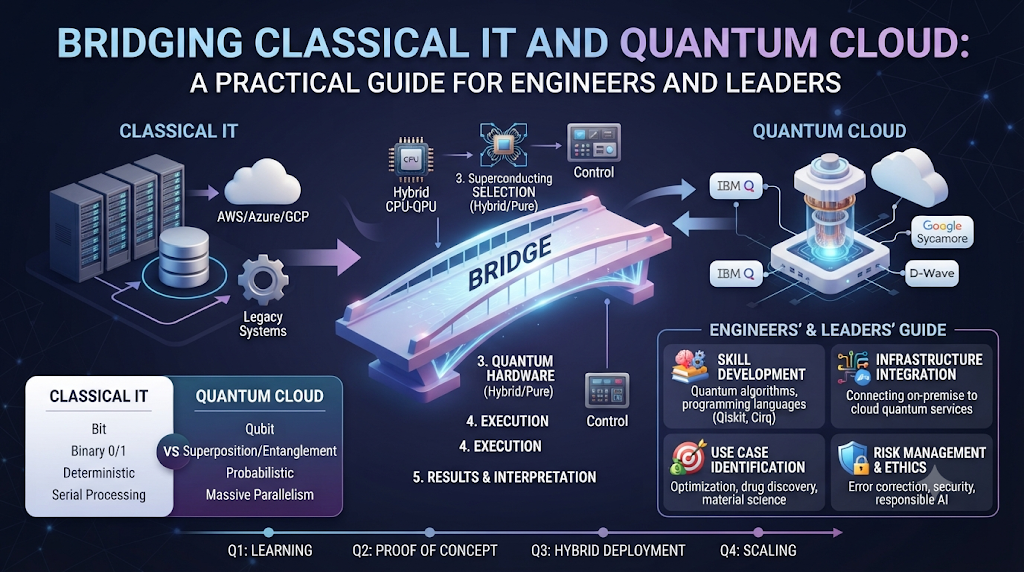
Imagine managing a cloud infrastructure where your servers operate near absolute zero temperature, your code outputs probabilities instead of exact answers, and a classical CPU works side-by-side with a quantum chip. This is the reality of modern quantum cloud computing training and enterprise IT evolution.
For years, quantum technology stayed inside university labs. Today, cloud providers let everyday developers run quantum circuits from a standard laptop. However, moving from theory to real-world IT operations creates a new challenge. Software teams and infrastructure leaders must learn how to connect quantum processors with existing cloud pipelines.
This guide takes a fresh, operations-first look at quantum technology. Instead of heavy physics equations, we focus on software engineering, cloud architecture, and IT governance. You will learn how quantum systems work, which tools to use, and how teams can build practical skills without getting lost in complex theory.
Understanding the Shift: Classical Servers vs. Quantum Processors
To manage or build quantum applications, you first need to see how they differ from standard cloud servers.
How Classical Computers Think
Every laptop, smartphone, and cloud server processes data using bits. A bit is simple. It is either 0 (off) or 1 (on). Even the fastest supercomputers just flip billions of these tiny binary switches every second.
What Makes Qubits Different?
A quantum computer uses qubits (quantum bits). Instead of being stuck at 0 or 1, a qubit uses the rules of quantum physics to hold a combination of both states at the exact same time.
Three core ideas power every quantum system:
- Superposition: Think of a spinning coin. While it spins, it is neither heads nor tails—it is a mix of both until it lands. Similarly, a qubit stays in a mix of
0and1until a sensor measures it. - Entanglement: This links two or more qubits together. Once entangled, changing one qubit instantly affects its partner, no matter how far apart they are. Algorithms use this link to process complex patterns quickly.
- Interference: Quantum algorithms amplify the chances of getting the right answer while canceling out wrong answers, much like noise-canceling headphones block unwanted sound.
Circuits, Gates, and Simulators
In your daily coding, functions change variables. In quantum coding, quantum gates change the state of qubits. When you line up several gates in a row, you create a quantum circuit.
Because real quantum chips are expensive and rare, developers test their circuits on a quantum simulator. A simulator is regular software running on a classical CPU or GPU that mimics how a quantum chip behaves.
Where Quantum Cloud Adds Real Value
Quantum computers will not replace your web servers, databases, or mobile apps. They are specialized co-processors built for specific math problems that choke classical computers.
Today, enterprises explore cloud quantum tools in four main areas:
- Supply Chain and Logistics: Finding the fastest delivery routes across thousands of trucks and warehouses involves millions of combinations. Quantum algorithms help narrow down optimal paths.
- Drug Discovery and Materials: Simulating how molecules interact requires tracking quantum behavior. Quantum processors model chemical reactions more naturally than classical servers.
- Financial Risk Modeling: Banks test quantum methods to spot fraud patterns, price complex options, and balance investment portfolios.
- Cybersecurity Readiness: Future quantum machines could break today’s standard encryption. IT teams are already preparing networks with quantum-safe security updates.
Important Reality Check: Today’s quantum hardware is still in an early stage. Physical qubits are fragile and make mistakes easily. Right now, companies focus on learning, testing small prototypes, and training staff rather than running full-scale production workloads.
Step-by-Step: How a Quantum Cloud Job Runs
Running a quantum program over the cloud follows a clear, repeatable workflow. Here is what happens behind the scenes when you hit “run”:
- Define the Business Problem: Pick a task that involves heavy optimization or molecular simulation. Always test a classical solution first to set a baseline.
- Write the Circuit: Use Python and a quantum software kit to build your logic gates.
- Test Locally: Run the code on a local simulator on your laptop to catch basic syntax or logic bugs.
- Transpile the Code: Real quantum chips have strict wiring limits. A transpiler translates your ideal circuit into instructions that match the exact physical layout of the target chip.
- Send to the Cloud Queue: Your code travels through a secure cloud API and waits in line for an available Quantum Processing Unit (QPU).
- Execute Multiple Shots: Because quantum results are based on probability, the cloud system runs your circuit 1,000 to 10,000 times (called shots) to build a reliable chart of outcomes.
- Analyze the Output: The cloud sends back the final counts, and your classical code processes the winning answer.
Top Quantum Cloud Platforms and Frameworks Compared
You do not need to build hardware to start coding. Major cloud providers offer instant access to simulators and real quantum chips. Enrolling in a Qiskit programming course or AWS Braket training usually introduces you to these core platforms:
| Platform / Framework | Best For | Primary Coding Language | Hardware Access | Key Operational Feature |
| Qiskit & IBM Quantum | Deep circuit control and runtime speed | Python | IBM superconducting chips | Qiskit Runtime keeps classical and quantum compute close together |
| Amazon Braket | Multi-vendor testing inside AWS | Python | IonQ, Rigetti, IQM, QuEra | Integrates directly with AWS IAM, S3 storage, and CloudWatch |
| Azure Quantum & Q# | Enterprise Microsoft shops & resource estimation | Q#, Python | Quantinuum, IonQ, Atom Computing | Built-in Resource Estimator predicts future hardware needs |
| Google Cirq | Hardware-level noise and pulse experiments | Python | Google quantum processors (restricted) + fast simulators | Fine-grained control over gate timing and chip layout |
Qiskit and IBM Quantum
Qiskit is the most widely used open-source quantum toolkit. Developers write circuits in Python and send them to IBM’s cloud fleet. IBM uses “primitives” (Sampler and Estimator) that simplify how code gathers probabilities and energy values from real chips.
Amazon Braket
Amazon Braket acts as a single gateway to different types of quantum hardware. Instead of signing contracts with five hardware makers, cloud engineers use one AWS account. Braket also provides “Hybrid Jobs,” which automatically spin up classical servers alongside quantum chips.
Microsoft Azure Quantum
Azure Quantum pairs Microsoft’s Q# programming language with third-party quantum hardware. Its standout feature for IT planners is the Resource Estimator, which calculates how many qubits a future fault-tolerant machine will need to solve your specific business problem.
Google Cirq
Cirq is built for researchers and engineers who care deeply about hardware physics. It lets you map qubits to exact grid spots on a chip to reduce errors during execution.
Hands-On Example: Creating Entanglement with Python and Qiskit
Let us look at real code. This simple Python script creates a Bell State, where two qubits become linked so they always produce matching results.
What You Need
- Python 3.10 or newer
- Qiskit installed via terminal (
pip install qiskit)
The Code
Python
from qiskit import QuantumCircuit
from qiskit.primitives import StatevectorSampler

# Create a circuit with 2 qubits and 2 classical bits
circuit = QuantumCircuit(2, 2)

# Put qubit 0 into superposition
circuit.h(0)

# Link qubit 0 and qubit 1 together (entanglement)
circuit.cx(0, 1)

# Measure both qubits to read the final values
circuit.measure([0, 1], [0, 1])

# Run 1,000 tests on a local simulator
sampler = StatevectorSampler()
job = sampler.run([circuit], shots=1000)
counts = job.result()[0].data.c.get_counts()

print("Final Results:", counts)
Line-by-Line Breakdown
QuantumCircuit(2, 2)sets up two qubits and two standard bits to record the answers.circuit.h(0)applies a Hadamard gate, putting the first qubit into a 50/50 state of0and1.circuit.cx(0, 1)applies a CNOT gate. If qubit 0 is1, it flips qubit 1. Now both qubits share the exact same fate.circuit.measure([0, 1], [0, 1])reads the quantum states and saves them as normal binary numbers.StatevectorSampler()runs the circuit 1,000 times on your computer’s CPU.
What You Will See: The output will print roughly {'00': 500, '11': 500}. Notice that '01' and '10' never appear. Because the qubits are entangled, they always match. On a real cloud QPU, slight hardware noise will cause a few '01' or '10' errors to sneak in.
Inside Quantum Cloud Architecture
From an infrastructure view, a quantum computer is actually a hybrid data center stack. Several layers work together to execute a single job:
- The Quantum Chip (QPU): Superconducting chips sit inside massive dilution refrigerators cooled to 15 millikelvin—colder than deep space—to protect qubits from heat noise.
- Control Electronics: Room-temperature classical servers convert your Python code into precise microwave pulses that travel down cables to control the qubits.
- The Cloud API Layer: Standard web gateways handle user logins, job queues, and billing metrics.
- Security and Networking: Enterprise setups use private cloud links, role-based access control (RBAC), and encrypted storage buckets so sensitive company data never leaks.
How Hybrid Quantum-Classical Systems Work Together
Pure quantum programs rarely exist in practice. Instead, companies rely on hybrid quantum-classical computing training to build systems where classical and quantum processors share the workload.
Think of a hybrid loop like a coach and an athlete:
- The Classical Server (The Coach): Prepares the raw business data, picks starting settings for the quantum circuit, and evaluates how good the answers are.
- The Quantum Chip (The Athlete): Runs the heavy quantum math step and sends raw measurement counts back to the server.
- The Feedback Loop: The classical server tweaks the settings and sends the circuit back to the QPU. This cycle repeats hundreds of times until the system finds the best solution.
Cloud tools like Qiskit Runtime and Amazon Braket Hybrid Jobs package these two steps into the same data center facility so network delays do not slow down the loop.
Balancing Benefits and Operational Challenges
Before committing budget, leaders exploring quantum computing for IT managers must weigh clear benefits against real hardware limits.
Key Advantages
- Zero Hardware Maintenance: Cloud platforms handle cryogenic cooling, chip calibration, and hardware upgrades behind the scenes.
- DevOps Compatibility: Teams store quantum code in Git, run automated simulator tests in CI/CD pipelines, and track costs in standard cloud dashboards.
- Multi-Architecture Testing: Engineers can test the same problem on superconducting, trapped-ion, and neutral-atom chips without buying hardware.
Current Roadblocks
- High Error Rates: Qubits lose their quantum state in fractions of a second. Long circuits fail before finishing.
- Error Correction Overhead: Building one reliable “logical qubit” currently requires combining dozens or hundreds of noisy physical qubits.
- Cloud Queue Delays and Costs: Popular QPUs have waiting lines, and running thousands of shots per iteration can get expensive if teams skip local simulator testing.
Building Skills: Career Paths in QuantumOps
You do not need a physics PhD to work in this field. Most roles build directly on existing software and cloud skills.
- Software Engineers: Focus on Python, basic linear algebra (vectors and matrices), and SDKs like Qiskit. This is the core of quantum computing for software engineers.
- Cloud and DevOps Engineers: Manage IAM permissions, containerized runtimes, cost alerts, and hybrid job pipelines.
- Solution Architects: Design how classical databases, APIs, and QPUs connect securely.
Professionals looking for structured growth often pursue a quantum computing certification course or a specialized quantum computing architecture course. At QuantumOps School, learning tracks align directly with real enterprise job roles:
- QuantumOps Architect: Covers system design, hardware selection, and hybrid cloud integration.
- QuantumOps Engineer: Focuses on hands-on coding, circuit transpilation, and cloud SDK workflows.
- QuantumOps Manager: Helps IT leaders plan budgets, evaluate vendors, and manage quantum readiness.
- QuantumOps Professional: Teaches core concepts, gates, simulators, and basic cloud execution.
Earning a QuantumOps certification shows employers you understand both quantum mechanics and practical IT operations—especially when backed by real code projects on GitHub.
IT Governance: Managing Quantum Projects in Business
IT managers can keep quantum experiments safe, affordable, and productive with four simple rules:
- Enforce Simulator-First Policies: Require developers to verify every circuit on free local simulators before spending cloud credits on real QPUs.
- Set Strict Cloud Budgets: Use cloud billing alerts and shot limits so an infinite loop in a hybrid script does not drain your monthly IT budget.
- Start Post-Quantum Security Audits: Map out where your apps use older encryption (like RSA) and plan upgrades to NIST-approved quantum-resistant encryption standards.
- Pair Domain Experts with Coders: Combine supply-chain or finance specialists with Python developers so quantum tests solve real business bottlenecks.
Common Mistakes Beginners Make
- Using Quantum for Simple Tasks: Never use a QPU to sort spreadsheets or run basic SQL queries. Classical servers do those jobs millions of times faster and cheaper.
- Trusting Ideal Simulator Outputs Blindly: A circuit that works 100% of the time on a clean laptop simulator may fail on real hardware due to chip noise. Always test with noise models enabled.
- Ignoring Transpilation Costs: If two qubits sit on opposite sides of a chip, the compiler adds extra
SWAPgates to connect them, increasing errors. - Forgetting Classical Bottlenecks: Slow data transfers between your cloud storage and the quantum runtime can ruin hybrid performance.
Best Practices for Getting Started
- Keep Circuits Short: Use as few two-qubit gates (
CNOT) as possible, since they cause the most hardware errors. - Write Portable Code: Use open standards like OpenQASM 3.0 so you can switch between IBM, AWS, and Azure backends without rewriting everything.
- Automate Testing: Add simulator checks into your standard GitHub Actions or GitLab CI workflows.
- Focus on Hybrid Workflows: Master how classical optimizers interact with quantum circuits, as hybrid apps will dominate enterprise use for years.
Future Trends to Watch
- Logical Qubits Go Mainstream: Hardware makers are shifting focus from raw qubit counts to error-corrected logical qubits that run longer, cleaner programs.
- Supercomputer + QPU Integration: National labs and cloud providers are wiring quantum chips directly into high-performance GPU clusters for unified scientific computing.
- Pre-Built Quantum Functions: Cloud vendors are releasing ready-made business functions so developers can solve optimization problems without designing low-level gates.
- Mandatory Security Upgrades: Governments and financial regulators are setting firm deadlines for companies to adopt post-quantum cryptography.
How QuantumOps School Supports Your Growth
QuantumOps School bridges the gap between complex quantum theory and everyday IT operations. Through its advertised Architect, Engineer, Manager, and Professional learning paths, the platform offers instructor-led training, hands-on labs, circuit simulations, real-world case studies, and capstone projects across Qiskit, Cirq, AWS Braket, IBM Quantum, and Azure Quantum.
For companies planning their next steps, QuantumOps School also provides quantum computing consulting services covering cloud integration, hybrid architecture design, workload optimization, and quantum security strategy.
Conclusion
Quantum cloud computing puts experimental processors into the hands of everyday developers and IT teams. While hardware noise and qubit limits still exist, mastering hybrid architectures, cloud governance, and Python SDKs today prepares your team for the next wave of enterprise computing.
Start small: install Qiskit or the Amazon Braket SDK, run a two-qubit entanglement script on your laptop, and see firsthand how probabilistic computing works.
Frequently Asked Questions (FAQs)
1. What is QuantumOps in simple terms?
QuantumOps is the combination of software engineering, cloud architecture, and IT operations practices used to build, test, deploy, and manage quantum workloads in cloud environments.
2. Can a software engineer learn quantum computing without a physics background?
Yes. Software engineers only need Python skills, basic probability, and simple linear algebra to build and run quantum circuits using modern SDKs like Qiskit and Cirq.
3. How do companies access quantum computers without buying hardware?
Companies use cloud platforms like IBM Quantum, Amazon Braket, and Microsoft Azure Quantum to rent access to real quantum processors and simulators over standard internet APIs.
4. Why do quantum programs run thousands of “shots”?
Quantum measurements return random outcomes based on probability. Running a circuit 1,000 or more times (shots) lets developers count the results and find the most likely correct answer.
5. What is the main difference between a simulator and a QPU?
A simulator is classical software that mimics a quantum computer without hardware errors. A QPU (Quantum Processing Unit) is a real physical quantum chip that experiences environmental noise and gate errors.
6. Why are hybrid quantum-classical workflows so important?
Current quantum chips cannot store large files or run standard loops well. Hybrid workflows let classical servers handle data and optimization while quantum chips run specialized math steps.
7. What does AWS Braket training teach cloud engineers?
AWS Braket training teaches engineers how to write quantum circuits, run managed cloud simulators, access multiple hardware vendors, and control security and costs using AWS IAM and S3.
8. How does a Qiskit programming course help developers?
A Qiskit programming course teaches developers how to build quantum gates in Python, optimize circuits through transpilation, simulate noise, and run jobs on IBM Quantum systems.
9. What should IT managers prioritize first for quantum readiness?
IT managers should first audit their systems for post-quantum encryption upgrades, set cloud simulator-first policies to control costs, and upskill key architects and developers.
10. What is circuit transpilation?
Transpilation is the process of rewriting an abstract quantum circuit so it matches the exact physical wiring and native gate rules of a specific quantum chip.
11. How do QuantumOps Architect and Engineer roles differ?
A QuantumOps Engineer writes circuit code, runs simulations, and automates pipelines, while a QuantumOps Architect designs the overall hybrid cloud infrastructure, security, and vendor strategy.
12. Are quantum computers replacing classical cloud servers?
No. Quantum processors act as specialized accelerators for optimization and chemistry simulations, while classical servers continue handling everyday apps, databases, and web traffic.
