Introduction
The demand for specialized engineering roles is growing as artificial intelligence moves from research labs into the heart of enterprise systems. This guide focuses on the Certified MLOps Architect program, which provides a structured approach to managing the machine learning lifecycle. It is designed to help professionals transition from traditional software operations to the specialized world of AI infrastructure. By focusing on production-grade skills, this guide helps engineers and leaders make informed decisions about their career growth and technical investments. You can explore this certification and other advanced learning paths directly through Aiopsschool to start your journey.
What is the Certified MLOps Architect?
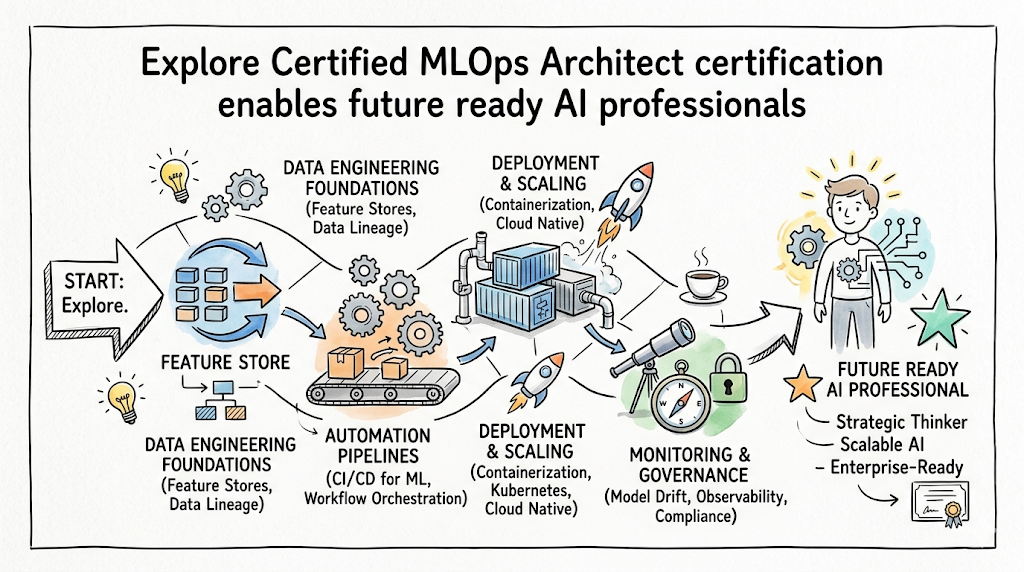
The Certified MLOps Architect is a professional validation that focuses on the intersection of data science, data engineering, and traditional DevOps. It exists to solve the “last mile” problem of machine learning, where many models fail to make it into a stable production environment. This certification emphasizes hands-on, practical skills over abstract theory, ensuring that architects can build scalable and resilient systems. It aligns perfectly with modern enterprise standards where automation, monitoring, and model governance are mandatory for business success.
Who Should Pursue Certified MLOps Architect?
This certification is highly beneficial for DevOps engineers, SREs, and cloud architects who want to specialize in the rapidly expanding AI sector. It is also an excellent path for data scientists who need to understand how their models are deployed and managed at scale. Managers and technical leaders will find value in learning the architectural patterns required to lead modern engineering teams. Whether you are based in a global tech hub or the growing technology market in India, these skills are becoming a core requirement for senior roles.
Why Certified MLOps Architect is Valuable Today and Beyond
Enterprise adoption of machine learning is no longer optional, and the need for professionals who can manage these systems is at an all-time high. This certification offers long-term career stability because it focuses on core principles that remain relevant regardless of which specific tools are in fashion. By mastering MLOps, you ensure that you can provide a high return on investment for your organization through automated and efficient model delivery. It helps you stay competitive in a landscape that is increasingly moving toward “AI-first” infrastructure and platform engineering.
Certified MLOps Architect Certification Overview
The program is delivered through the official platform at https://aiopsschool.com/certifications/certified-mlops-architect.html and is hosted on Aiopsschool. It utilizes a practical assessment approach that tests your ability to design and implement real-world AI pipelines. The certification is structured to cover various levels of expertise, ensuring that both beginners and senior architects have a clear path forward. It focuses on the ownership of the entire model lifecycle, from initial data ingestion to long-term performance monitoring in production.
Certified MLOps Architect Certification Tracks & Levels
The program is divided into distinct tracks that align with different career stages and technical interests. The foundation level provides the essential vocabulary and concepts needed to speak the language of MLOps. The professional level is deeply technical, focusing on the automation and orchestration of models using modern cloud-native tools. Finally, the advanced architect level is for those designing complex, global systems that require high levels of governance and cost optimization. These tracks allow professionals to progress naturally as they gain more industry experience.
Complete Certified MLOps Architect Certification Table
| Track | Level | Who it’s for | Prerequisites | Skills Covered | Recommended Order |
| MLOps Core | Foundation | Beginners/Managers | Basic IT Literacy | Lifecycle basics, Git, ML Terms | 1st |
| Engineering | Professional | ML/DevOps Engineers | Foundation Cert | CI/CD, Kubernetes, Monitoring | 2nd |
| Architecture | Advanced | Senior Architects | Professional Cert | Scaling, Cost, Governance | 3rd |
| Data | Specialist | Data Engineers | Data handling knowledge | Feature stores, ETL, Lineage | Optional |
| Security | Specialist | Security Engineers | Cloud Security basics | Model security, Privacy, Compliance | Optional |
Detailed Guide for Each Certified MLOps Architect Certification
Certified MLOps Architect – Foundation
What it is
This level validates a professional’s understanding of the basic concepts and the “why” behind machine learning operations. It ensures you understand how MLOps differs from traditional software development.
Who should take it
It is perfect for junior engineers, product managers, and recruitment professionals who need to understand the AI ecosystem. It is also a great entry point for traditional system admins.
Skills you’ll gain
- Understanding the machine learning development lifecycle.
- Basics of versioning code, data, and models.
- Knowledge of production-level deployment strategies.
- Familiarity with the MLOps tool landscape.
Real-world projects you should be able to do
- Create a documentation plan for a basic model lifecycle.
- Set up a simple version-controlled environment for a small project.
Preparation plan
- 7-14 Days: Review the core glossary and introductory modules provided by the school.
- 30 Days: Complete the basic labs and pass the foundational practice assessments.
- 60 Days: This timeframe is usually reserved for those new to the IT industry entirely.
Common mistakes
Candidates often try to dive into complex coding before they understand the conceptual lifecycle. Another mistake is ignoring the importance of data quality at the foundation stage.
Best next certification after this
- Same-track option: Certified MLOps Architect – Professional.
- Cross-track option: Certified DataOps Professional.
- Leadership option: AI Strategy for Managers.
Certified MLOps Architect – Professional
What it is
This is a technical certification that proves you can build and automate machine learning pipelines. It focuses on the “how” of deploying models into production environments.
Who should take it
DevOps engineers and ML engineers who are responsible for the daily operations of AI models. It requires a good grasp of containerization and automation.
Skills you’ll gain
- Designing CI/CD pipelines specifically for machine learning.
- Orchestrating models using Kubernetes and specialized ML tools.
- Implementing automated monitoring for data and model drift.
- Managing experiment tracking and model registries at scale.
Real-world projects you should be able to do
- Build a fully automated pipeline that retrains a model when performance drops.
- Deploy a containerized model to a production cluster with monitoring enabled.
Preparation plan
- 7-14 Days: Set up a deep-dive lab environment and review automation scripts.
- 30 Days: Practice building various pipelines and focus on troubleshooting common errors.
- 60 Days: Conduct advanced testing on model scaling and resource management.
Common mistakes
A common error is focusing only on the deployment and forgetting about long-term monitoring. Many also struggle with the specific networking requirements of ML clusters.
Best next certification after this
- Same-track option: Certified MLOps Architect – Advanced.
- Cross-track option: Certified DevSecOps Professional.
- Leadership option: Technical Lead – AI Infrastructure.
Certified MLOps Architect – Advanced
What it is
This level is for the designers of the systems. It validates the ability to create high-level architectures that support multiple teams and complex compliance requirements.
Who should take it
Senior architects and principal engineers who are tasked with building a company-wide AI platform. It is meant for those with significant production experience.
Skills you’ll gain
- Architecting multi-cloud and hybrid-cloud AI environments.
- Implementing enterprise-level security and data governance.
- Strategic cost optimization for large-scale GPU workloads.
- Leading the cultural shift toward automated AI operations.
Real-world projects you should be able to do
- Design a blueprint for a global model serving infrastructure.
- Create a governance framework for tracking model lineage and compliance.
Preparation plan
- 7-14 Days: Focus on architectural patterns and high-level case studies.
- 30 Days: Develop design documents for complex, multi-layered AI systems.
- 60 Days: Review your designs with peers and refine your approach to cost and security.
Common mistakes
Architects sometimes choose overly complex tools when a simpler solution would be more reliable. Forgetting to factor in the cost of data movement is another frequent pitfall.
Best next certification after this
- Same-track option: Specialized AI Governance Certification.
- Cross-track option: Certified FinOps Professional.
- Leadership option: Director of Engineering – AI Platforms.
Choose Your Learning Path
DevOps Path
For traditional DevOps engineers, this path is about extending your automation skills into the world of data. You will focus on how to treat models as software artifacts while accounting for the unique challenges of data versioning. This transition allows you to leverage your existing knowledge of CI/CD and Kubernetes while adding a high-value specialization. It is the most common path for those wanting to enter the MLOps space.
DevSecOps Path
Security is a critical concern in AI, and this path addresses the unique vulnerabilities of machine learning systems. You will learn how to secure data pipelines, protect model weights, and ensure that AI outputs are safe and compliant. This path is essential for engineers working in highly regulated sectors like finance or defense. It combines security rigor with the agility of modern operations.
SRE Path
Site Reliability Engineers will find this path useful for applying reliability principles to AI services. You will learn how to set SLIs and SLOs for model performance and how to handle the “silent failures” common in machine learning. This path focuses on observability, incident response, and ensuring that AI systems are as stable as traditional web services. It is ideal for those who care about uptime and performance.
AIOps Path
This path focuses on using artificial intelligence to improve traditional IT operations. You will learn how to build systems that analyze massive amounts of log data to predict and prevent outages. It is distinct from MLOps because the focus is on the health of the infrastructure rather than the deployment of business models. Professionals here become experts in building self-healing systems.
MLOps Path
The dedicated MLOps path is for those who want to be at the center of the AI lifecycle. It covers the entire journey from raw data ingestion to the final serving of a model to an end user. You will master the tools and workflows that allow data scientists to move fast without breaking production. This is the most direct route to becoming a specialized MLOps Engineer.
DataOps Path
Data is the foundation of every AI model, and this path ensures that data is reliable, clean, and accessible. You will focus on automating data pipelines and managing feature stores that serve multiple models. This specialization is critical for organizations with massive amounts of data that need to be processed in real-time. It bridges the gap between raw databases and training-ready data.
FinOps Path
As AI workloads grow, so do the cloud bills. This path teaches you how to manage and optimize the costs associated with training and running large models. You will learn about GPU cost tracking, spot instance strategies, and how to prove the financial value of AI projects. This is a highly sought-after skill by engineering managers and stakeholders who are mindful of the bottom line.
Role → Recommended Certified MLOps Architect Certifications
| Role | Recommended Certifications |
| DevOps Engineer | MLOps Foundation + Professional |
| SRE | MLOps Professional + SRE Specialist |
| Platform Engineer | MLOps Architect (Advanced) |
| Cloud Engineer | MLOps Foundation + Cloud Specialty |
| Security Engineer | MLOps Foundation + DevSecOps Specialist |
| Data Engineer | DataOps Specialist + MLOps Foundation |
| FinOps Practitioner | FinOps Specialist + MLOps Foundation |
| Engineering Manager | MLOps Foundation + Leadership Track |
Next Certifications to Take After Certified MLOps Architect
Same Track Progression
Deepening your knowledge in MLOps is always a good strategy. You might choose to specialize in specific areas like edge AI or high-performance computing for model training. Staying within the same track ensures you remain a subject matter expert who can solve the most difficult technical challenges in the field. Continuous learning is necessary as the tools in this space evolve rapidly.
Cross-Track Expansion
Expanding into related fields like DevSecOps or DataOps makes you a much more versatile professional. By understanding how security and data quality affect your MLOps pipelines, you can design more robust and reliable systems. This broader perspective is often what distinguishes a senior architect from a mid-level engineer. It allows you to lead cross-functional teams more effectively.
Leadership & Management Track
If you are interested in moving into management, focusing on AI strategy and engineering leadership is the next step. These certifications help you transition from solving technical problems to solving organizational and business problems. You will learn how to build AI teams, manage budgets, and align technical roadmaps with the overall goals of the company. This is a rewarding path for those who enjoy mentoring and strategic planning.
Training & Certification Support Providers for Certified MLOps Architect
DevOpsSchool is a well-known provider that offers a massive library of resources for engineers at all levels. They focus on community learning and provide detailed tutorials that cover the entire DevOps and MLOps spectrum. Their approach is practical and designed to help professionals get up to speed with the latest industry tools quickly.
Cotocus provides highly technical training environments that are ideal for hands-on learners. They specialize in cloud-native technologies and offer guided labs where you can build and break real systems. This provider is a great choice for those who want to gain deep technical competence in a structured setting.
Scmgalaxy is a veteran organization in the software configuration and supply chain space. They offer extensive documentation and training on how to manage the lifecycle of complex software systems. Their focus on the long-term health of software makes them a reliable partner for MLOps training.
BestDevOps offers targeted coaching and resources specifically designed to help candidates pass their certification exams. They provide high-quality practice tests and study guides that focus on the most important technical domains. Their goal is to make the certification process as efficient as possible for busy professionals.
devsecopsschool.com is the go-to resource for anyone looking to integrate security into their operations and AI pipelines. They offer specialized courses that cover everything from threat modeling for ML to securing data at rest and in transit. This provider is essential for building trustworthy AI systems.
sreschool.com focuses on the principles of site reliability and how they apply to modern, complex infrastructures. Their training helps you understand how to build systems that are not just automated, but also highly resilient and observable. They are leaders in teaching the “Ops” side of the MLOps equation.
aiopsschool.com is the official hosting site for the Certified MLOps Architect program and other specialized AI certifications. They provide the most up-to-date curriculum and have a global community of practitioners and experts. This is the primary destination for anyone serious about a career in MLOps.
dataopsschool.com offers training focused on the automation of data flows and the management of data quality. They help engineers understand how to build the robust data foundations required for successful machine learning. Their courses are a perfect complement to any MLOps certification.
finopsschool.com addresses the financial side of engineering by teaching cloud cost management and optimization. Their training is critical for anyone responsible for managing the high costs of AI infrastructure. They provide the tools and knowledge needed to keep cloud spending under control.
Frequently Asked Questions (General)
- How hard is the Certified MLOps Architect assessment?
The difficulty level is moderate to high, as it requires a mix of theoretical knowledge and hands-on technical skills in automation and cloud systems.
- What is the average time needed for preparation?
Most candidates with a technical background spend four to six weeks studying, while those newer to the field may need eight to twelve weeks.
- Are there any mandatory prerequisites for the foundation level?
There are no formal prerequisites, but having a basic understanding of Linux and software development will make the learning process much smoother.
- Is the certification recognized by major employers?
Yes, companies globally recognize these certifications as proof of specialized skills in one of the most in-demand areas of modern technology.
- Can I renew my certification after it expires?
Yes, there is usually a renewal process that involves taking an updated exam or demonstrating continued professional development in the field.
- Does the program include hands-on labs?
Yes, the professional and architect levels are heavily focused on labs where you must demonstrate your ability to build and manage real AI pipelines.
- Is knowledge of Python required for the exam?
A basic to intermediate understanding of Python is highly recommended, as it is the primary language used in the machine learning ecosystem.
- Can I take the training and exam remotely?
Yes, all training materials and the final assessment are available online, allowing you to learn and get certified from any location.
- What kind of tools will I learn about in the program?
You will gain exposure to containerization tools like Docker, orchestrators like Kubernetes, and specialized ML tools like MLflow and Kubeflow.
- Is there a community for certified professionals?
Yes, once certified, you gain access to a global network of professionals where you can share knowledge and find career opportunities.
- Does the certification cover generative AI operations?
The curriculum is frequently updated to include the latest trends, including the unique operational challenges of large language models and GenAI.
- How does this certification help my salary prospects?
Professionals with specialized MLOps certifications often command a significant premium over generalist DevOps or data science roles.
FAQs on Certified MLOps Architect
- Does this certification focus on a specific cloud provider?
While the labs may use specific clouds, the principles taught are universal and can be applied to AWS, Azure, GCP, or on-premise environments.
- How is MLOps different from traditional DevOps?
MLOps introduces the challenges of data versioning and model performance decay, which are not typically found in standard software DevOps.
- Can I skip the foundation level and go straight to professional?
It is recommended to follow the levels in order, but those with significant industry experience can sometimes move directly to higher levels.
- Will I learn about model monitoring and alerting?
Yes, monitoring for both infrastructure health and model performance (like drift detection) is a core part of the professional curriculum.
- Does the program cover data privacy and compliance?
Yes, the architect level includes training on how to design systems that comply with global data privacy regulations like GDPR.
- Is this certification suitable for data engineers?
Absolutely, data engineers will find the sections on data versioning and feature stores particularly relevant to their daily work.
- How are the technical labs evaluated?
Labs are evaluated based on the success of the automation and whether the resulting infrastructure meets the specified requirements.
- Are there discounts for taking multiple levels?
Many providers offer bundled packages for those who plan to progress through all three levels of the certification track.
Final Thoughts
The transition to AI-driven enterprise systems is not a trend; it is a fundamental shift in how software is built. Based on years of seeing teams struggle with unmanaged models, I can say that a structured approach is the only way to succeed. The Certified MLOps Architect provides that structure, giving you the tools to handle the complexity of production AI. It is an honest, technical path that requires hard work, but the career rewards are substantial. If you want to move beyond basic automation and lead the next wave of technical innovation, this is the right place to start.
