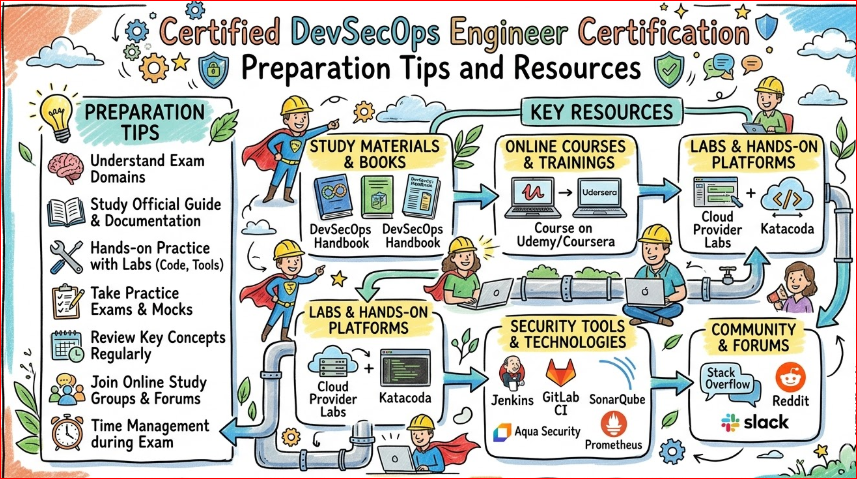
Modern software teams ship code frequently, run on cloud-native platforms, and face constant security risks. In this environment, security can no longer sit at the end of the release cycle. It must be built into every stage of development and operations. The Certified DevSecOps Engineer certification is designed for working professionals who want to combine DevOps speed with strong, practical security across the entire software lifecycle.
Core Structure of the Certified DevSecOps Engineer Program
What it is
The Certified DevSecOps Engineer program is a hands-on certification for engineers who want to apply security in DevOps workflows. It covers both concepts and practical implementation, so you can design, build, and run secure delivery pipelines.
The focus is on real-world tools, patterns, and decision-making used in modern engineering teams.
Who should take it
- Software engineers who want to move into DevSecOps roles
- DevOps engineers who want to add strong security skills
- Cloud and platform engineers managing production infrastructure
- Security engineers who want to work closely with DevOps teams
- SREs who support critical production systems and services
- Engineering managers responsible for secure delivery practices
Skills you will gain
- DevSecOps principles and culture
- Secure SDLC and secure coding basics
- Security in CI/CD pipelines (build, test, release)
- SAST, DAST, SCA, and container image scanning
- Secrets management and secure configuration
- Cloud security fundamentals (IAM, network, storage, policies)
- Container and Kubernetes security fundamentals
- Security automation and security as code
- Policy as code and compliance automation
- Monitoring, logging, and incident handling with a security lens
Real-world projects you should be able to do
- Build a secure CI/CD pipeline with integrated security scans
- Implement automated SAST, DAST, and dependency scanning in a pipeline
- Design and implement secrets management for applications and pipelines
- Secure a containerized application running on Kubernetes or similar platforms
- Introduce policy as code to control deployments and configurations
- Set up security gates that protect production without blocking every release
- Work with teams to triage and fix security findings in a structured way
Preparation plan
7–14 day fast-track plan
- Day 1–3: Learn DevSecOps fundamentals, secure SDLC, and threat basics
- Day 4–6: Focus on CI/CD security, scanning tools, and basic labs
- Day 7–10: Build one sample secure pipeline with scans and secrets
- Day 11–14: Revise, review your notes, and take mock tests
Best for: people already working in DevOps, cloud, or security.
30 day focused plan
- Week 1: DevSecOps concepts, culture, and security basics
- Week 2: CI/CD tools, pipeline design, SAST/DAST/SCA, secrets management
- Week 3: Cloud security basics, container/Kubernetes security, policy as code
- Week 4: Build and refine end-to-end projects; take practice tests and review
Best for: working professionals able to spend 1–2 hours daily.
60 day deep plan
- Weeks 1–2: DevOps foundation, Linux, Git, and basic security concepts
- Weeks 3–4: CI/CD pipelines, common tools, integrations, and automation
- Weeks 5–6: Cloud and container security, monitoring, and incident response
- Weeks 7–8: Multiple hands-on projects, practice exams, and documentation
Best for: people newer to DevOps or cloud but serious about DevSecOps.
Common mistakes to avoid
- Treating DevSecOps as only tools, ignoring mindset and collaboration
- Skipping fundamentals of DevOps, cloud, and networking
- Reading only theory without building real pipelines and labs
- Ignoring secure coding basics and relying only on scanners
- Not practicing how to handle security findings in real workflows
- Trying to learn too many tools at once without depth
- Underestimating the importance of documentation and runbooks
Best next certification after this
- Same track: an advanced DevSecOps or cloud security certification
- Cross-track: SRE, Kubernetes security, or DataOps/MLOps certifications
- Leadership: DevSecOps Architect or engineering leadership programs that combine technology and governance
Certification Table: Tracks and Learning View
| Track | Level | Who it’s for | Prerequisites | Skills covered | Recommended order |
|---|---|---|---|---|---|
| DevSecOps | Foundation | Early-career engineers and developers | Basic OS concepts, Git, basic scripting | DevSecOps basics, secure SDLC, intro pipeline security | First DevSecOps-focused certification |
| DevSecOps | Intermediate | DevOps, cloud, security, and SRE engineers | 1–2 years IT/DevOps/cloud experience | Secure CI/CD, SAST/DAST/SCA, secrets, cloud and container security basics | After core DevOps or cloud certification |
| DevSecOps | Career enabler | Professionals moving into dedicated DevSecOps roles | Hands-on CI/CD, cloud basics, application awareness | Security automation, policy as code, incident response, governance-aware work | Before advanced security, architecture, or leadership programs |
Choose Your Path: 6 Structured Learning Paths
1. DevOps Path
- Start with Linux, Git, and basic scripting
- Learn CI/CD concepts and one pipeline tool
- Do a general DevOps or cloud certification
- Take Certified DevSecOps Engineer to secure your pipelines
- Move into DevOps Engineer or Platform Engineer roles
2. DevSecOps Path
- Learn DevOps basics and security fundamentals
- Focus on CI/CD, scanning tools, and secure practices
- Take Certified DevSecOps Engineer as your core certification
- Build projects around secure pipelines and cloud environments
- Progress to advanced DevSecOps or cloud security topics
3. SRE Path
- Study Linux, networking, and observability basics
- Learn SRE concepts like SLOs, error budgets, and incident response
- Take an SRE-focused certification
- Add Certified DevSecOps Engineer to secure systems and pipelines
- Grow into SRE roles with strong security understanding
4. AIOps/MLOps Path
- Learn DevOps, data, and ML basics
- Understand CI/CD for ML models and data pipelines
- Take Certified DevSecOps Engineer to secure ML and data pipelines
- Work on projects combining observability, automation, and security
- Grow into AIOps/MLOps roles in data-driven organizations
5. DataOps Path
- Learn data engineering, databases, and ETL tools
- Understand DataOps and continuous data delivery principles
- Take Certified DevSecOps Engineer for secure data pipelines and platforms
- Focus on data access control, encryption, and secure operations
- Move into DataOps Engineer roles with security as a core skill
6. FinOps Path
- Learn cloud cost management and optimization basics
- Understand how architecture, performance, and cost connect
- Take Certified DevSecOps Engineer to align security with cost and performance
- Implement secure and cost-aware infrastructure practices
- Grow into FinOps Practitioner or FinOps Engineer positions
Role → Recommended Certifications Mapping
Use this as a quick reference for building a certification roadmap around Certified DevSecOps Engineer.
| Role | Recommended certifications set |
|---|---|
| DevOps Engineer | DevOps foundation, cloud platform certification, Certified DevSecOps Engineer |
| SRE | SRE/observability certification, cloud platform certification, Certified DevSecOps Engineer |
| Platform Engineer | Kubernetes/containers certification, cloud platform certification, Certified DevSecOps Engineer |
| Cloud Engineer | Core cloud certification (AWS/Azure/GCP), infrastructure-as-code certification, Certified DevSecOps Engineer |
| Security Engineer | Security fundamentals, cloud security certification, Certified DevSecOps Engineer |
| Data Engineer | Data engineering or DataOps certification, cloud data services certification, Certified DevSecOps Engineer |
| FinOps Practitioner | FinOps foundation certification, cloud platform certification, Certified DevSecOps Engineer |
| Engineering Manager | Agile/leadership certification, cloud fundamentals, Certified DevSecOps Engineer |
Next Certifications After Certified DevSecOps Engineer
Same track (DevSecOps-focused)
- Advanced DevSecOps or secure cloud DevOps certification
- Kubernetes or container security certification
- Specialized courses in policy as code or compliance automation
Cross-track (broadening your skills)
- SRE or reliability certification to connect reliability and security
- Advanced cloud platform certifications to deepen cloud knowledge
- DataOps or MLOps certifications to secure data and ML pipelines
Leadership track
- DevSecOps Architect or Security Architecture programs
- Engineering leadership, team management, or technical management courses
- Governance, risk, and compliance programs for policy-level responsibilities
Top Institutions for Certified DevSecOps Engineer Training
DevOpsSchool
DevOpsSchool focuses on real-world DevOps and DevSecOps training with strong hands-on practice. It offers structured programs, labs, and guidance for professionals preparing for certifications like Certified DevSecOps Engineer.
Cotocus
Cotocus provides specialized training and consulting in DevOps, cloud, and security. Their programs are designed for engineers and managers who want practical skills that can be applied in projects and production environments.
ScmGalaxy
ScmGalaxy offers training around software configuration management, DevOps toolchains, and automation. They emphasize lab work and project-based learning, which helps learners build confidence with tools and workflows.
BestDevOps
BestDevOps curates learning paths for DevOps and DevSecOps professionals. The focus is on modern tools, practical workflows, and skills that map well to real jobs and roles in industry.
devsecopsschool.com
devsecopsschool.com is dedicated to DevSecOps and security in modern software delivery. It offers training and certification programs, including Certified DevSecOps Engineer, that focus on secure pipelines, automation, and governance.
sreschool.com
sreschool.com provides training focused on Site Reliability Engineering. It helps learners understand reliability, observability, and incident response, which fits well with DevSecOps for secure and stable systems.
aiopsschool.com
aiopsschool.com is centered on AIOps and intelligent operations. Their programs connect monitoring, automation, and data-driven operations, which can extend DevSecOps practices with smarter observability and response.
dataopsschool.com
dataopsschool.com focuses on DataOps, secure data pipelines, and reliable data flows. This is useful for engineers who deal with data platforms and want to integrate DevSecOps principles into data systems.
finopsschool.com
finopsschool.com provides training on FinOps and cloud cost optimization. It helps teams and engineers manage cost, performance, and security together, supporting sustainable and secure cloud operations.
FAQs on Certified DevSecOps Engineer (at least 12)
1. How difficult is the Certified DevSecOps Engineer exam?
It is moderate in difficulty for someone with DevOps or cloud experience. Newer professionals may find it challenging at first, but a structured study plan and hands-on practice make it achievable.
2. How long does it take to prepare?
Most working professionals need 30–60 days with regular daily study. Experienced DevOps or security engineers who already work with CI/CD and cloud might be ready in 7–14 days of focused preparation.
3. What are the main prerequisites?
You should be comfortable with Linux basics, Git, and at least one CI/CD tool. Some basic understanding of cloud and security concepts will also help you progress faster through the content.
4. Do I need strong coding skills?
You do not need to be a full-time developer, but basic scripting skills and understanding how applications are built and deployed will be very helpful. DevSecOps focuses more on automation, pipelines, and integration than on heavy coding.
5. Is this certification only for security professionals?
No, it is suitable for DevOps engineers, cloud engineers, SREs, and developers as well as security professionals. The goal is to help all these roles apply security in their daily workflows.
6. Is this certification useful for managers?
Yes, it is valuable for engineering managers, platform leaders, and security leads. It helps them design better processes, align teams, and make realistic decisions on tools and practices for secure delivery.
7. What kinds of tools are covered?
You will learn about CI/CD tools, scanners for code and dependencies, container and cloud security tools, secrets management, and policy as code concepts. The focus is more on patterns and workflows than on any single tool.
8. How does this certification compare to general security certifications?
General security certifications focus on broad security knowledge, policies, and theory. Certified DevSecOps Engineer focuses on applying security directly inside pipelines, infrastructure, and cloud-native platforms used by engineering teams.
9. Will this certification help me get a job?
It can help you stand out for roles like DevSecOps Engineer, DevOps Engineer, security-focused SRE, and security-aware platform roles. Employers value people who can combine speed and security in real workflows.
10. Can freshers or early-career engineers take it?
Yes, but they should first learn basic DevOps, Linux, Git, and a bit of cloud. After that, Certified DevSecOps Engineer becomes a strong way to show interest and capability in security-focused engineering roles.
11. How important is hands-on practice?
Hands-on practice is critical. You should build at least one or two secure pipelines, experiment with scanners, and try basic cloud and container security tasks. This will make both the exam and the real job much easier.
12. What is the ideal sequence with other certifications?
A common sequence is: DevOps or cloud fundamentals → Certified DevSecOps Engineer → advanced cloud security, SRE, or architecture certifications. This keeps your foundation strong while you build specialized skills.
FAQs
1. Why is the Certified DevSecOps Engineer role important?
This role is important because it connects development, operations, and security in one practice. Instead of adding security at the end, it brings it into every stage of delivery. This helps reduce vulnerabilities, incidents, and last‑minute surprises in production.
2. Is Certified DevSecOps Engineer only about tools?
No, it is not only about tools. Tools are important, but DevSecOps also covers mindset, culture, and process. You learn how to design workflows where security is natural, not forced, and how to work with people as well as technology.
3. Can I take this certification if I am a software developer?
Yes, software developers are a great fit for this certification. It helps you write more secure code, understand how pipelines protect your changes, and work better with security and operations teams. It can also prepare you for senior or lead roles.
4. Will this certification help if I already work in security?
Yes, it helps security professionals understand how engineering teams build and ship software. You learn how to place security controls inside real pipelines and systems instead of only doing reviews and audits. This makes your security work more practical and accepted by teams.
5. What topics are usually covered in the Certified DevSecOps Engineer program?
Common topics include DevSecOps principles, secure SDLC, CI/CD security, static and dynamic scanning, dependency management, secrets management, container and Kubernetes security basics, IaC security, and cloud security fundamentals. You also learn about monitoring, logging, and simple incident handling.
6. Do I need to know Kubernetes before preparing?
Knowing Kubernetes is helpful but not a hard requirement. You should at least understand the basic idea of containers and orchestration. During preparation, you can learn the key Kubernetes and container security concepts you need for DevSecOps work.
7. How is this certification different from a pure DevOps certification?
A pure DevOps certification focuses mainly on automation, CI/CD, and collaboration. Certified DevSecOps Engineer adds a strong security layer to that base. You still learn about pipelines and automation, but with a clear focus on protecting code, infrastructure, and data.
8. What kind of roles can I target after becoming a Certified DevSecOps Engineer?
You can target roles such as DevSecOps engineer, secure DevOps engineer, DevOps or SRE with strong security focus, cloud security engineer with DevOps skills, platform security engineer, or security champion within a product team. Over time, it can also support moves into lead and manager positions.
Conclusion
Certified DevSecOps Engineer is a strong step for professionals who want to bring security into everyday engineering work. It connects development, operations, and security in a practical way, using tools and methods that real teams already rely on. Whether you are a hands-on engineer or a manager, this certification can help you build secure pipelines, safer platforms, and more confident teams. With a clear study plan, focused hands-on practice, and the right guidance, you can use DevSecOps to make security a natural part of your software delivery journey.
