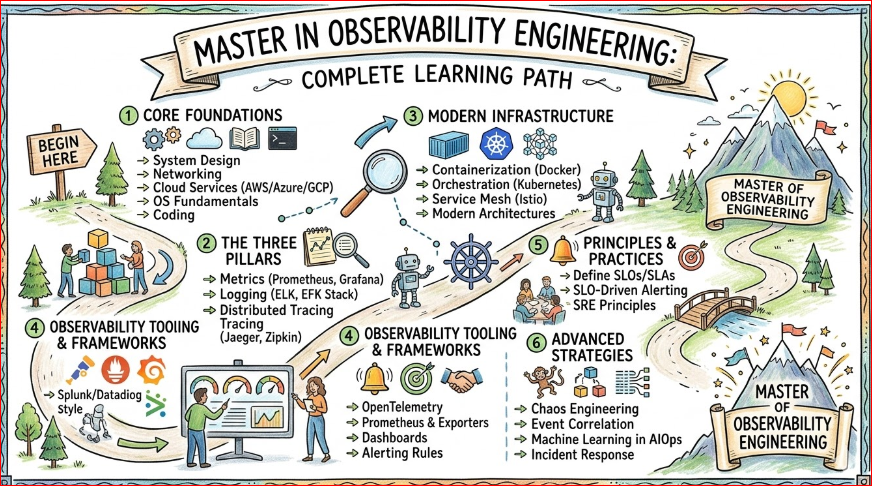
Observability is now at the heart of every modern digital business. Systems are becoming more distributed, more complex, and more critical than ever before. When things break, teams need fast, reliable ways to understand what is happening in real time. This is where Observability Engineering comes in. The Master in Observability Engineering (MOE) certification by DevOpsSchool is a comprehensive, hands-on program designed to build deep, end-to-end expertise in observability for real-world systems. This guide will help you understand what MOE is, who it is for, what you will learn, and how to use it to build a strong career in DevOps, SRE, and platform engineering.
What is Master in Observability Engineering (MOE)?
Master in Observability Engineering (MOE) is a specialized certification and training program that focuses on designing, implementing, and operating observability for modern applications and infrastructure. It goes beyond basic monitoring and teaches you how to work with metrics, logs, traces, events, and telemetry pipelines across cloud-native environments. The program is offered by DevOpsSchool and is structured to give you both strong fundamentals and deep practical exposure using popular tools like Prometheus, Grafana, ELK Stack, OpenTelemetry, CloudWatch, and others. By the end, you are able to design observability architectures, automate observability in CI/CD, and drive reliability across complex systems.
Why Observability Engineering Matters Today
Modern systems are microservices-based, containerized, multi-cloud, and highly dynamic. Traditional monitoring is no longer enough because it tells you that something is wrong, but not always why it is wrong.
Observability Engineering helps you:
- Understand how requests flow across services using distributed tracing.
- Correlate metrics, logs, and traces to find root causes faster.
- Build reliable alerting, SLOs, and incident response workflows.
- Improve performance, availability, and customer experience continuously.
This makes observability a critical capability for DevOps, SRE, platform, security, and data teams in any serious digital organization.
Overview of the MOE Certification
The Master in Observability Engineering (MOE) certification from DevOpsSchool is designed as a complete journey from fundamentals to advanced topics. The curriculum blends theory, tools, hands-on labs, and real-case simulations.
Key coverage includes:
- Core observability pillars: metrics, logs, traces, and events
- Telemetry pipelines and instrumentation best practices
- Application performance monitoring (APM)
- Cloud-native observability for containers and Kubernetes
- OpenTelemetry fundamentals and architecture
- Designing dashboards, alerts, and SLO/SLI frameworks
- Troubleshooting and incident management using observability data
- Automation of observability in CI/CD and DevOps workflows
The program is available in online live instructor-led mode with guided labs, projects, and post-training support.
MOE Certification Details
What it is
Master in Observability Engineering (MOE) is a professional certification and training program that builds end-to-end observability skills for cloud-native and distributed systems. It focuses on practical implementation using real tools, environments, and production-like scenarios.
Who should take it
- DevOps Engineers and SREs working with microservices and Kubernetes
- Platform and Cloud Engineers responsible for reliability and performance
- Software Engineers who want to design observable applications
- Security, AIOps, and DataOps professionals who depend on telemetry data
- Engineering Managers who want to build observability-first teams
Skills you’ll gain
- Strong understanding of observability concepts, pillars, and patterns
- Ability to instrument applications for metrics, logs, and traces
- Hands-on expertise with Prometheus, Grafana, ELK, OpenTelemetry, CloudWatch, and similar tools
- Designing dashboards, alerts, and SLO/SLI frameworks for services
- Implementing observability for Kubernetes, containers, and cloud-native workloads
- Root cause analysis and incident troubleshooting using observability data
- Integrating observability into CI/CD pipelines and DevOps workflows
Real-world projects you should be able to do after it
- Design and implement an observability stack for a microservices-based application
- Set up end-to-end tracing, logging, and metrics for a Kubernetes cluster
- Build dashboards and alerts for critical business transactions and SLOs
- Implement OpenTelemetry-based instrumentation for polyglot services
- Run incident simulations and use observability to drive root cause analysis
- Optimize system performance and cost using observability data
Preparation plan
You can adapt your preparation based on your current level and available time.
7–14 days fast-track plan
- Day 1–2: Learn observability fundamentals and pillars (metrics, logs, traces).
- Day 3–4: Explore one full tool chain (e.g., Prometheus + Grafana or ELK).
- Day 5–7: Practice instrumentation on a sample app and build dashboards/alerts.
- Day 8–10: Focus on Kubernetes and cloud-native observability.
- Day 11–14: Work on a mini project and revise concepts, SLOs, and incident workflows.
30 days structured plan
- Week 1: Fundamentals, architecture of observability systems, and basic tooling.
- Week 2: Logs, metrics, traces, APM tools, and visualization.
- Week 3: OpenTelemetry, Kubernetes observability, and cloud-native patterns.
- Week 4: Project work, performance tuning, incident simulations, and exam readiness.
60 days deep-dive plan
- First 30 days: Follow the 30-day plan thoroughly with intensive practice.
- Next 30 days: Focus on multiple tools, multi-cloud scenarios, automation in CI/CD, and advanced performance engineering.
Common mistakes
- Treating observability as only “monitoring and dashboards” without focusing on instrumentation
- Ignoring traces and depending only on logs or CPU/memory metrics
- Over-alerting without good SLOs, leading to alert fatigue
- Not integrating observability into CI/CD and release pipelines
- Learning tools in isolation without end-to-end scenarios
Best next certification after this
- Same track: Advanced SRE or Reliability-focused certification (e.g., SRE Certified Professional from DevOpsSchool).
- Cross-track: AIOps/MLOps-focused certification to use observability data for intelligent automation.
- Leadership: Engineering Manager or DevOps Architect–oriented programs that emphasize observability strategy and governance.
MOE Certification Table
Below is a structured view of the Master in Observability Engineering (MOE) certification.
| Track | Level | Who it’s for | Prerequisites | Skills covered | Recommended order |
|---|---|---|---|---|---|
| Observability / DevOps | Intermediate to Advanced | DevOps Engineers, SREs, Platform Engineers, Cloud Engineers, Software Engineers working on distributed systems | Basic Linux, CI/CD, cloud concepts, understanding of any programming language, familiarity with web applications | Observability fundamentals, metrics/logs/traces, OpenTelemetry, APM, Kubernetes observability, dashboards, alerting, incident management, CI/CD integration | Take after you have basic DevOps/Cloud knowledge and some production exposure |
Choose Your Path: 6 Learning Paths Using MOE
You can position MOE as a core building block within different career paths.
1. DevOps Path
- Start with core DevOps and CI/CD fundamentals.
- Take MOE to build end-to-end observability into your pipelines and platforms.
- Extend into containerization, Kubernetes, and infrastructure as code.
2. DevSecOps Path
- Build a solid DevOps foundation first.
- Use MOE to gain deep visibility into application and infrastructure behavior, which supports security monitoring and anomaly detection.
- Add DevSecOps tools and practices for secure pipelines, runtime security, and compliance.
3. SRE Path
- Learn Linux, networking, cloud, and SRE principles (SLI, SLO, error budgets).
- Use MOE as a core SRE enabler for observability-first incident management and reliability engineering.
- Grow into advanced SRE roles handling large-scale production systems.
4. AIOps / MLOps Path
- Start with DevOps, cloud, and basic data/ML concepts.
- Use MOE to generate high-quality telemetry data from systems and applications.
- Build on top with AIOps/MLOps tools that use observability data for automated insights, predictions, and optimizations.
5. DataOps Path
- Begin with data engineering, ETL, and pipeline fundamentals.
- Apply MOE concepts to monitor data pipelines, latency, data quality, and reliability.
- Extend into DataOps practices for continuous delivery of reliable data.
6. FinOps Path
- Learn cloud cost management, billing models, and usage patterns.
- Use observability skills from MOE to correlate resource usage, performance, and cost.
- Build dashboards and alerts for cost anomalies, optimization opportunities, and business KPIs.
Role → Recommended Certifications (Using MOE)
Here is how MOE fits into different roles and their certification journeys.
| Role | Recommended certifications including MOE |
|---|---|
| DevOps Engineer | Core DevOps/Cloud certification → Master in Observability Engineering (MOE) → Container/Kubernetes certification |
| SRE | Core SRE/Reliability training → Master in Observability Engineering (MOE) → Advanced SRE or incident management specialization |
| Platform Engineer | Cloud + Kubernetes platform certification → Master in Observability Engineering (MOE) → Automation/Infrastructure-as-Code specialization |
| Cloud Engineer | Cloud provider certification (AWS/Azure/GCP) → Master in Observability Engineering (MOE) → Multi-cloud or advanced networking/security training |
| Security Engineer | Security fundamentals → DevSecOps program → Master in Observability Engineering (MOE) for visibility into runtime and application behavior |
| Data Engineer | Data engineering foundation → Master in Observability Engineering (MOE) for monitoring pipelines → DataOps or streaming analytics certification |
| FinOps Practitioner | Cloud fundamentals + FinOps basics → Master in Observability Engineering (MOE) for cost-aware observability → Advanced FinOps or cloud economics training |
| Engineering Manager | Core leadership/architecture programs → Master in Observability Engineering (MOE) to design observability strategy → Org/DevOps transformation programs |
Top Institutions for Training and Certifications in MOE
DevOpsSchool
DevOpsSchool is the official provider of the Master in Observability Engineering (MOE) certification. It offers live instructor-led training, guided labs, real projects, interview preparation, and strong community support.
Cotocus
Cotocus works closely with DevOps, SRE, and observability-focused programs and is involved in designing and delivering advanced certification ecosystems. It focuses on hands-on, scenario-driven learning for working professionals in India and globally.
ScmGalaxy
ScmGalaxy is an established training platform for DevOps, CI/CD, and related engineering practices. It supports learners with curated courses, workshops, and resources that align well with observability and modern operations.
BestDevOps
BestDevOps acts as a knowledge hub and community gateway for DevOps, SRE, and observability resources. It helps professionals discover training programs like MOE and stay updated with best practices and tooling trends.
devsecopsschool.com
devsecopsschool.com focuses on integrating security into DevOps workflows. With MOE skills, learners can better connect observability data with runtime security, threat detection, and compliance monitoring.
sreschool.com
sreschool.com is dedicated to empowering Site Reliability Engineers with structured learning paths. Observability through MOE becomes a core pillar for anyone following SRE-focused programs with this ecosystem.
aiopsschool.com
aiopsschool.com focuses on the intersection of observability, automation, and AI-driven operations. MOE-trained professionals can leverage such platforms to build intelligent monitoring and self-healing systems.
dataopsschool.com
dataopsschool.com emphasizes DataOps practices and reliable data pipelines. Combining MOE with DataOps enables teams to observe, measure, and continuously improve data flows.
finopsschool.com
finopsschool.com helps professionals master cloud cost management and FinOps practices. When combined with observability skills from MOE, practitioners can link performance, reliability, and cost for better business outcomes.
FAQs on Observability and MOE (Program-Level)
Here are some frequently asked questions about observability and the MOE certification as a career enabler.
- Is observability different from monitoring?
Yes. Monitoring tells you when something is wrong, while observability helps you understand why it is wrong by giving deep visibility into system behavior using metrics, logs, traces, and events. - Do I need coding skills to learn observability?
Basic programming knowledge is helpful because you will instrument applications and work with telemetry libraries, but you do not need to be a full-time developer. - Is MOE only for DevOps or also for developers?
MOE is useful for DevOps, SRE, platform, and cloud engineers, but it is also valuable for software engineers who want to build observable, production-ready services. - How much time does it take to become comfortable with observability tools?
With focused effort, many professionals become comfortable within 30–60 days of structured learning and hands-on practice. - Can observability help with security and DevSecOps?
Yes. Observability data can expose anomalies, suspicious patterns, and performance issues tied to security events, which is highly valuable in DevSecOps pipelines. - Is MOE recognized globally?
The MOE certification from DevOpsSchool is recognized across many organizations that value hands-on, tool-driven expertise in observability and reliability engineering. - Will MOE help me transition to SRE roles?
Yes. Observability is central to SRE work, and MOE directly supports the skills needed for incident management, SLO/SLI design, and production troubleshooting. - Can I do MOE if I am from a non-Cloud background?
Having basic cloud and DevOps understanding is recommended, but motivated learners from adjacent backgrounds can catch up with some foundation learning before or alongside MOE. - Does observability matter for data and analytics teams?
Absolutely. Data pipelines, streaming jobs, and analytics platforms need observability for latency, failures, and data quality checks. - Is there a lot of math in observability?
You will encounter concepts like time-series analysis and statistical thresholds, but most tools abstract heavy math; practical intuition and hands-on practice matter more. - Will MOE increase my salary potential?
Organizations pay a premium for professionals who can keep systems reliable and observable at scale, and observability skills are strongly linked with higher-value DevOps/SRE roles. - How do I combine MOE with my existing certifications?
Position MOE as your deep reliability and visibility layer, then combine it with cloud, DevOps, security, data, or leadership certifications depending on your target role.
FAQs on Master in Observability Engineering (MOE) (Certification-Focused)
- What exactly is covered in the MOE course?
The MOE course covers observability fundamentals, metrics/logs/traces, tooling like Prometheus, Grafana, ELK, OpenTelemetry, cloud-native observability, dashboards, alerting, SLOs, incident management, and CI/CD integration. - What is the typical duration of MOE training?
The program is designed as an intensive course, with online live sessions, hands-on labs, and projects delivered over a focused duration. - Do I get hands-on labs and real projects?
Yes. The MOE certification emphasizes guided labs, production-like scenarios, and real-world projects to ensure you can implement observability beyond theory. - What kind of support is available after the training?
DevOpsSchool and its ecosystem provide post-training support, interview preparation, and community interactions to help learners continue their growth. - Is MOE suitable for freshers?
It is more suitable for working professionals with at least some exposure to software, infrastructure, or cloud, but serious learners can still benefit if they build the basics alongside. - Can MOE help me move into cloud-native roles?
Yes. The course emphasizes observability for containers, Kubernetes, and cloud-native platforms, which are core requirements in modern cloud roles. - Does MOE cover multi-cloud environments?
The principles and tools taught are applicable across multiple clouds, and many examples relate to popular platforms like AWS and others. - How do I enroll in MOE?
You can enroll through the official Master in Observability Engineering (MOE) certification page at DevOpsSchool.
Conclusion
Observability is no longer optional in a world of cloud-native, microservices-driven, always-on systems. Master in Observability Engineering (MOE) from DevOpsSchool gives you a structured, practical, and industry-aligned way to build deep expertise in this critical area. Whether you are a DevOps Engineer, SRE, Platform or Cloud Engineer, Security or Data professional, or an Engineering Manager, MOE can become a central pillar in your career path and technical toolkit. By combining observability skills with your existing domain knowledge, you can design, operate, and continuously improve reliable, efficient, and cost-effective systems at scale.
