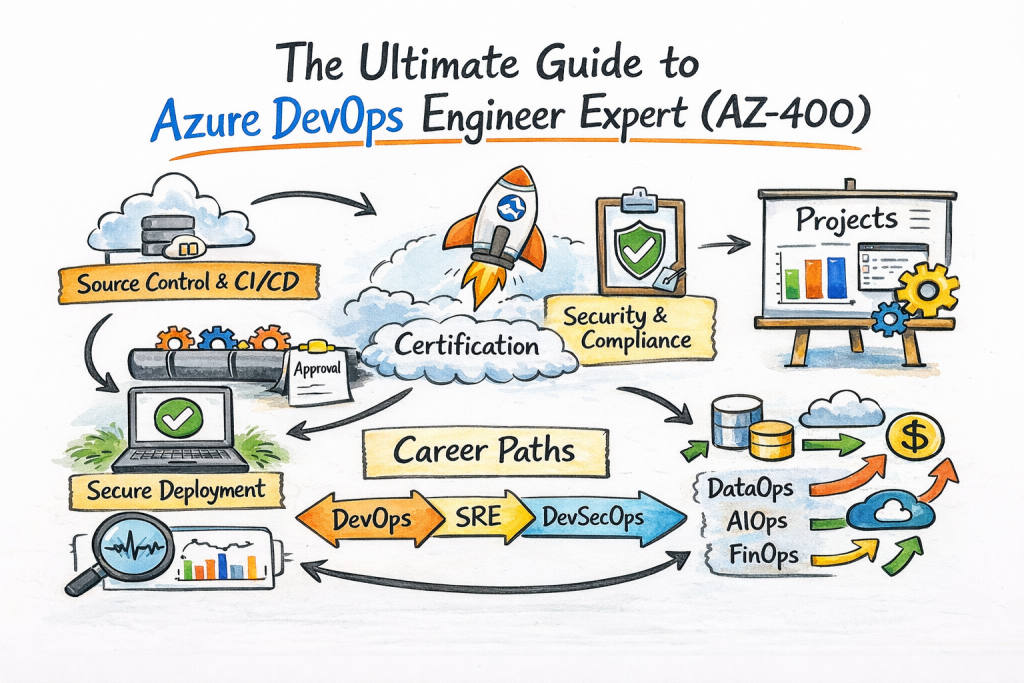
Introduction
The landscape of software delivery and infrastructure management has fundamentally shifted. Today, engineering teams are expected to ship faster, secure code earlier, and maintain unshakeable reliability. In the Microsoft Azure ecosystem, the ultimate validation of your ability to orchestrate this culture and technology is the Azure DevOps Engineer Expert (AZ-400) certification. Whether you are a software engineer looking to master CI/CD pipelines, a system administrator transitioning into cloud automation, or an engineering manager aiming to streamline your team’s delivery lifecycle, this certification is your roadmap. It bridges the gap between development and operations, proving you can design and implement strategies for collaboration, source control, security, continuous integration, and continuous delivery (CI/CD). This master guide breaks down everything you need to know about the AZ-400 certification, how to prepare, where to train, and how it accelerates your career progression across modern IT operations domains.
The Microsoft Azure DevOps Certification Landscape
To understand where the AZ-400 fits, you must look at the prerequisite ecosystem. The table below outlines the primary path to achieving the DevOps Expert badge.
| Track | Level | Who it’s for | Prerequisites | Skills covered | Recommended order |
|---|---|---|---|---|---|
| Azure Administration | Associate | System Administrators, Infrastructure Engineers | None (AZ-900 recommended) | Compute, Storage, Networking, Identity (Entra ID), Governance | 1 (Option A) |
| Azure Developer | Associate | Software Engineers, Cloud Application Developers | None (AZ-900 recommended) | Azure Compute, Cloud Storage, Azure Security, App Monitoring | 1 (Option B) |
| Azure DevOps | Expert | DevOps Engineers, SREs, Cloud Architects, Managers | AZ-104 OR AZ-204 | CI/CD, IaC, DevSecOps, Source Control, Continuous Feedback | 2 |
Deep Dive: Azure DevOps Engineer Expert (AZ-400)
What it is
The AZ-400 is an expert-level certification that validates your ability to design and implement DevOps processes and practices. It tests your proficiency in streamlining delivery by optimizing practices, improving communications, and creating automated CI/CD pipelines on Microsoft Azure.
Who should take it
This certification is designed for cloud professionals, developers, and system administrators who have hands-on experience administering or developing in Azure. It is highly recommended for working engineers aiming for senior DevOps roles, as well as engineering managers (both in India and globally) who oversee cloud transformations and need to standardize deployment practices.
Skills you’ll gain
- Designing and implementing enterprise-grade source control strategies using Azure Repos and GitHub.
- Creating robust, automated Continuous Integration (CI) and Continuous Delivery (CD) pipelines.
- Managing infrastructure as code (IaC) using tools like Azure Resource Manager (ARM) templates, Bicep, and Terraform.
- Integrating security and compliance into the delivery lifecycle (shifting left/DevSecOps).
- Implementing continuous feedback and monitoring mechanisms using Azure Monitor and Application Insights.
- Formulating effective site reliability engineering (SRE) and health-tracking strategies.
Real-world projects you should be able to do after it
- End-to-End Microservices Pipeline: Build a fully automated pipeline that compiles code, runs unit tests, builds Docker containers, and deploys them to Azure Kubernetes Service (AKS).
- Automated Infrastructure Provisioning: Write modular Terraform or Bicep scripts to dynamically spin up secure, compliant staging and production environments directly from a Git commit.
- DevSecOps Implementation: Integrate automated static application security testing (SAST), dependency scanning, and secret management (Azure Key Vault) into existing build pipelines.
- Observability Dashboard Setup: Configure custom monitoring dashboards that aggregate metrics, logs, and alerts, providing immediate feedback to development teams on application performance.
Preparation plan
Your timeline depends entirely on your daily hands-on exposure to Azure.
- 7–14 days (For Experienced DevOps Practitioners): Focus purely on the exam syllabus and Microsoft documentation. You already know the concepts; your goal is to map your knowledge to Microsoft’s specific terminology. Take high-quality practice exams to identify minor knowledge gaps.
- 30 days (For Azure Admins/Developers transitioning): Dedicate week one to source control and CI/CD basics. Spend week two building actual pipelines. Use week three to master Infrastructure as Code (IaC) and DevSecOps integrations. Reserve the final week for review and mock exams.
- 60 days (For Beginners with prerequisites): Take a structured training program from a provider like DevOpsSchool. Spend the first month mastering the theory and basic lab work. Dedicate the second month to complex, multi-stage pipeline projects and deep-dive troubleshooting.
Common mistakes
- Ignoring the Prerequisites: Attempting AZ-400 without a solid grasp of Azure Administration (AZ-104) or Development (AZ-204) leads to failure, as the exam assumes you understand underlying Azure services.
- Focusing Only on Theory: The exam is highly scenario-based. If you haven’t built pipelines or written IaC code in the Azure Portal or via CLI, the case studies will confuse you.
- Overlooking Third-Party Integrations: Azure DevOps doesn’t exist in a vacuum. Neglecting how GitHub, Terraform, SonarQube, and Jenkins integrate with Azure will cost you valuable points.
- Underestimating Security: DevSecOps is a major pillar of this exam. Treating security as an afterthought rather than an integrated pipeline step is a critical error.
Best next certification after this
1. The Cloud-Native Route: Certified Kubernetes Administrator (CKA)
The CKA takes you beyond deploying to AKS and teaches you the deep internals of managing, securing, and troubleshooting the Kubernetes clusters themselves. Combining AZ-400 pipeline automation with CNCF-certified container orchestration makes you a highly sought-after, elite Platform Engineer.
2. The Enterprise Architecture Route: Azure Solutions Architect Expert (AZ-305)
While AZ-400 focuses on how to deliver applications, AZ-305 focuses on what to build by covering macro-level compute, network, and storage design. Holding both expert badges positions you as a Principal Cloud Architect who designs global systems and builds the automated pipelines to deliver them.
3. The DevSecOps Route: GitHub Advanced Security or SC-100
Specializing in security guarantees long-term career resilience by teaching you to build zero-trust delivery pipelines that pass rigorous compliance audits. The GitHub Advanced Security certification deepens your CI/CD code scanning skills, while the SC-100 (Cybersecurity Architect) focuses on enterprise-wide cloud security posture.
Choose Your Path
The AZ-400 is not a dead end; it is a gateway. DevOps has evolved into specialized disciplines. Here is how the knowledge gained from AZ-400 applies to six distinct career paths:
1. DevOps
This is the most direct path. AZ-400 solidifies your foundational ability to break down silos between development and operations. You will use Azure Boards for agile planning, Azure Repos for code management, and Azure Pipelines to automate the delivery of business value directly to the customer.
2. DevSecOps
Security can no longer be a gatekeeper at the end of the release cycle. By mastering AZ-400, you learn how to “shift left.” You will apply this path by integrating tools like GitHub Advanced Security, automated credential scanning, and policy-as-code (Azure Policy) directly into the CI/CD pipelines you design.
3. SRE (Site Reliability Engineering)
While DevOps focuses on delivery speed, SRE focuses on reliability and error budgets. The monitoring, continuous feedback, and infrastructure automation skills covered in AZ-400 are vital for an SRE. You will use these skills to build auto-remediation scripts, scale infrastructure dynamically, and ensure maximum uptime for Azure-hosted services.
4. AIOps / MLOps
Artificial Intelligence and Machine Learning require deployment pipelines just like traditional software. The AZ-400 provides the automation framework necessary for MLOps. You will use Azure DevOps alongside Azure Machine Learning to automate model training, testing, and deployment, ensuring data scientists can ship models reliably.
5. DataOps
Data engineering teams need agile methodologies and automated deployments for data pipelines. The IaC and version control concepts from AZ-400 allow you to apply software engineering best practices to data architecture, automating the deployment of Azure Data Factory, Databricks, and Synapse Analytics environments.
6. FinOps
Cloud spending can easily spiral out of control without automation. FinOps blends financial accountability with cloud engineering. The infrastructure-as-code skills from AZ-400 allow FinOps practitioners to embed cost-control tags, automate resource shutdowns during off-hours, and deploy cost-optimized architecture programmatically.
Role → Recommended Certifications Mapping
To build a robust IT operations career, you need the right mix of certifications for your specific job title.
| Your Role | Recommended Certifications Path |
|---|---|
| DevOps Engineer | AZ-104 → AZ-400 → CKA (Kubernetes) |
| SRE (Site Reliability Engineer) | AZ-104 → AZ-400 → Certified SRE Professional |
| Platform Engineer | AZ-400 → CKA → Terraform Associate |
| Cloud Engineer | AZ-900 → AZ-104 → AZ-305 (Architect) |
| Security Engineer | AZ-500 (Security) → AZ-400 (DevSecOps focus) |
| Data Engineer | DP-203 (Data Engineer) → AZ-400 (DataOps focus) |
| FinOps Practitioner | AZ-900 → FinOps Certified Practitioner → AZ-400 |
| Engineering Manager | AZ-900 → AZ-400 → Certified DevOps Manager |
Next Certifications to Take
After conquering the AZ-400, you should strategically choose your next certification based on your long-term career trajectory.
1. Same Track (Deepening Expertise): GitHub Administration / Advanced Security
Microsoft is heavily integrating GitHub into the Azure ecosystem. Earning certifications in GitHub Actions and GitHub Advanced Security perfectly complements your Azure DevOps knowledge, making you a master of modern Microsoft-stack CI/CD.
2. Cross-Track (Broadening Technology): Certified Kubernetes Administrator (CKA)
Containers are the standard for modern deployments. While AZ-400 teaches you how to deploy to Kubernetes, the CKA teaches you how to manage, secure, and troubleshoot the Kubernetes cluster itself. This combination makes you an unstoppable force in platform engineering.
3. Leadership Track (Moving to Management): Certified DevOps Manager
If your goal is to move away from the keyboard and into engineering leadership, pursue management-level frameworks. A certification in DevOps Management or Enterprise Architecture (like TOGAF) will teach you how to scale the practices you learned in AZ-400 across an entire global organization.
Top Institutions for AZ-400 Training & Certification
Navigating the complexities of Azure DevOps requires hands-on guidance. The following institutions are industry leaders in providing practical, project-based training for the AZ-400 and related IT operations disciplines:
DevOpsSchool
DevOpsSchool is a global pioneer in IT operations training, offering highly interactive, expert-led sessions. They focus heavily on real-world scenarios, ensuring that you don’t just pass the AZ-400 exam, but actually know how to build enterprise-grade pipelines.
Cotocus
Cotocus stands out by blending consulting expertise with rigorous training programs. Their instructors bring immediate, real-world cloud transformation challenges into the classroom, preparing engineers for the exact scenarios they will face in global enterprise environments.
Scmgalaxy
Scmgalaxy is a community-driven powerhouse that provides extensive resources, forums, and structured learning paths for software configuration management and DevOps. Their training is highly practical, focusing on the day-to-day tools and scripts that engineers actually use in production.
BestDevOps
BestDevOps focuses on delivering streamlined, high-impact learning experiences for busy IT professionals. Their curriculum is strictly aligned with industry demands, stripping away fluff to ensure candidates grasp core CI/CD and cloud automation concepts quickly and effectively.
devsecopsschool.com
Dedicated entirely to the intersection of security and operations, this institution is perfect for engineers looking to master the “shift-left” paradigm. Their training emphasizes embedding security gates, vulnerability scanning, and compliance into Azure pipelines seamlessly.
sreschool.com
Focused on Site Reliability Engineering, this platform teaches engineers how to apply software engineering principles to infrastructure and operations problems. They provide deep-dive training on observability, incident management, and building highly available systems.
aiopsschool.com
As AI continues to transform IT operations, AIOpsSchool provides cutting-edge training on automating anomaly detection, intelligent alerting, and predictive maintenance. They help forward-thinking engineers integrate machine learning into their daily operational workflows.
dataopsschool.com
Specializing in the automation of data pipelines, this institution bridges the gap between data engineering and DevOps. They train professionals on how to version control, test, and deploy massive data workloads with the same rigor used in traditional software development.
finopsschool.com
Cloud cost management is a critical engineering skill. FinOpsSchool provides specialized training on cloud financial management, teaching engineers and managers how to optimize Azure spend, implement resource tagging, and design cost-aware automated architectures.
Frequently Asked Questions (FAQs)
1. How difficult is the AZ-400 exam?
The exam is considered highly difficult because it requires a blend of development, infrastructure, and security knowledge. It is heavily scenario-based, meaning theoretical knowledge alone is not enough; you must have hands-on experience configuring pipelines and infrastructure.
2. Do I absolutely need AZ-104 or AZ-204 before taking AZ-400?
Yes. Microsoft requires you to hold either the Azure Administrator Associate (AZ-104) or Azure Developer Associate (AZ-204) certification to earn the Azure DevOps Engineer Expert badge.
3. How much time does it take to prepare?
For an engineer with active DevOps experience, 2 to 4 weeks of focused study on Azure-specific tooling is usually sufficient. Beginners should expect to spend 2 to 3 months to fully grasp both the concepts and the hands-on lab work.
4. What is the difference between Azure DevOps and GitHub?
Azure DevOps is an all-in-one suite (Boards, Repos, Pipelines, Artifacts) optimized for enterprise project management. GitHub is heavily focused on source control, open-source collaboration, and increasingly, GitHub Actions for CI/CD. The AZ-400 exam covers integrating both.
5. Will the AZ-400 certification increase my salary?
Yes. In both the Indian and global markets, the “Expert” badge demonstrates high-level capability. Certified DevOps Engineers consistently command premium salaries compared to standard system administrators or developers.
6. Does the AZ-400 certification expire?
Yes, Microsoft role-based certifications expire after one year. However, you can renew them for free by taking an online assessment on Microsoft Learn before your certification expiration date.
7. Do I need to be a programmer to pass?
You do not need to be a full-stack software developer, but you absolutely must understand scripting. Proficiency in PowerShell, Bash, YAML (for pipelines), and JSON/Bicep/Terraform (for infrastructure) is mandatory.
8. Can an Engineering Manager benefit from taking AZ-400?
Absolutely. While managers may not write code daily, understanding the capabilities, limitations, and security integrations of Azure DevOps allows them to design better engineering workflows, estimate project timelines accurately, and lead technical teams effectively.
9. What happens if I fail the exam?
If you fail the first time, you must wait 24 hours before retaking it. If you fail a second time, a 14-day waiting period applies for subsequent attempts. Focus on the score report to identify your weak domains.
10. How much does the AZ-400 exam cost?
The cost varies by region. In the United States, it is typically $165 USD. In India, the cost is historically around ₹4,800 INR, plus applicable taxes. Always check the official Microsoft page for current local pricing.
11. Does the exam cover third-party tools outside of Microsoft?
Yes. You are expected to understand how to integrate third-party tools into Azure DevOps, including Jenkins, SonarQube, Terraform, Docker, and various open-source security scanning tools.
12. Is the AZ-400 globally recognized?
Yes, it is one of the most highly respected, globally recognized credentials in the cloud industry. It carries significant weight with enterprise companies and global system integrators that rely on the Microsoft technology stack.
FAQs: Azure DevOps Engineer Expert (AZ-400)
Q1. What exactly is the Azure DevOps Engineer Expert (AZ-400) certification?
The AZ-400 is an Expert-level Microsoft certification that validates your ability to design, implement, and manage enterprise-grade DevOps practices on the Azure platform. It covers the full software delivery lifecycle — from source control strategy and CI/CD pipeline design to infrastructure as code, DevSecOps integration, and continuous monitoring. It is the most recognized DevOps-specific credential in the Microsoft certification ecosystem and is respected by enterprise employers across India and globally.
Q2. Who is the ideal candidate for the AZ-400 exam?
The ideal candidate is an experienced cloud professional who works at the intersection of software development and IT operations — someone who actively builds pipelines, manages Azure infrastructure, and is responsible for the reliability and security of software delivery processes. It is equally relevant for software engineers who want to own the full application lifecycle, system administrators transitioning into cloud automation roles, and engineering managers leading DevOps transformation programs. If your daily work involves Azure services and you want a globally recognized credential to formalize that expertise, the AZ-400 is built for you.
Q3. Is the AZ-400 exam hard to pass?
Yes, the AZ-400 is widely considered one of the most challenging certifications in the Microsoft portfolio because it demands real, hands-on experience across multiple disciplines simultaneously — CI/CD, IaC, security, containers, and monitoring. The exam is scenario-based and tests your ability to analyze complex enterprise situations and choose the most optimal technical solution under constraints. Candidates who rely purely on theoretical study without actual pipeline-building and lab experience consistently underperform. The exam rewards genuine practitioners who have solved real DevOps problems in production Azure environments.
Q4. What are the prerequisites required for the AZ-400?
Microsoft requires you to hold either the Azure Administrator Associate (AZ-104) or the Azure Developer Associate (AZ-204) certification before the AZ-400 Expert badge will be issued. Beyond the formal certification prerequisites, you should also have hands-on experience with Azure Pipelines or GitHub Actions, working knowledge of source control systems like Git, familiarity with IaC tools such as Terraform or Bicep, and a solid understanding of containerization using Docker and Kubernetes. These prerequisites are not bureaucratic formalities — the AZ-400 exam genuinely assumes this foundational knowledge at every turn.
Q5. How long does it take to prepare for the AZ-400?
Preparation time varies significantly based on your existing hands-on experience with Azure services and DevOps tooling. Active DevOps practitioners already working with Azure Pipelines daily can be exam-ready in 2 to 4 weeks of focused preparation. Engineers transitioning from Azure administration or development backgrounds should budget 4 to 6 weeks for thorough preparation, including dedicated lab time. Complete beginners who have recently earned their associate prerequisites should plan for 2 to 3 months of structured learning. Regardless of timeline, consistent hands-on lab practice building real pipelines and IaC scripts is far more valuable than passive video watching or reading documentation alone.
Q6. What is the career impact of earning the AZ-400 certification?
The career impact is substantial and immediate. In India, AZ-400 certified engineers consistently command salaries 30 to 50 percent higher than non-certified peers in similar experience bands, particularly at companies where Azure is the primary cloud platform. Globally, the certification opens access to senior engineer, principal engineer, and cloud architect roles that are frequently gated behind Expert-level credentials by enterprise hiring teams. Beyond salary, the AZ-400 significantly improves your credibility in technical interviews, architectural reviews, and leadership conversations, because it signals that your DevOps knowledge has been formally validated against a rigorous, industry-recognized benchmark.
Q7. How often does the AZ-400 exam content get updated?
Microsoft regularly reviews and updates its certification exam content to keep pace with the rapidly evolving Azure platform and industry DevOps practices, typically releasing updates every 6 to 12 months. These updates can include the addition of new service integrations — such as changes related to GitHub Actions workflows, Bicep templates, or updated Azure Monitor capabilities — as well as removal of outdated content that no longer reflects current industry practices. Before you begin your preparation, always download and review the latest official Exam Skills Outline from the Microsoft Learn website to ensure your study plan aligns with the current exam objectives rather than outdated learning materials.
Q8. What are the most common topics that candidates struggle with in the AZ-400?
Based on real-world exam feedback from thousands of test-takers, there are four consistently challenging areas. First, multi-stage YAML pipeline design — many engineers are comfortable with the classic editor but struggle with complex YAML syntax, templates, and conditional stages under exam pressure. Second, Infrastructure as Code integration — specifically understanding when to use ARM templates vs. Bicep vs. Terraform in different enterprise scenarios. Third, DevSecOps and compliance integrations — embedding security gates, managing secrets with Azure Key Vault, and configuring branch protection policies is frequently underestimated during preparation.
Testimonials
“Transitioning from a traditional sysadmin to a cloud role felt overwhelming. Earning the AZ-104 and then pushing through the AZ-400 completely transformed my career. The hands-on pipeline knowledge I gained allowed me to automate weeks of manual server configurations into a 10-minute deployment.”
— Rajesh K., Senior Platform Engineer
“As an Engineering Manager handling distributed teams across India and the US, standardizing our release process was a nightmare. Preparing for the AZ-400 gave me the architectural blueprint to implement DevSecOps properly. Our deployment failures dropped by 80% within three months.”
— Sarah M., Director of Cloud Operations
“I was already writing code, but I had no idea how it got to production. The AZ-400 taught me the operations side of the house. Learning ARM templates, YAML pipelines, and Azure Kubernetes Service integration made me a much more valuable, full-lifecycle software engineer.”
— David L., Lead Software Developer
Conclusion
The Azure DevOps Engineer Expert (AZ-400) is much more than a credential; it is proof that you understand the modern pulse of software engineering. It validates your ability to eliminate bottlenecks, automate tedious infrastructure tasks, and weave security into the fabric of your code delivery. Whether you are aiming to become an elite hands-on engineer or an insightful technical leader, mastering these skills will make you an indispensable asset to any global organization. Start building your pipelines, embrace continuous learning, and take the next definitive step in your IT operations career.