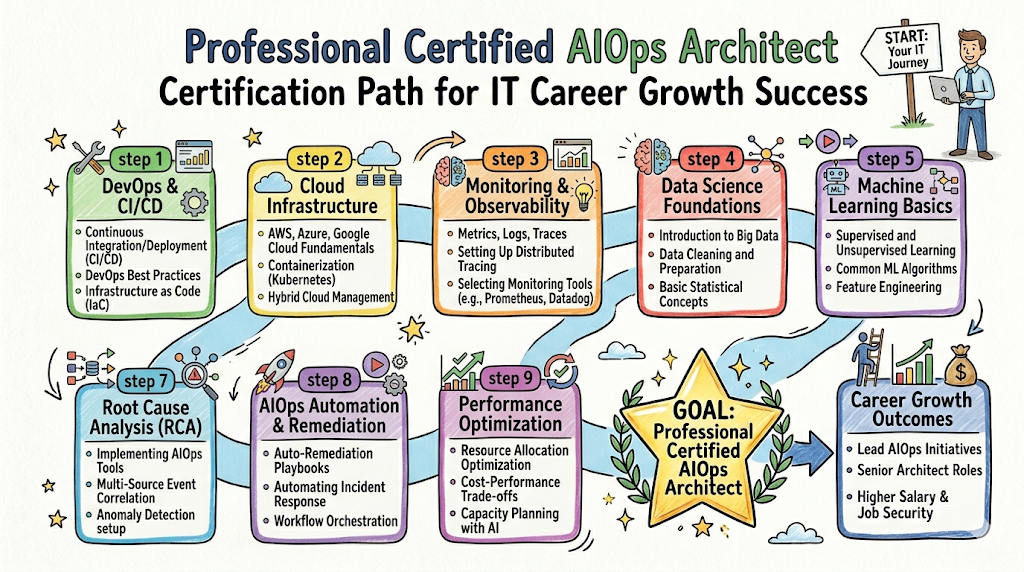
The shift toward algorithmic IT operations is no longer a luxury but a necessity for modern enterprise environments. The Certified AIOps Architect program is a comprehensive curriculum designed to bridge the gap between traditional site reliability engineering and artificial intelligence. This guide is built for professionals who want to move beyond manual monitoring into the realm of predictive, self-healing systems. It positions individuals at the forefront of cloud-native evolution by teaching them how to apply machine learning to telemetry data. By following this guide, engineers and managers can navigate the complexities of AIOps without getting lost in the hype. We provide a clear roadmap for career decisions, ensuring that you invest your time in skills that translate to production-grade stability. Whether you are managing a massive microservices architecture or scaling a platform team, understanding AIOps is the next logical step in your professional journey. You can learn more about this specialization at Aioopsschool which hosts the official Certified AIOps Architect program for global professionals.
What is the Certified AIOps Architect?
The Certified AIOps Architect represents the pinnacle of modern operational excellence, focusing on the integration of big data, machine learning, and automation. It exists to address the “data fatigue” that occurs when human operators are overwhelmed by the sheer volume of logs, metrics, and traces generated by distributed systems. Rather than focusing on simple dashboarding, this certification emphasizes the creation of intelligent systems that can identify patterns and remediate issues before they impact the end user.
In a real-world production environment, theory often falls short, which is why this program prioritizes practical implementation over abstract concepts. It aligns perfectly with modern engineering workflows by treating operational data as a first-class citizen in the software development lifecycle. Enterprise practices now demand a “shift-left” approach to observability, and this certification provides the framework to build that infrastructure. It turns the noise of a chaotic environment into actionable insights that drive business value.
Who Should Pursue Certified AIOps Architect?
This certification is designed for a broad spectrum of technical professionals who are responsible for system uptime and performance. DevOps engineers, Site Reliability Engineers (SREs), and Cloud Architects will find the content most directly applicable to their daily tasks. Additionally, security professionals who need to detect anomalies in network traffic and data engineers who manage the pipelines feeding into observability platforms will gain significant value from the curriculum.
Beyond individual contributors, engineering managers and technical leaders should pursue this path to understand the strategic benefits of AI-driven operations. For beginners, it provides a structured entry point into the world of intelligent automation, while experienced engineers can use it to formalize their knowledge of advanced pattern recognition. In both the Indian market and the global landscape, there is a massive demand for professionals who can reduce Mean Time To Repair (MTTR) using automated, intelligent systems.
Why Certified AIOps Architect is Valuable
The demand for AIOps expertise is surging as enterprises realize that traditional monitoring cannot keep pace with ephemeral cloud-native architectures. This certification provides longevity to your career because it focuses on the underlying logic of data analysis and automation rather than specific, fleeting tools. As toolsets evolve, the architectural principles of AIOps remain constant, allowing you to adapt to new technologies with minimal friction.
Investing in this certification offers a high return on time because it addresses the most expensive problems in IT: downtime and inefficient resource allocation. Companies are actively seeking architects who can implement FinOps-aligned AIOps to optimize cloud spend and SRE-aligned AIOps to improve reliability. By mastering these skills, you become an indispensable asset to any organization looking to scale its digital operations without linear growth in headcount.
Certified AIOps Architect Certification Overview
The Certified AIOps Architect program is a structured learning path delivered via the official educational portals and hosted on the Aioopsschool platform. The program is designed to be rigorous yet accessible, utilizing a multi-level assessment approach that includes both theoretical exams and hands-on lab projects. This ensures that a certified individual does not just know the terminology but can actually execute a deployment strategy.
Ownership of the program lies with a consortium of industry experts who have managed some of the world’s largest distributed systems. The structure is broken down into modular components, covering everything from data ingestion and cleaning to model training and automated incident response. It is a vendor-neutral program, meaning the skills you learn can be applied to any major cloud provider or on-premises environment. This practical ownership model makes it one of the most respected credentials in the field today.
Certified AIOps Architect Certification Tracks & Levels
The certification is structured into three primary levels: Foundation, Professional, and Advanced. The Foundation level introduces the core concepts of machine learning in the context of IT operations, making it ideal for those transitioning from traditional roles. The Professional level dives deep into the implementation of anomaly detection and event correlation, while the Advanced level focuses on architecting end-to-end self-healing platforms.
Specialization tracks allow professionals to tailor their learning to their specific career goals, whether that involves DevOps, SRE, or even FinOps. These tracks ensure that the AIOps principles are applied in a way that makes sense for the individual’s role. As you progress through the levels, you move from understanding how models work to designing complex systems that can autonomously manage entire clusters of applications.
Complete Certified AIOps Architect Certification Table
| Track | Level | Who it’s for | Prerequisites | Skills Covered | Recommended Order |
| AIOps Core | Foundation | Aspiring Engineers | Basic Linux/Cloud | Data ingestion, basic ML, Observability | 1 |
| AIOps Core | Professional | Senior DevOps/SRE | Foundation Level | Anomaly detection, Event correlation | 2 |
| AIOps Core | Advanced | Lead Architects | Professional Level | Self-healing systems, LLMs for Ops | 3 |
| SRE Track | Professional | Reliability Leads | SRE experience | Error budget automation, Predictive scaling | 2 |
| FinOps Track | Professional | Cloud Financial Ops | Cloud Cost mgmt | AI-driven cost optimization, Forecasting | 2 |
| Security Track | Professional | SecOps Engineers | Basic Security | Threat detection, Automated response | 2 |
Detailed Guide for Each Certified AIOps Architect Certification
Certified AIOps Architect – Foundation
What it is
This certification validates a candidate’s understanding of the fundamental building blocks of AIOps. It covers the basic terminology, the data lifecycle, and how AI differs from traditional rule-based monitoring.
Who should take it
This is suitable for junior engineers, helpdesk professionals moving into DevOps, or managers who need a high-level technical understanding of the field.
Skills you’ll gain
- Understanding the AIOps data pipeline.
- Differentiating between metrics, logs, and traces.
- Basic knowledge of supervised vs. unsupervised learning for IT.
- Identifying use cases for automation in IT operations.
Real-world projects you should be able to do
- Setting up a basic centralized logging system.
- Creating a data ingestion pipeline from a cloud provider.
- Mapping out an incident management workflow.
Preparation plan
Explain 7–14 days for quick review, 30 days for intermediate study, and 60 days for deep conceptual mastery. The focus should be on understanding the vocabulary of AIOps and the basic flow of telemetry data from source to dashboard.
Common mistakes
- Overcomplicating the machine learning aspect before understanding the data source.
- Skipping the fundamentals of observability.
Best next certification after this
- Same-track option: Certified AIOps Architect – Professional
- Cross-track option: Certified SRE Professional
- Leadership option: Engineering Management Foundation
Certified AIOps Architect – Professional
What it is
The Professional level focuses on the implementation of AIOps solutions. It validates the ability to build and deploy models that can detect anomalies and reduce alert fatigue through intelligent correlation.
Who should take it
Mid-to-senior level DevOps engineers, SREs, and Platform engineers who are actively working in production environments.
Skills you’ll gain
- Implementing algorithmic anomaly detection.
- Building event correlation engines to reduce noise.
- Automating Root Cause Analysis (RCA) using AI models.
- Integrating AIOps tools into existing CI/CD pipelines.
Real-world projects you should be able to do
- Deploying a system that identifies “silent” failures in microservices.
- Reducing alert volume by 50% through intelligent grouping.
- Creating an automated rollback mechanism based on performance regressions.
Preparation plan
Explain 7–14 days of intensive tool review, 30 days of lab-based implementation, and 60 days for integrating models into a staging environment. This level requires significant hands-on coding and configuration.
Common mistakes
- Neglecting data quality and “garbage-in, garbage-out” scenarios.
- Building models that are too complex to maintain in production.
Best next certification after this
- Same-track option: Certified AIOps Architect – Advanced
- Cross-track option: Certified FinOps Professional
- Leadership option: Technical Program Manager (TPM) in Infrastructure
Certified AIOps Architect – Advanced
What it is
This is the highest level of certification, focusing on the architectural design of global-scale, autonomous systems. It validates the ability to lead the AIOps transformation within a large enterprise.
Who should take it
Principal engineers, Chief Architects, and Technical Directors who are responsible for long-term infrastructure strategy.
Skills you’ll gain
- Designing self-healing infrastructure architectures.
- Implementing Generative AI and LLMs for operational assistance.
- Governance and ethical considerations of AI in IT.
- Multi-cloud AIOps orchestration and strategy.
Real-world projects you should be able to do
- Architecting a global observability platform for a Fortune 500 company.
- Leading a team to implement a full-stack self-healing remediation system.
- Developing a cost-optimization engine that predicts future cloud spend.
Preparation plan
Explain 7–14 days for high-level strategy review, 30 days for case study analysis, and 60 days for a comprehensive capstone architectural project. This level is more about strategy than syntax.
Common mistakes
- Focusing only on the technology while ignoring the cultural shift required for AIOps.
- Failing to align the AIOps strategy with specific business KPIs.
Best next certification after this
- Same-track option: Specialized Research Fellowships
- Cross-track option: Certified Data Architect
- Leadership option: CTO or VP of Engineering credentials
Choose Your Learning Path
DevOps Path
The DevOps path focuses on integrating AIOps into the continuous delivery pipeline. This ensures that performance data from production is fed back into the development cycle to improve code quality. Engineers on this path will learn how to use AI to predict how a new code release will impact system stability. The goal is to create a seamless feedback loop where AI acts as a quality gate for deployments.
DevSecOps Path
In the DevSecOps path, the emphasis is on using AIOps for security orchestration and automated response. This involves identifying unusual patterns in network traffic or user behavior that might indicate a breach. Professionals will learn to automate the isolation of compromised resources using intelligent triggers. This path turns security from a reactive bottleneck into a proactive, AI-driven guardian of the infrastructure.
SRE Path
The Site Reliability Engineering (SRE) path is perhaps the most natural fit for AIOps. It focuses on using data to maintain Service Level Objectives (SLOs) and manage error budgets more effectively. SREs will learn how to automate the toil of manual incident response by building predictive models that anticipate resource exhaustion. This path is essential for those managing high-availability systems where every second of downtime is costly.
AIOps Path
The pure AIOps path is for those who want to specialize entirely in the intersection of AI and operations. This focuses heavily on the underlying machine learning models and data engineering required to sustain an intelligent platform. Professionals will study various algorithms for time-series forecasting and natural language processing for log analysis. It is a deep technical dive into making infrastructure truly “smart” from the ground up.
MLOps Path
The MLOps path focuses on the operationalization of machine learning models themselves. This is a “meta” path where AIOps principles are applied to ensure that ML models are performing correctly and not drifting over time. It covers the lifecycle of a model from training to deployment and monitoring. Engineers here are responsible for the infrastructure that allows other AI models to thrive within the organization.
DataOps Path
The DataOps path focuses on the integrity and flow of data that powers AIOps. Without clean, reliable data, AI models are useless. This path teaches professionals how to build resilient data pipelines that can handle the massive throughput of modern telemetry. It bridges the gap between traditional database administration and modern real-time streaming analytics.
FinOps Path
The FinOps path uses AIOps to bring financial accountability to the cloud. By using predictive analytics, professionals can forecast future cloud spending and identify areas where resources are being wasted. AI can automatically adjust scaling parameters to ensure that performance is maintained at the lowest possible cost. This path is becoming increasingly critical as cloud budgets continue to grow in complexity.
Role → Recommended Certified AIOps Architect Certifications
| Role | Recommended Certifications |
| DevOps Engineer | Foundation, Professional (DevOps Track) |
| SRE | Professional (SRE Track), Advanced |
| Platform Engineer | Professional (AIOps Track), Advanced |
| Cloud Engineer | Foundation, Professional (FinOps Track) |
| Security Engineer | Professional (Security Track) |
| Data Engineer | Professional (DataOps Track) |
| FinOps Practitioner | Professional (FinOps Track) |
| Engineering Manager | Foundation, Leadership Workshops |
Next Certifications to Take After Certified AIOps Architect
Same Track Progression
After completing the Certified AIOps Architect levels, the best way to progress is to seek deep specialization in specific AI technologies. This might include certifications in Deep Learning or specialized natural language processing if you are focusing on log analysis. You should also look for advanced certifications in specific cloud platforms that focus on their native AI/ML services. Deepening your knowledge in the same track ensures you remain the go-to expert for complex operational challenges.
Cross-Track Expansion
If you have mastered AIOps, expanding into MLOps or DataOps is a logical next step to broaden your skill set. Understanding how to manage the data that feeds your AIOps engine or how to operationalize the models themselves makes you a more versatile architect. Cross-training in FinOps is also highly recommended, as it allows you to speak the language of both engineering and finance. This breadth of knowledge is what separates a senior engineer from a principal-level leader.
Leadership & Management Track
For those looking to move into management, the next step is to pursue certifications that focus on organizational transformation and strategy. Leading an AIOps initiative requires more than just technical skill; it requires the ability to manage change and demonstrate ROI to stakeholders. Certifications in Agile leadership, Technical Program Management, or even an Executive MBA can help you transition into high-level decision-making roles. This track focuses on the “human” side of implementing advanced technology at scale.
Training & Certification Support Providers for Certified AIOps Architect
DevOpsSchool
DevOpsSchool stands as a premier global institution providing in-depth training across the entire spectrum of modern IT operations. With a focus on hands-on labs and real-world project simulations, they help professionals master the complexities of AIOps and cloud-native engineering. Their curriculum is meticulously updated to reflect the latest industry trends, ensuring that students are always learning the most relevant skills. The community-driven approach fosters collaboration and networking among engineers worldwide, making it a hub for career growth. Whether you are looking for foundation knowledge or advanced architectural strategies, DevOpsSchool provides the tools and expert mentorship needed to succeed in a competitive technical landscape.
Cotocus
Cotocus is a highly specialized training and consulting organization that focuses on high-end niche technologies like SRE, Cloud-native architecture, and AIOps. They pride themselves on delivering training that is deeply rooted in production-grade environments rather than just theoretical textbooks. Their instructors are industry veterans who bring years of experience from managing massive infrastructures at global scale. Cotocus offers customized corporate training programs that help entire engineering teams transition to intelligent, automated workflows. By focusing on deep-dive technical sessions and complex problem-solving, they ensure that their students are prepared for the most rigorous certification exams and professional challenges.
Scmgalaxy
Scmgalaxy has established itself as one of the most comprehensive knowledge repositories and training providers for DevOps and software configuration management. They offer a unique blend of community resources, tutorials, and professional certification programs that cater to all skill levels. Their focus on the practical implementation of CI/CD and observability makes them an ideal partner for anyone pursuing an AIOps career path. Scmgalaxy provides extensive study materials, community forums, and expert-led webinars that keep professionals informed about the latest toolsets and methodologies. Their long-standing presence in the industry makes their training programs highly respected by employers across the globe.
BestDevOps
BestDevOps is dedicated to providing streamlined and effective learning paths for professionals who want to accelerate their careers in the cloud and automation space. They offer a variety of certification prep courses that are specifically designed to be concise yet thorough. Their approach is focused on identifying the key skills that have the highest impact in the workplace today. BestDevOps provides a flexible learning environment, allowing engineers to balance their professional responsibilities with their educational goals. By offering targeted training in AIOps and related disciplines, they help students achieve certification quickly and with a high degree of confidence.
devsecopsschool.com
This platform is a leading authority on the integration of security into the modern DevOps lifecycle. They provide specialized training that explores how AIOps can be leveraged to create more secure and resilient systems. Their curriculum covers automated threat detection, security orchestration, and the use of AI for predictive security analytics. By bridging the gap between operations and security, they prepare professionals for high-demand roles in DevSecOps. Their courses are designed to be hands-on, ensuring that students can implement security automation tools and practices in real-world production environments with ease and precision.
sreschool.com
Sreschool.com is a dedicated educational platform focused entirely on the principles and practices of Site Reliability Engineering. They offer specialized courses that prepare professionals to manage the reliability, scalability, and performance of complex systems using AI and automation. Their curriculum is built around the core SRE tenets of error budgets, SLOs, and incident response automation. Students at sreschool.com benefit from the expertise of seasoned practitioners who have built and managed some of the world’s most resilient infrastructures. This focus on reliability makes them a critical resource for anyone pursuing the Certified AIOps Architect credential.
aiopsschool.com
Aiopsschool.com is the definitive source for AIOps education and the primary hosting site for the official architect certification program. They provide an exhaustive curriculum that covers everything from the fundamentals of machine learning to the design of self-healing infrastructures. Their platform is designed to provide a cohesive and structured learning journey, with access to cutting-edge tools and real-world datasets. As a specialized institution, they stay at the forefront of the AIOps movement, ensuring their students are equipped with the most advanced skills in the industry. They are the primary destination for those seeking deep expertise in algorithmic operations.
dataopsschool.com
Dataopsschool.com addresses the critical need for data integrity and efficient pipeline management in the world of intelligent operations. They provide specialized training on how to build and maintain the data infrastructures that power AIOps models. Their courses focus on data quality, real-time streaming, and the governance required to support large-scale AI initiatives. By teaching engineers how to treat operational data with the same rigor as application code, they ensure that AIOps systems are reliable and accurate. This data-centric approach is essential for any professional looking to master the technical foundations of AI-driven IT management.
finopsschool.com
Finopsschool.com is at the intersection of cloud engineering and financial management, offering training on how to use AI to optimize cloud spending. Their curriculum teaches professionals how to use AIOps principles to forecast costs, identify waste, and automate savings across multi-cloud environments. This specialized knowledge is increasingly valuable as organizations look to maximize the return on their cloud investments. By providing practical frameworks for cloud financial accountability, finopsschool.com helps engineers and managers align their technical strategies with business goals. Their courses are a vital component of a comprehensive education for modern cloud and platform architects.
Frequently Asked Questions (General)
- How difficult is the Certified AIOps Architect exam?The difficulty varies by level; the Foundation exam tests conceptual knowledge, while the Professional and Advanced exams require deep technical proficiency and hands-on experience.
- How much time does it take to get certified?Most candidates spend between 1 to 3 months per level, depending on their existing experience with cloud operations and data science principles.
- What are the prerequisites for the program?The Foundation level is open to everyone, but the Professional and Advanced levels generally require completion of the preceding tier and relevant industry experience.
- Does this certification cover specific tools like Splunk or Datadog?The program is vendor-neutral, focusing on the core architectural principles that apply across all modern observability and AIOps toolsets.
- Is there a recertification requirement?Yes, you must typically recertify every two to three years to ensure your skills stay aligned with the latest advancements in AI and automation.
- What is the ROI of becoming a Certified AIOps Architect?The ROI is reflected in higher salary potential, access to leadership roles, and the ability to solve the most complex operational challenges in the enterprise.
- Can I take the exam online?Yes, the exams are available through a proctored online format, making them accessible to professionals globally regardless of their location.
- How are the lab portions of the exam graded?Labs are graded based on your ability to achieve specific production-grade outcomes, such as successfully automating a remediation workflow or identifying an anomaly.
- Is this certification recognized globally?Yes, it is a globally recognized standard that validates an engineer’s ability to manage modern, high-scale infrastructures using intelligent automation.
- Are there group discounts for engineering teams?Most training providers associated with the program offer corporate packages and discounts for teams looking to upskill together.
- What kind of support is available during the learning process?Students have access to extensive documentation, community forums, and mentor support through the various affiliated training schools.
- How does this differ from a standard SRE certification?While SRE focuses on the practices of reliability, AIOps specifically focuses on the integration of artificial intelligence and machine learning to automate those practices.
FAQs on Certified AIOps Architect
- Which programming languages are most useful for this certification?Python is the primary language used in the curriculum due to its extensive libraries for data science and automation, though some shell scripting is also expected.
- How does AIOps improve Mean Time To Repair (MTTR)?It reduces MTTR by using automated correlation to identify the root cause of an issue instantly, often before a human operator could even investigate the alert.
- Can I skip the Foundation level if I have years of DevOps experience?While possible, it is not recommended as the Foundation level establishes the specific vocabulary and data science concepts unique to the AIOps framework.
- Is knowledge of big data platforms like Spark or Hadoop required?A basic understanding of data processing is helpful, but the course specifically teaches you the data engineering necessary for operational telemetry.
- Does the program cover AIOps for hybrid cloud environments?Yes, the architectural principles taught are designed to work across on-premises, private cloud, and public cloud environments simultaneously.
- What is the focus of the self-healing module in the Advanced track?It focuses on creating closed-loop automation where the system detects a failure, determines the fix, and executes the remediation without human intervention.
- How does the certification handle the ethical use of AI in operations?The Advanced track includes specific governance modules that discuss the importance of transparency and human-in-the-loop oversight for critical automated actions.
- Are there any local study groups in major tech hubs like Bangalore or London?Through the various training providers, students can access local and virtual study groups to collaborate with other professionals in their region.
Final Thoughts
From my perspective as a mentor who has seen the industry move from physical servers to complex distributed clouds, AIOps is not just another buzzword—it is the inevitable future of our profession. The human brain simply cannot process the volume of data our systems now produce. Choosing to become a Certified AIOps Architect is a choice to remain relevant in an era where automation is king.
If you are looking for a “quick win” or a certificate to just hang on your wall, this might not be for you. It requires a genuine commitment to learning new ways of thinking about data and systems. However, if you want to be the person who designs the systems that keep the digital world running while everyone else is drowning in alerts, then this is arguably the most valuable investment you can make in your career today. Focus on the labs, understand the data, and the professional growth will follow naturally.