Introduction
The Certified AIOps Manager program is a strategic credential designed for professionals who want to bridge the gap between traditional operations and AI-driven automation. This guide is crafted for engineers and leaders who recognize that manual intervention is no longer sustainable in complex, distributed cloud environments. By exploring this certification, you are choosing a path that prioritizes proactive system health and intelligent incident response over reactive firefighting.
In the current landscape of DevOps and platform engineering, the volume of telemetry data has surpassed human capacity for analysis. This guide helps you navigate the transition from a standard operations role to a more strategic, data-driven leadership position. We will analyze how this program fits into your existing career and how it prepares you for the next generation of infrastructure management. As we delve into the details, you will learn how to make an informed decision about your educational investments and career trajectory.
The certification is hosted on AIOpsSchool, a platform dedicated to advancing the standards of artificial intelligence for IT operations. Whether you are a seasoned SRE or a rising manager, understanding AIOps is no longer optional for those operating at scale. This article provides the roadmap you need to master these complex concepts and apply them effectively in enterprise environments.
What is the Certified AIOps Manager?
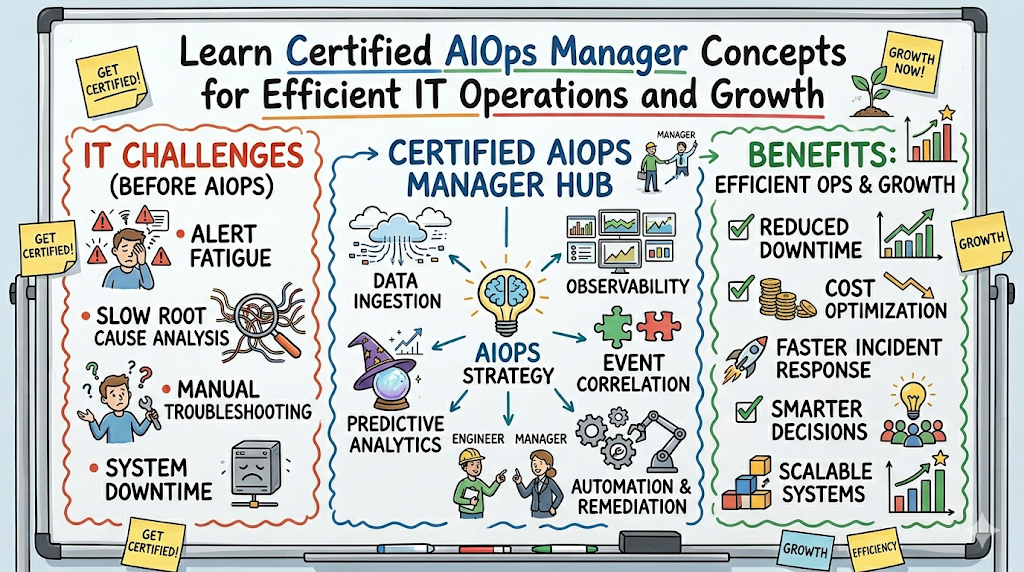
The Certified AIOps Manager is a professional designation that validates an individual’s ability to design, implement, and oversee AI-driven IT operations. It represents a shift from legacy monitoring to intelligent observability, where machine learning models are used to predict and resolve issues before they impact end users. This program exists because modern enterprises require a specific set of skills that combine data science principles with robust infrastructure management.
Unlike theoretical courses, this certification focuses on real-world application within production environments. It addresses the practical challenges of data silos, alert fatigue, and root cause analysis in microservices architectures. Professionals who hold this title are expected to understand how to integrate AI tools into existing DevOps pipelines to enhance efficiency and reliability.
Furthermore, it aligns with modern engineering workflows by emphasizing the automation of repetitive operational tasks. It provides a framework for selecting the right algorithms for anomaly detection and event correlation. By focusing on enterprise practices, the certification ensures that managers can drive digital transformation without sacrificing stability or security.
Who Should Pursue Certified AIOps Manager?
This program is primarily designed for experienced DevOps engineers, Site Reliability Engineers (SREs), and Cloud Architects who want to advance into leadership roles. It is equally beneficial for Platform Engineers who are tasked with building the internal tools that support high-velocity development teams. Security and Data professionals will also find value in learning how AI can be leveraged to monitor system integrity and data pipeline health.
Beginners who have a strong foundation in cloud computing and automation can use this certification to leapfrog traditional roles. It provides a structured entry point into the world of intelligent operations, making them highly competitive in the job market. For experienced engineers, it serves as a formal validation of their ability to manage complex, modern systems using advanced technologies.
Engineering managers and technical leaders should pursue this certification to better lead their teams through the adoption of AIOps practices. Understanding the technical nuances of AI-driven operations allows managers to set realistic goals and choose appropriate tooling. This relevance extends globally, with a significant demand in India’s growing tech hubs where enterprises are scaling rapidly and require sophisticated management strategies.
Why Certified AIOps Manager is Valuable and Beyond
The demand for AIOps expertise is driven by the sheer complexity of cloud-native ecosystems that are now the industry standard. As organizations move toward serverless, edge computing, and multi-cloud strategies, the longevity of this certification is guaranteed. It provides a future-proof skill set that remains relevant even as specific vendors or tools change over time.
Enterprise adoption of AIOps is no longer a luxury but a necessity for maintaining uptime and performance in a competitive market. By becoming a Certified AIOps Manager, you demonstrate a commitment to staying at the forefront of technological innovation. This helps you avoid career stagnation and ensures that your contributions remain critical to the organization’s bottom line.
The return on time and career investment is substantial, as professionals with these skills often command higher salaries and more influential positions. It empowers you to lead high-impact projects that directly improve operational efficiency and reduce costs. Ultimately, it positions you as a visionary leader who can navigate the intersection of human expertise and machine intelligence.
Certified AIOps Manager Certification Overview
The program is delivered via the official curriculum and is hosted on the AIOpsSchool platform. It is structured to provide a comprehensive learning journey, starting from fundamental concepts and moving toward complex management strategies. The assessment approach is rigorous, combining theoretical knowledge with practical, scenario-based evaluations.
Ownership of the certification rests with a community of industry experts who ensure the content is updated to reflect the latest trends and technologies. The structure is practical, focusing on the deployment of AI models for log analysis, metric correlation, and automated remediation. Candidates are expected to demonstrate proficiency in both the technical and managerial aspects of AIOps.
Certification levels are designed to cater to different stages of a professional’s career, ensuring a clear path for progression. Each level builds upon the previous one, reinforcing core principles while introducing more sophisticated techniques. This modular approach allows learners to progress at their own pace while maintaining a high standard of excellence.
Certified AIOps Manager Certification Tracks & Levels
The certification is divided into Foundation, Professional, and Advanced levels to provide a structured growth path. The Foundation level introduces the core pillars of AIOps, including data ingestion, noise reduction, and the role of machine learning in operations. It is intended for those new to the field or those looking to establish a solid baseline of knowledge.
The Professional level dives deeper into specialized tracks such as SRE-focused AIOps, FinOps integration, and automated incident response. At this stage, candidates learn how to implement AIOps strategies across different functional areas of an IT organization. This level aligns with senior engineering roles and technical lead positions where cross-functional collaboration is key.
The Advanced level is focused on strategic leadership and the long-term management of AIOps initiatives at the enterprise level. It covers topics like organizational change management, ROI calculation for AI projects, and the ethical implications of automated decision-making. This level is specifically designed for aspiring and current Engineering Managers and Directors.
Complete Certified AIOps Manager Certification Table
| Track | Level | Who it’s for | Prerequisites | Skills Covered | Recommended Order |
| Operations | Foundation | Junior Engineers, Analysts | Basic Linux & Cloud | Data Ingestion, Alerting | 1 |
| Engineering | Professional | Senior DevOps, SREs | Foundation Level | ML for Logs, Correlation | 2 |
| Management | Advanced | Lead Engineers, Managers | Professional Level | Strategy, ROI, Governance | 3 |
| Specialized | SRE Focus | SRE Professionals | Foundation Level | Error Budgets, Automation | 2 (Optional) |
| Specialized | FinOps Focus | Cost Analysts | Foundation Level | Predictive Billing, Optimization | 2 (Optional) |
Detailed Guide for Each Certified AIOps Manager Certification
Certified AIOps Manager – Foundation
What it is
This certification validates a professional’s understanding of the basic concepts of AI-driven operations and the challenges of modern infrastructure. It serves as the entry point for anyone looking to transition into the field of AIOps.
Who should take it
It is suitable for junior system administrators, support engineers, and early-career DevOps professionals who want to understand the future of IT operations. It is also ideal for project managers who need to speak the language of AIOps teams.
Skills you’ll gain
- Understanding the AIOps lifecycle and data pipeline.
- Basic knowledge of anomaly detection and event correlation.
- Ability to identify noise in monitoring systems and suggest improvements.
- Knowledge of common AIOps tools and vendor landscapes.
Real-world projects you should be able to do
- Configure basic log aggregation and filtering for a small application.
- Set up threshold-based alerts that reduce false positives.
- Create a dashboard that visualizes system health across multiple services.
Preparation plan
- 7–14 days: Focus on reading core documentation and understanding the vocabulary of AIOps.
- 30 days: Review case studies and practice with basic monitoring tools to see data patterns.
- 60 days: Not typically required for this level, but helpful for those with no operations background.
Common mistakes
- Overcomplicating the role of AI and ignoring traditional monitoring basics.
- Failing to understand the importance of clean data ingestion.
- Underestimating the cultural shift required for AIOps.
Best next certification after this
- Same-track option: Certified AIOps Manager – Professional.
- Cross-track option: Certified SRE Professional.
- Leadership option: Certified IT Operations Lead.
Certified AIOps Manager – Professional
What it is
This level focuses on the practical implementation of AI models within the DevOps lifecycle to enhance system reliability and performance. It validates the ability to build and maintain intelligent automation workflows.
Who should take it
Senior DevOps engineers, SREs, and Platform Engineers who are actively involved in building and maintaining production systems. It is for those who want to move beyond simple alerting to predictive maintenance.
Skills you’ll gain
- Implementing machine learning models for root cause analysis.
- Developing automated remediation scripts for common production issues.
- Integrating AIOps tools with CI/CD pipelines for performance testing.
- Analyzing large-scale telemetry data to identify long-term trends.
Real-world projects you should be able to do
- Build an automated incident response system that triggers on predicted failures.
- Implement an event correlation engine that groups related alerts into single incidents.
- Develop a predictive scaling model for cloud infrastructure based on historical traffic.
Preparation plan
- 7–14 days: Review advanced ML concepts related to time-series data and pattern matching.
- 30 days: Engage in hands-on labs focused on integrating AIOps platforms with Kubernetes.
- 60 days: Deep dive into specific enterprise AIOps use cases and architectural patterns.
Common mistakes
- Treating AIOps as a “black box” without understanding the underlying logic.
- Ignoring the need for human-in-the-loop validation for automated actions.
- Failing to measure the actual impact of AI on Mean Time to Resolve (MTTR).
Best next certification after this
- Same-track option: Certified AIOps Manager – Advanced.
- Cross-track option: Certified MLOps Engineer.
- Leadership option: Certified Engineering Manager.
Certified AIOps Manager – Advanced
What it is
The Advanced level is a strategic certification that validates the ability to lead enterprise-wide AIOps transformations. It focuses on the intersection of technology, people, and business value.
Who should take it
Engineering Managers, Directors of Operations, and Principal Architects who are responsible for the technical direction of their organizations. It is for leaders who need to justify and execute complex AI initiatives.
Skills you’ll gain
- Designing an organizational roadmap for AIOps adoption.
- Calculating the Return on Investment (ROI) for AIOps tooling and personnel.
- Establishing governance frameworks for automated systems.
- Mentoring teams on the transition from manual to AI-assisted operations.
Real-world projects you should be able to do
- Draft a comprehensive AIOps strategy for a multi-national corporation.
- Select and justify a toolchain for a complex multi-cloud environment.
- Design a training program to upskill existing operations staff in AI principles.
Preparation plan
- 7–14 days: Focus on leadership frameworks and organizational change management theories.
- 30 days: Analyze financial models for IT spending and cost-benefit analysis of automation.
- 60 days: Develop a comprehensive mock proposal for an AIOps implementation in a legacy environment.
Common mistakes
- Focusing purely on technology while ignoring the cultural and process changes needed.
- Failing to set clear, measurable KPIs for the AIOps program.
- Over-promising the capabilities of AI to executive stakeholders.
Best next certification after this
- Same-track option: Continued professional development via industry seminars.
- Cross-track option: Certified FinOps Professional.
- Leadership option: Chief Technology Officer (CTO) Program.
Choose Your Learning Path
DevOps Path
The DevOps learning path emphasizes the integration of AI into the continuous integration and continuous delivery pipelines. You will learn how to use AIOps to provide feedback loops that inform developers about the production performance of their code. This path focuses on reducing the friction between development and operations through intelligent automation. It is ideal for those who want to ensure that software is not just delivered quickly, but also runs reliably.
DevSecOps Path
In the DevSecOps path, the focus shifts toward using AI to enhance the security posture of applications and infrastructure. You will learn how AIOps can detect anomalous behavior that might indicate a security breach or a vulnerability exploit. This path covers the automation of security audits and the integration of threat intelligence into the operational workflow. It is designed for professionals who believe that security should be a proactive, data-driven component of the lifecycle.
SRE Path
The SRE path is deeply rooted in the principles of reliability, availability, and scalability. By incorporating AIOps, SREs can better manage error budgets and automate the toil that often plagues their daily work. This path focuses on using machine learning to refine SLIs and SLOs, ensuring that alerts are meaningful and actionable. It is the perfect route for those who want to build systems that are truly self-healing and resilient.
AIOps Path
The dedicated AIOps path is for those who want to specialize exclusively in the science of intelligent operations. It covers the full spectrum of data science for IT, from data collection to the deployment of complex neural networks for system management. This path is focused on building the core platforms that other teams will use to monitor and manage their services. It is best suited for engineers who are passionate about the intersection of data and infrastructure.
MLOps Path
The MLOps path focuses on the operational challenges of managing machine learning models in production. While AIOps uses AI to manage operations, MLOps applies operational rigor to the AI lifecycle itself. You will learn how to automate the training, deployment, and monitoring of models to ensure they remain accurate over time. This is a critical path for organizations that are deploying AI-driven features as part of their core product offering.
DataOps Path
The DataOps path focuses on the reliability and quality of the data pipelines that fuel both business intelligence and AIOps systems. You will learn how to apply DevOps principles to data management, ensuring that data flows are consistent and error-free. This path is essential because the effectiveness of any AI system is entirely dependent on the quality of the data it receives. It is ideal for data engineers who want to bring operational excellence to their data platforms.
FinOps Path
The FinOps path leverages AIOps to manage and optimize the costs associated with cloud computing. You will learn how to use predictive analytics to forecast cloud spend and identify opportunities for cost savings without impacting performance. This path bridges the gap between engineering and finance, providing transparency and accountability for cloud resources. It is increasingly important for organizations looking to maximize the value of their cloud investments.
Role → Recommended Certified AIOps Manager Certifications
| Role | Recommended Certifications |
| DevOps Engineer | Foundation, Professional |
| SRE | Professional, SRE Focus |
| Platform Engineer | Foundation, Professional |
| Cloud Engineer | Foundation, Professional |
| Security Engineer | Foundation, DevSecOps Focus |
| Data Engineer | Foundation, DataOps Focus |
| FinOps Practitioner | Foundation, FinOps Focus |
| Engineering Manager | Professional, Advanced |
Next Certifications to Take After Certified AIOps Manager
Same Track Progression
Deep specialization within the AIOps track involves moving through the Foundation, Professional, and Advanced levels. Once you have mastered these, you can look for vendor-specific certifications that focus on particular AIOps platforms. This progression ensures that you have both the theoretical framework and the practical expertise to handle complex enterprise environments. Staying within this track allows you to become a recognized subject matter expert in the field of intelligent operations.
Cross-Track Expansion
Expanding your skills across different tracks like MLOps or DevSecOps allows you to become a more versatile professional. By understanding how AIOps interacts with security or data management, you can lead cross-functional initiatives that provide broader value to the organization. This breadth of knowledge is highly valued in senior technical roles where architectural decisions impact multiple departments. It prevents you from becoming siloed and keeps your career options open in a rapidly evolving market.
Leadership & Management Track
For those looking to move into people management or executive leadership, following up with management-focused certifications is a logical step. These programs focus on the soft skills and strategic thinking required to lead large engineering organizations. Combining a strong technical background in AIOps with leadership training makes you a formidable candidate for Director or CTO roles. It allows you to bridge the gap between high-level business goals and the technical realities of modern IT operations.
Training & Certification Support Providers for Certified AIOps Manager
DevOpsSchool is a premier training provider that has established itself as a leader in the DevOps and AIOps education space. They offer a wide range of courses that are designed to be hands-on and industry-relevant, ensuring that students can apply what they learn immediately. Their instructors are seasoned professionals with years of experience in the field, providing valuable insights into the challenges of modern software delivery. DevOpsSchool focuses on creating a holistic learning experience that covers everything from culture to toolchains. They are particularly known for their intensive bootcamps and corporate training programs that help organizations upskill their teams quickly. Their commitment to student success is reflected in their extensive support network and community forums.
Cotocus is a specialized consulting and training firm that focuses on providing high-quality technical education for enterprise clients. They pride themselves on their ability to tailor their curriculum to meet the specific needs of different industries and organizations. Cotocus offers a range of certifications and training programs in areas such as cloud computing, DevOps, and AIOps. Their approach is heavily focused on practical application, with a significant portion of their courses dedicated to lab work and real-world scenarios. This ensures that learners are not just memorizing theory but are developing the skills they need to solve complex problems. Cotocus is a trusted partner for many large corporations looking to drive digital transformation through education.
Scmgalaxy is a popular online platform that provides a wealth of resources for DevOps and SRE professionals. They offer a mix of free tutorials, in-depth blogs, and professional certification programs that cater to all skill levels. Scmgalaxy is known for its community-driven approach, with many of its resources being contributed by experts working in the field. This ensures that the content is always up-to-date and reflects the latest trends and best practices. Their training programs are designed to be accessible and affordable, making them a great choice for individuals looking to advance their careers. Scmgalaxy also hosts webinars and workshops that provide opportunities for networking and collaborative learning among peers.
BestDevOps provides a comprehensive suite of training and certification programs designed to help engineers master the complexities of modern IT operations. They focus on providing a structured learning path that takes students from foundational concepts to advanced management strategies. BestDevOps is highly regarded for its rigorous assessment process, which ensures that certified professionals truly possess the skills they claim. Their curriculum is developed in collaboration with industry leaders to ensure it meets the demands of the current job market. In addition to technical training, BestDevOps also offers guidance on career development and job placement. Their focus on quality and professional excellence has made them a go-to resource for aspiring DevOps and AIOps managers.
devsecopsschool.com specializes in the intersection of security and operations, providing targeted training for professionals who want to integrate security into their DevOps workflows. They recognize that in the modern world, security can no longer be an afterthought and must be baked into every stage of the lifecycle. Their courses cover a wide range of topics, including automated security testing, threat modeling, and compliance as code. devsecopsschool.com uses a hands-on approach that allows students to practice with the same tools and techniques used by security professionals in the field. Their certifications are highly valued by organizations that prioritize data protection and system integrity. They are a key resource for anyone looking to build a career in the growing field of DevSecOps.
sreschool.com is dedicated to the discipline of Site Reliability Engineering, offering specialized training that focuses on system reliability and scalability. Their curriculum is built around the core principles of SRE, such as service level objectives, error budgets, and the reduction of operational toil. sreschool.com provides students with the tools and knowledge they need to build and maintain high-availability systems in the cloud. Their courses are designed for engineers who want to move beyond traditional operations and embrace a more software-centric approach to system management. The certifications offered by sreschool.com are recognized by top tech companies as a mark of expertise in reliability engineering. They provide a clear path for professionals who want to excel in this critical and demanding role.
aiopsschool.com is the primary destination for professionals looking to master the art and science of AI-driven IT operations. They offer a deep and comprehensive curriculum that covers everything from data ingestion and machine learning to automated incident response. aiopsschool.com is unique in its focus on the practical application of AI in production environments, ensuring that its students are prepared for real-world challenges. Their certifications, including the Certified AIOps Manager, are designed to validate a high level of expertise in this emerging field. The platform provides a range of learning resources, including hands-on labs, case studies, and expert-led webinars. It is the leading authority for anyone serious about building a career in AIOps and staying ahead of the curve.
dataopsschool.com focuses on the emerging field of DataOps, providing training for professionals who manage the data pipelines that power modern enterprises. They teach students how to apply DevOps principles to data management, ensuring that data is delivered accurately and reliably to those who need it. Their curriculum covers topics such as data quality, orchestration, and the automation of data workflows. dataopsschool.com recognizes that high-quality data is the foundation of any successful AI or AIOps initiative. Their certifications are designed to validate the skills needed to build robust and scalable data platforms. They are an essential resource for data engineers and architects who want to bring operational excellence to their data practices and support the organization’s broader goals.
finopsschool.com is dedicated to the practice of cloud financial management, helping professionals optimize their cloud spend and maximize business value. They provide training that covers the entire FinOps lifecycle, from informing and optimizing to operating. Their courses teach students how to use data-driven insights to make informed decisions about cloud resources and costs. finopsschool.com bridges the gap between engineering, finance, and business teams, fostering a culture of accountability and transparency. Their certifications are highly valued by organizations looking to get the most out of their cloud investments without overspending. As cloud costs continue to rise, the expertise provided by finopsschool.com is becoming increasingly critical for companies of all sizes.
Frequently Asked Questions (General)
- How difficult is the AIOps certification exam?
The difficulty depends on your level of experience with operations and data analysis. The Professional and Advanced levels require a solid understanding of both infrastructure and machine learning principles, making them challenging but fair.
- How much time does it take to get certified?
A dedicated learner can typically complete the Foundation level in a few weeks. The Professional and Advanced levels often take two to three months of consistent study and hands-on practice.
- Are there any prerequisites for these certifications?
While the Foundation level has no strict prerequisites, a basic understanding of cloud computing and Linux is highly recommended. Higher levels require the completion of previous levels or equivalent industry experience.
- What is the Return on Investment for this certification?
The ROI is significant, often resulting in salary increases and access to higher-level roles. It also provides the intangible benefit of long-term career stability in an increasingly automated industry.
- Is it better to take these certifications in a specific order?
Yes, we highly recommend following the Foundation to Advanced sequence. This ensures you have a strong grasp of the basics before tackling more complex architectural and management topics.
- Do I need a background in data science for AIOps?
A full degree in data science is not required, but you should be comfortable with basic statistical concepts and the fundamentals of how machine learning models function.
- How often is the certification content updated?
The curriculum is reviewed annually by a panel of experts to ensure it reflects current industry trends, tools, and best practices.
- Does this certification help with vendor-specific AIOps tools?
Yes, the principles you learn are applicable across all major AIOps platforms, including those from Splunk, Dynatrace, and Datadog.
- Are the exams proctored or open-book?
The exams are typically proctored to maintain the integrity and value of the certification. They focus on testing your ability to apply knowledge rather than just memorizing facts.
- Can this certification help me move into management?
Absolutely, the Advanced level is specifically designed to prepare senior engineers for the transition into technical leadership and management roles.
- Is this certification recognized globally?
Yes, it is recognized by enterprises around the world as a standard for expertise in intelligent operations management.
- What kind of support is available during the learning process?
Providers like AIOpsSchool offer extensive support, including community forums, hands-on labs, and access to industry mentors.
FAQs on Certified AIOps Manager
- What makes the Certified AIOps Manager unique compared to other DevOps certs?
It focuses specifically on the application of artificial intelligence to operational data, which is a specialized niche not covered in detail by general DevOps programs. It bridges the gap between infrastructure management and data science, making it a highly specialized credential for the modern era.
- How does this certification address alert fatigue?
The program teaches advanced event correlation and noise reduction techniques. You will learn how to use AI to group related alerts into meaningful incidents, ensuring that your team only responds to issues that truly require human intervention.
- Will this program help me with cloud cost optimization?
Yes, the integration of AIOps with FinOps is a key component of the curriculum. You will learn how to use predictive analytics to forecast spending and identify waste in your cloud environments.
- Is hands-on experience required to pass the exam?
While not strictly required for the Foundation level, hands-on experience is essential for the Professional and Advanced levels. The exams include scenario-based questions that test your ability to solve real-world problems.
- How does AIOps impact the role of a traditional SRE?
AIOps enhances the SRE role by automating the discovery of patterns in large datasets that a human might miss. It allows SREs to focus on higher-level architectural improvements rather than manual monitoring.
- Does the certification cover the ethical use of AI in operations?
Yes, the Advanced level includes a module on governance and ethics. This ensures that automated decisions are transparent, fair, and aligned with organizational values.
- Can I take the exam online?
Yes, most providers offer online proctored exams for convenience, allowing you to get certified from anywhere in the world.
- What is the passing score for the certification?
The passing score varies by level but generally requires a 70% or higher to demonstrate a solid understanding of the material.
Final Thoughts: Is Certified AIOps Manager Worth It?
From a mentor’s perspective, the decision to pursue the Certified AIOps Manager designation should be based on your long-term career goals. If you intend to remain in the operations or infrastructure space, the shift toward AI is inevitable. This certification provides a structured and validated way to stay ahead of that curve. It is not just about adding another badge to your profile; it is about fundamentally changing how you approach system management.
The real value lies in the shift from being a reactive engineer to a proactive manager. You will gain the ability to look at your systems through the lens of data and machine learning, which is a powerful differentiator in the current market. The investment of time and effort is substantial, but the clarity and confidence you gain in managing complex environments are well worth it.
Ultimately, this certification is for those who are tired of the cycle of manual firefighting and want to lead their organizations toward a more efficient, automated future. It requires a commitment to continuous learning and an openness to new ways of working. If you are ready to embrace the intersection of human intelligence and machine scale, this is the right path for you.