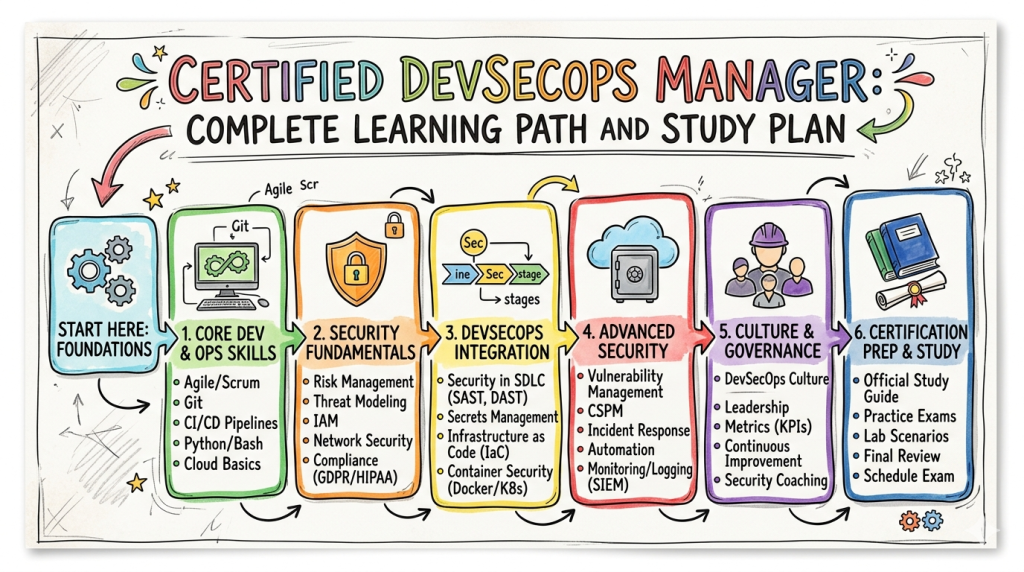
Introduction
Software teams now ship code faster than ever, across cloud, containers, and microservices. If security is not built into this speed, one small gap can cause incidents, data leaks, and compliance problems. The Certified DevSecOps Manager program from DevSecOpsSchool.com is designed for professionals who want to lead security across DevOps, cloud, and product teams in a structured and practical way. It goes beyond tools and scripts and focuses on strategy, governance, risk management, and culture. This guide explains what the Certified DevSecOps Manager is, who should take it, what skills you gain, how to prepare, which paths you can follow (DevOps, DevSecOps, SRE, AIOps/MLOps, DataOps, FinOps), and how it fits into a long-term certification roadmap for software engineers and managers.
Certified DevSecOps Manager – Detailed View
What It Is
The Certified DevSecOps Manager is a high-level program that teaches you how to integrate security into DevOps at scale. It covers strategy, governance, compliance, and culture, along with secure pipelines and tooling choices.
Who Should Take It
- DevOps and SRE engineers planning to move into lead or manager roles.
- Security engineers who want to own DevSecOps, not just point tools.
- Platform, cloud, and engineering managers responsible for risk and compliance.
- Architects and technical leaders who design end-to-end delivery and security models.
Skills You’ll Gain
- DevSecOps governance models and operating frameworks.
- Threat modeling and risk-based prioritization across products and platforms.
- Secure SDLC and secure CI/CD pipeline design.
- Policy as code and automated compliance in pipelines.
- Managing SAST, DAST, SCA, secrets, and container security at scale.
- Metrics, KPIs, and maturity roadmapping for DevSecOps initiatives.
- Communication, stakeholder management, and leading culture change.
Real-World Projects You Should Be Able to Do After It
- Design a DevSecOps rollout roadmap for a product line or business unit.
- Build a reference architecture for a secure CI/CD pipeline on a major cloud platform.
- Define policy-as-code rules and integrate them into build and deployment stages.
- Map ISO/SOC2/GDPR-like requirements to practical checks in your pipelines.
- Create dashboards for DevSecOps KPIs and present them to leadership.
- Run structured incident postmortems that include security, reliability, and business impact.
Preparation Plan (7–14 Days / 30 Days / 60 Days)
These plans are inspired by common professional learning roadmaps.
7–14 Days – Fast Track (Executive Sprint)
- For: senior engineers and managers already active in DevOps/Security.
- Time: 3–4 hours per day.
- Focus:
30 Days – Balanced Track (Working Professional)
- For: busy working engineers and managers.
- Time: 1–2 hours per day.
- Plan:
- For: professionals new to DevSecOps leadership.
- Time: 1 hour per day (or 2–3 hours on weekends).
- Plan:
Common Mistakes
- Treating the exam like a pure technical test instead of a leadership and strategy program.
- Ignoring people and culture topics such as collaboration and resistance to change.
- Skipping foundational DevOps and cloud concepts and jumping straight to security frameworks.
- Not practicing with real-world scenarios or designing at least one complete DevSecOps blueprint.
- Focusing only on tools and not linking security outcomes to business value and risk.
Best Next Certification After This (3 Options)
Based on typical software engineering certification paths.
- Same track (DevSecOps / Security):
- A hands-on DevSecOps engineer or professional-level certification to strengthen practical security pipeline skills.
- Cross-track:
- A cloud architect or cloud developer certification (such as AWS, Azure, or Google Cloud professional-level programs) to deepen your cloud design and platform understanding.
- Leadership:
- A broader engineering leadership or secure software lifecycle certification (for example, CSSLP-type programs) to connect governance with SDLC and organization-wide strategy.
Certification Table: Big-Picture Roadmap
| Track | Level | Who it’s for | Prerequisites | Skills covered | Recommended order |
|---|---|---|---|---|---|
| DevOps | Associate | New DevOps / software engineers | Basic programming, Linux, Git | CI/CD basics, containers, basic cloud concepts | 1 |
| DevOps | Professional | Experienced DevOps / SRE engineers | 1–2 years DevOps/SRE, cloud exposure | Advanced CI/CD, IaC, observability, scaling | 2 |
| DevSecOps | Professional | DevOps/SRE/security engineers | DevOps basics, CI/CD understanding | SAST, DAST, SCA, secure pipelines, secrets and container security | 2–3 |
| DevSecOps | Manager | Leads, architects, engineering/security managers | 3–5 years in DevOps/SRE/security | Governance, risk, compliance, culture, secure SDLC, KPIs | 3–4 |
| SRE | Professional | SREs and platform engineers | Cloud basics, DevOps foundation | SLOs, error budgets, incident management, reliability engineering | 3 |
| AIOps/MLOps | Professional | Data/ML/platform engineers | Python, cloud ML basics, CI/CD | ML pipeline automation, monitoring, AIOps-driven incident detection | 3–4 |
| DataOps | Professional | Data engineers and architects | SQL, data pipelines | Data pipeline reliability, data governance, quality checks | 3–4 |
| FinOps | Practitioner | Cloud/FinOps practitioners and managers | Cloud fundamentals, cost basics | Cloud cost optimization, showback/chargeback, budget and unit economics | 2–3 |
Choose Your Path: 6 Learning Paths
1) DevOps Path
- Step 1: DevOps foundation or associate-level certification to learn CI/CD and basic automation.
- Step 2: DevOps professional-level certification to deepen your pipeline and infrastructure skills.
- Step 3: Certified DevSecOps Manager to own security strategy across your DevOps practice.
This path is ideal for DevOps engineers who want to grow into platform or engineering leadership with a strong security focus.
2) DevSecOps Path
- Step 1: DevOps or cloud fundamentals (AWS/Azure/GCP associate-level).
- Step 2: DevSecOps professional/engineer-level certification for hands-on secure pipelines.
- Step 3: Certified DevSecOps Manager to lead governance, risk, and culture.
This path is best if you come from security or DevOps and want to become the main DevSecOps owner in your organization.
3) SRE Path
- Step 1: DevOps practitioner or SRE fundamentals.
- Step 2: SRE professional/reliability-focused certifications.
- Step 3: Certified DevSecOps Manager to align reliability and security objectives.
This helps SREs handle uptime, performance, and security posture together.
4) AIOps / MLOps Path
- Step 1: Software engineering and cloud fundamentals, plus basic ML or data skills.
- Step 2: AIOps/MLOps professional certifications for ML pipelines and AI-driven operations.
- Step 3: Certified DevSecOps Manager to secure ML pipelines, models, and data flows.
This is useful as AI workloads become central and heavily regulated in many industries.
5) DataOps Path
- Step 1: Data engineering and SQL/big data certifications.
- Step 2: DataOps or data governance programs.
- Step 3: Certified DevSecOps Manager to manage access, compliance, and secure change in data platforms.
This helps data engineers manage both quality and security for critical data systems.
6) FinOps Path
- Step 1: Cloud fundamentals plus a FinOps or cloud cost certification.
- Step 2: More advanced FinOps or cloud architect training.
- Step 3: Certified DevSecOps Manager to connect cost, risk, and security decisions in one model.
This is powerful for platform and cloud leaders who must balance cost, security, and speed.
Role → Recommended Certifications
Top Institutions for Training and Certification Support
DevOpsSchool
DevOpsSchool provides structured DevOps, DevSecOps, SRE, and cloud training tailored for working professionals. Its courses mix theory, hands-on labs, and real project case studies so you can apply skills directly at work.
Cotocus
Cotocus offers advanced technology training and consulting in DevOps, security, cloud, and automation. It supports both individuals and enterprises with customized learning plans, workshops, and implementation guidance for modern engineering practices.
Scmgalaxy
Scmgalaxy focuses on DevOps, configuration management, CI/CD, and release engineering training. It helps teams design better pipelines, choose the right tools, and improve collaboration across development and operations.
BestDevOps
BestDevOps acts as an information and learning portal for DevOps and related domains. It shares articles, training options, news, and resources that help professionals explore DevOps and DevSecOps career paths.
devsecopsschool.com
DevSecOpsSchool.com is dedicated to DevSecOps training and certifications, including the Certified DevSecOps Manager program itself. It offers role-based courses for engineers, architects, and managers, with strong focus on governance, secure pipelines, and leadership.
sreschool.com
SRESchool specializes in Site Reliability Engineering training. Its programs cover SLOs, error budgets, incident management, reliability culture, and observability, which combine well with DevSecOps responsibility.
aiopsschool.com
AIOpsSchool focuses on AIOps and MLOps, helping professionals learn how to use AI and ML for operations and automation. For DevSecOps Managers, these skills support intelligent monitoring, anomaly detection, and smarter incident handling.
dataopsschool.com
DataOpsSchool provides training in DataOps, data pipeline management, and data governance. This is valuable when you want to extend DevSecOps principles to data platforms with strong security and compliance needs.
finopsschool.com
FinOpsSchool focuses on financial operations in the cloud, including cost optimization, budgeting, and unit economics. Combining FinOps and DevSecOps management helps you design strategies that balance cost, security, and performance.
FAQs (Difficulty, Time, Value, Career)
1. Is the Certified DevSecOps Manager exam very difficult?
It is demanding but manageable for working engineers and managers who already understand DevOps and basic security. The exam focuses more on scenarios and decisions than on memorizing definitions.
2. How much time do I need to prepare?
Most professionals need 30–60 days of focused, regular study to feel confident. Very experienced leaders can complete a fast 7–14 day sprint if they already work in similar roles.
3. Do I need hands-on technical experience?
Yes, you should have practical exposure to CI/CD, cloud, and security basics before attempting this certification. Without this background, many of the examples and case studies will feel abstract.
4. Is this certification suitable early in my career?
It is better to first complete one or two practitioner-level certifications (DevOps, cloud, or security) and gain project experience. This certification is designed for people who already make technical or process decisions.
5. How is this different from a DevSecOps engineer certification?
Engineer-level certifications focus on tools, scripts, and implementation details. The Certified DevSecOps Manager focuses on strategy, governance, metrics, and leading teams.
6. What kind of roles can this certification help me reach?
It supports roles like DevSecOps Lead, Security Engineering Manager, Head of DevSecOps, Platform Security Lead, or Engineering Manager with security responsibility. It strengthens your profile for senior positions that mix technology, risk, and leadership.
7. Does this certification help in cloud-native environments?
Yes, it is very relevant for cloud-native stacks using containers, Kubernetes, and managed services. You learn how to integrate security into those pipelines and platforms in a structured way.
8. Will this certification stay relevant as AI and automation grow?
Yes, because AI, AIOps, and automation still require strong governance, risk management, and secure practices. DevSecOps leadership becomes even more important as systems become more complex and automated.
9. Is this recognized globally?
DevSecOps and security leadership skills are in demand across regions and industries worldwide. Certifications focused on DevSecOps management fit well into global hiring trends for platform, security, and cloud leadership roles.
10. How does it add value for engineering managers?
It gives engineering managers a clear framework to manage trade-offs between speed, safety, and cost. It also gives them language and models to communicate with CISOs, auditors, and product teams.
11. Can I combine this with other popular certifications?
Yes, it works well alongside cloud architect, DevOps engineer, SRE, and secure software lifecycle certifications. Many professionals use these together to show both deep technical skills and strong governance capability.
12. Does it require a specific programming language?
No, it is language-agnostic. You only need enough technical understanding to follow how pipelines, tools, and automation work in your chosen stack.
FAQs – Certified DevSecOps Manager
1. Is the Certified DevSecOps Manager vendor-specific?
No, the concepts are vendor-neutral. You can apply them to any major cloud or CI/CD platform.
2. Do I get practical templates or frameworks?
The official program provides frameworks, models, and templates for governance, risk, and operating models. These can be adapted to your own organization’s context.
3. Is there support or community after training?
There is community and alumni-style engagement where professionals discuss implementation challenges. This can be valuable when you are driving DevSecOps changes at work.
4. How important is prior leadership experience?
Formal people management experience is helpful, but not mandatory. Many senior engineers use this certification to prepare for their first leadership or architect-level role.
5. Can I switch careers into DevSecOps using this certification?
It is a strong addition if you already have a technical base in software, DevOps, or security. On its own, it is not a substitute for basic technical experience, but it accelerates your move into security leadership.
6. How does it relate to compliance and audit teams?
It shows you how to translate compliance rules into practical checks and controls within pipelines and platforms. You become a bridge between auditors, security, and engineering.
7. Will this help me in regulated industries?
Yes, especially in sectors like finance, healthcare, and telecom where compliance is strict. The program’s governance and risk focus is directly useful there.
8. Is there a recommended sequence after doing this certification?
Many people follow it with a cloud architect, SRE, or advanced security certification to deepen one dimension. This keeps your profile both broad (leadership) and deep (technical).
Conclusion
The Certified DevSecOps Manager is more than a badge. It gives you a structured way to make security part of how your teams design, build, ship, and run software every day. If you are a working engineer or manager in India or anywhere in the world, this program can help you step into roles where you influence not just code, but culture, risk, and long-term business outcomes. Combine it with the right DevOps, cloud, SRE, AIOps/MLOps, DataOps, and FinOps certifications, and you will build a strong, future-ready career path in modern software engineering leadership.