Introduction
For a long time, industrial robots were like a worker who could do only one job, and do it the same way all day. A robot arm on a car line would pick up a door, move it to the same spot, and weld it in place. It did this thousands of times without getting tired. But if you moved the door just a little to the left, the robot would not notice. It would keep working as if nothing had changed, and the result would be a mess.
That era is ending. Today, a new kind of robot is showing up in factories and warehouses. These machines can see what is in front of them, understand what has changed, and adjust their moves. One minute they lift a heavy square box. The next minute they carefully pick up a round glass jar. They do not need a team of engineers to rebuild them each time. They learn, adjust, and keep going.
If you want to learn more about robots and how they are used in real operations, you can visit Robotsops.com. In this article, I will explain why old robots were so limited, what makes new robots flexible, and where this is heading. I will use simple words, so even a high school student can follow along.
The Problem with Traditional “One-Trick” Robots
Let us start with a little history. The first industrial robots appeared in factories in the 1960s and 1970s. Their job was to take over hard, dangerous, or boring work, like lifting heavy metal parts or spot welding car bodies. They were strong, fast, and very accurate. But they were also very simple in one important way. They followed a fixed list of steps, and they did not understand anything about the world around them.
Think of an old robot like a music box. A music box plays the same song perfectly every time you wind it up. But it cannot change the song. It cannot listen to the room. It cannot notice that someone asked for a different tune. Old robots worked the same way. Every move was programmed in advance, such as “go to this point, close the hand, move to that point, open the hand.” If the part was a bit out of place, the robot could not tell.
Because of this, factories had to build a whole world around the robot. Parts had to arrive in exactly the same position every time. Special holders, trays, and guides were made just to keep things lined up. The area around the robot was often fenced off, since the robot could not sense a person walking nearby. All of this took time and money to set up.
Now imagine the factory wants to make a new product. This used to be a big project. Engineers had to stop the line, rewrite the robot’s program step by step, build new holders and tools, and test everything again. It could take weeks, and sometimes months. During that time, the factory was not making money. Because changes were so costly, many companies only used robots for products that would stay the same for years. Anything that changed often was done by human hands.
How Modern Robots Learn and Adapt on the Fly
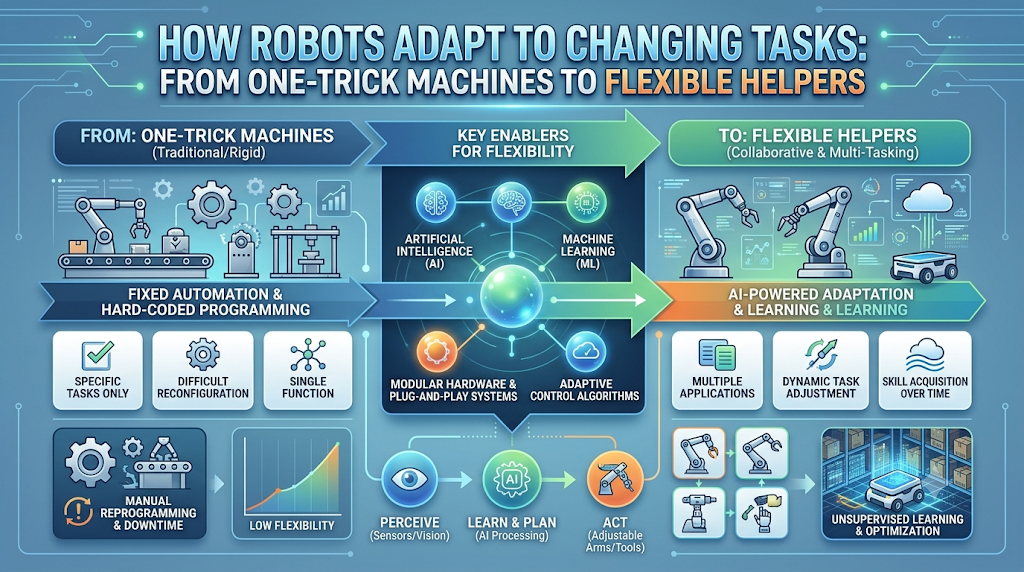
So what changed? Three big things came together: smarter software, better eyes, and faster ways to share what one robot learns. Together, they act like a brain, a pair of eyes, and a shared memory for the robot.
The Role of Artificial Intelligence
Artificial intelligence, or AI, is the “brain” of a modern robot. Instead of following a fixed list of steps, the robot is given a goal, like “pick up this item and put it in the box.” The AI then figures out the best way to do it based on what it sees at that moment.
The AI learns through a method called machine learning. Here is a simple way to think about it. Imagine teaching a child to pick up different things. At first, the child drops a few. Then they learn that a soft toy needs a gentle squeeze, and a heavy book needs a firm grip. A robot learns in a similar way. It tries, sees what worked and what did not, and slowly gets better. After enough practice, it can handle things it has never seen before, because it has learned the general idea and not just one exact move.
Computer Vision and Sensors
Computer vision is the “eyes” of the robot. Cameras take pictures of the scene, and software studies those pictures to find out what is there. It can tell where an object is, how big it is, and what shape it has. If a box sits at a slight angle, the robot sees this and adjusts its arm to match.
Cameras are not the only sense. Many robots also have touch sensors in their hands and force sensors in their wrists. These tell the robot how hard it is squeezing and whether the object is slipping. This is why a robot can hold a glass jar gently but grip a heavy carton firmly. It feels what it is holding and adjusts, just like your own hand does without you even thinking about it.
Cloud Learning
The third piece is the cloud, which simply means powerful computers connected over the internet. When one robot learns something useful, that lesson can be sent to the cloud and shared with other robots. Imagine a warehouse robot in one city struggles with a slippery bag, and finds a better way to grip it. That new skill can be sent out to hundreds of other robots overnight, and they all wake up a little smarter.
This shared learning is a huge change. In the old days, every robot had to be taught one by one. Now, a whole group of robots can improve together. It also means that when a new type of product arrives, the robots can pick up the new skill from the cloud, instead of waiting for an engineer to program each machine by hand.
Comparing Traditional Robots vs. Adaptive Robots
Here is a simple side-by-side look at the two kinds of robots.
| Area | Traditional Robots | Adaptive Robots |
|---|---|---|
| How they work | Follow a fixed list of steps | Look at the scene and choose the best move |
| Reprogramming time | Weeks or even months | Hours or days, and sometimes just a short training session |
| Ability to handle surprises | Very poor, they often stop or make errors | Good, they can adjust to small changes |
| Cost to change tasks | High, because of engineers, new tools, and line downtime | Much lower, since the same robot can learn new tasks |
| Need for perfect setup | Parts must be in the exact same place every time | Parts can be in slightly different places |
| Working near people | Usually fenced off for safety | Many can work safely near people with sensors |
| Best for | One product made in huge numbers | Many products, changing orders, and mixed items |
Notice the pattern in the table. Traditional robots are great when nothing ever changes. Adaptive robots are great when things change often, which is how much of the real world works. Orders change, products change, and even the shape of a box can change from one delivery to the next.
This does not mean old robots are useless. For a task that will stay the same for years, like welding the same part millions of times, a fixed robot can still be the cheapest and fastest choice. But as more companies sell many types of products and offer quick delivery, the need for flexible robots keeps growing.
The lower cost of changing tasks is a big deal for smaller companies too. In the past, only large factories could afford to use robots, because the setup was so expensive. Now, a smaller business can use a robot for one job in the morning and a different job in the afternoon. This opens the door for many more people to get the benefits of automation.
Real-World Scenarios: Adaptive Robots in Action
Let us look at a busy online shopping warehouse. Thousands of items come through every hour. One package might be a large flat box with a book. The next might be a small bottle of shampoo. After that comes a soft bag of clothes, and then a glass jar of candles. A fixed robot would be stuck, since every item needs a different grip. An adaptive robot looks at each item, decides where to grab it, picks the right amount of force, and places it in the right spot. If it drops something, it learns from the mistake and tries a better grip next time.
Now think about a factory that makes phones. Traditionally, a robot line built for one phone model could not handle another. When a new model came out, the factory had to rebuild everything. With adaptive robots, the same machines can be taught to assemble a tablet instead of a phone. The cameras find the new parts, the AI learns the new steps, and the robot arms adjust their moves. What used to take weeks of work can now take a fraction of the time.
There are other examples too. In food factories, robots can pack fruit that is different in size and shape, like apples and oranges, without bruising them. In hospitals, robots can carry supplies through hallways and go around people and carts that get in the way. On farms, robots can spot ripe strawberries and pick them gently, leaving the green ones for later.
Of course, adaptive robots are not perfect. They can still make mistakes, especially with odd or new objects. That is why most companies keep human workers nearby to help when a robot gets stuck. Over time, the robot learns from those moments, and the number of times it needs help goes down. The best setups treat robots and people as a team, where each does what it is best at.
The Future of Flexible Automation
Over the next ten years, we can expect robots to get much better at learning quickly. Today, teaching a robot a new task may still need some careful setup. In the future, a worker may be able to simply show the robot what to do a few times, like showing a new employee. The robot will watch, copy the moves, and then improve on its own. Some machines can already do simple versions of this now.
Will robots be able to walk into any factory and figure out what to do on their own? Probably not completely, at least not soon. The real world is messy and full of surprises. But robots will keep getting better at handling a wider range of tasks with less help. We may see robots that can switch from packing boxes to loading trucks to sorting returns in the same day, with only a short amount of training.
Humanoid robots, which have a body shape like a person, are also getting a lot of attention. The idea is that a robot shaped like us can use tools and spaces built for people, without changing the whole building. Several companies are testing these in warehouses and factories. It is still early, and they face challenges like cost, battery life, and safety, but it shows how much effort is going into flexible machines.
Safety and trust will matter as much as skill. As robots work closer to people, they must be able to sense humans and stop or slow down when needed. Companies will also need to train workers to run and work alongside these machines. The people who learn to guide, check, and fix robots will have very useful skills. Many jobs will change, and new types of jobs will appear in the process.
FAQs
1. Why could old robots only do one task?
Old robots followed a fixed list of steps and had no way to sense changes around them. If anything moved or changed, they could not adjust.
2. What makes modern robots able to adapt?
Modern robots combine AI for decision making, cameras and sensors to see and feel their surroundings, and cloud learning to share what they learn with other robots.
3. What is computer vision in robotics?
Computer vision is the robot’s sense of sight. Cameras take pictures, and software studies them to find out what objects are there, where they are, and what shape they have.
4. How does a robot learn from mistakes?
The robot tries a task, checks whether it worked, and uses that result to improve next time. Over many tries, it learns better ways to grip, move, and place objects.
5. Can one robot handle both heavy boxes and fragile items?
Yes. With cameras to see the object and sensors to feel force, an adaptive robot can change its grip and speed. It can hold a heavy box firmly and a glass jar gently.
6. How long does it take to change a modern robot to a new task?
It depends on the task, but it is often hours or days, compared with weeks or months for older fixed robots. Some simple changes can be done with a short training session.
7. Will adaptive robots take away human jobs?
Robots will take over some repetitive and heavy tasks, but new jobs are also created, such as robot supervisors and maintenance workers. Most workplaces still use people and robots together.
8. Are adaptive robots safe to work near people?
Many are built with sensors that detect people and slow down or stop when someone gets close. Safety rules and good setup are still very important.
9. Are traditional robots still useful?
Yes. For tasks that never change and need to be done millions of times, a fixed robot can still be the cheapest and fastest choice.
10. Will robots ever be able to work in any factory without training?
Not completely, at least not soon. Robots are getting better at learning quickly, but real workplaces are messy, so some setup and human guidance will still be needed.
Conclusion
Robots have come a long way from the music-box style machines of the past. Old robots were strong and accurate, but they could only repeat one fixed job, and changing that job was slow and expensive. Modern robots use AI as a brain, cameras and sensors as eyes and touch, and the cloud as shared memory. Together, these let them adjust to new tasks and surprises.
This shift matters because the world does not stand still. Products change, orders change, and customers want things quickly. Flexible robots can keep up with all of this, and they make automation possible for more businesses, not just huge factories.
We are not at the point where robots can do anything on their own. But the direction is clear. Robots are becoming better learners, better helpers, and better teammates. For anyone curious about the future of work and technology, this is a great time to watch how these machines grow.
