Introduction
The transition from traditional infrastructure management to algorithmic operations marks a pivotal moment in the evolution of modern engineering. As systems grow in complexity and data volume, the need for automated intelligence becomes a baseline requirement rather than a luxury. This guide is designed to help you navigate the Certified AIOps Engineer program, a credential that bridges the gap between systems engineering and artificial intelligence. By utilizing the resources at Aiopsschool, professionals can gain the technical depth needed to build self-healing systems and predictive maintenance workflows. This roadmap serves as a practical mentor for engineers in India and across the globe who are ready to lead the next generation of platform engineering.
What is the Certified AIOps Engineer?
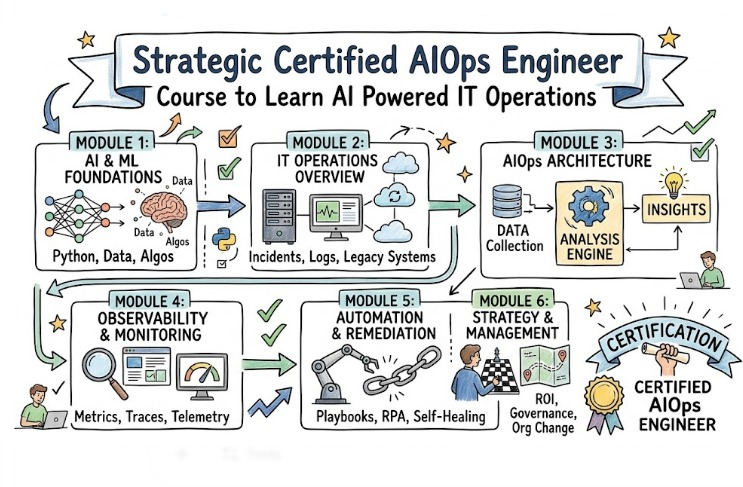
The Certified AIOps Engineer is a professional validation that signifies a practitioner’s ability to integrate machine learning and big data into IT operations. It represents a shift away from manual monitoring and toward a world where algorithms identify patterns, correlate events, and suggest remediations in real-time. This certification exists because traditional human-led operations are no longer scalable in the face of thousands of microservices and ephemeral cloud resources. It emphasizes a production-first approach, ensuring that engineers can actually deploy and manage AI models within an operational context.
By pursuing this path, you are aligning your skills with modern enterprise practices that prioritize high availability and rapid incident response. The curriculum focuses on how to leverage operational telemetry—logs, metrics, and traces—to build a more resilient infrastructure. It moves beyond the theory of artificial intelligence and focuses on the practical application of these technologies to solve real-world engineering bottlenecks. Achieving this certification proves that you can handle the “noise” of modern environments and extract actionable insights that protect business continuity.
Who Should Pursue Certified AIOps Engineer?
This certification is tailored for professionals who have spent time in the trenches of DevOps, Site Reliability Engineering, and Cloud Infrastructure. If you are tired of reactive firefighting and want to build systems that anticipate failures, this is the logical next step in your career. It is equally relevant for Platform Engineers who are designing internal developer platforms and Security Engineers who want to use AI for anomaly detection and threat hunting. Data Engineers will also find value here, as they are responsible for the pipelines that feed these operational AI models.
The relevance of this certification spans across both the Indian tech market and the global engineering community. For junior engineers, it provides a shortcut to understanding advanced automation strategies that usually take years of trial and error to learn. For senior leads and technical managers, it provides the strategic framework needed to oversee digital transformation and AI adoption within their organizations. Essentially, any professional who wants to remain relevant in an increasingly automated tech landscape should consider this a priority for their professional development.
Why Certified AIOps Engineer is Valuable and Beyond
The longevity of this certification comes from its focus on fundamental architectural principles rather than passing tool-specific trends. As enterprises continue to scale, the gap between the amount of data generated and the human ability to process it will only widen, making AIOps skills more valuable every day. This credential positions you as a high-value specialist who can reduce operational overhead and significantly lower the mean time to resolution for critical incidents. It is an investment in your ability to manage the massive scale of future digital ecosystems.
Beyond just the technical skills, this certification offers a significant return on your time and career investment. Companies are actively seeking engineers who can move beyond basic automation and into the realm of intelligent, data-driven operations. By mastering these concepts, you ensure your place in the top tier of infrastructure professionals, commanding higher compensation and working on the most challenging projects. It is a career-defining move that prepares you for a future where AI is the primary engine of IT operations and system reliability.
Certified AIOps Engineer Certification Overview
The program is a comprehensive training and assessment journey delivered via Certified AIOps Engineer and hosted on aiopsschool. It is structured to guide candidates through a logical progression of skills, starting from the basics of data ingestion and moving toward advanced automated remediation. The assessment is heavily weighted toward practical, performance-based tasks, ensuring that every certified professional can handle real-world infrastructure outages. This hands-on focus makes the certification highly respected among hiring managers and technical leaders.
Ownership of the program lies with industry experts who understand the daily pain points of managing complex production environments. The structure is designed to be flexible for working professionals, offering a blend of self-paced learning and rigorous examination. By completing this program, you demonstrate a clear understanding of how to bridge the gap between data science and systems operations. This unique intersection of skills is what makes a Certified AIOps Engineer an essential asset for any modern engineering team looking to achieve operational excellence.
Certified AIOps Engineer Certification Tracks & Levels
The certification is organized into three distinct levels to support long-term career growth and specialization. The Foundation level focuses on the core concepts, terminology, and the architecture of AIOps platforms, providing a solid starting point for those new to the field. It establishes the “why” and the “how” of algorithmic operations, ensuring that everyone on the team is speaking the same language. This level is critical for building the initial technical confidence needed to manage more complex intelligent systems.
The Professional and Advanced levels dive much deeper into implementation and strategic design. The Professional track is where engineers learn the specifics of model tuning, event correlation, and building automated root cause analysis workflows. The Advanced level is aimed at architects and leads who are responsible for designing the overall AIOps strategy for an entire enterprise. This tiered approach allows you to build your skills incrementally, ensuring that you have a deep and thorough understanding of the technology before moving into a leadership or architectural role.
Complete Certified AIOps Engineer Certification Table
| Track | Level | Who it’s for | Prerequisites | Skills Covered | Recommended Order |
| Operations | Foundation | Junior Engineers | Basic IT/Cloud | Data Ingestion, Basic ML | 1 |
| Engineering | Professional | DevOps/SREs | Foundation Cert | Event Correlation, RCA | 2 |
| Architecture | Advanced | Senior Leads | Professional Cert | Strategic Design, ROI | 3 |
| Specialized | Specialist | Data/Security | Industry Experience | Domain AI, Security Ops | Optional |
Detailed Guide for Each Certified AIOps Engineer Certification
Certified AIOps Engineer – Foundation
What it is
This is the entry-point certification that validates a professional’s understanding of AIOps core principles. It ensures you understand the data lifecycle and the various components required to build an intelligent monitoring ecosystem.
Who should take it
Entry-level engineers, system administrators, and technical project managers who want to understand how AI is changing the landscape of IT operations.
Skills you’ll gain
- Understanding AIOps terminology and the operational data lifecycle.
- Identifying different types of telemetry data (logs, metrics, traces).
- Knowledge of basic machine learning algorithms used in monitoring.
- Distinguishing between traditional automation and algorithmic operations.
Real-world projects you should be able to do
- Setting up a basic data ingestion pipeline for an application.
- Creating a dashboard that visualizes correlated operational data.
- Identifying redundant alerts in a standard monitoring setup.
Preparation plan
- 7–14 days: Study the fundamental modules and definitions on the official platform.
- 30 days: Set up a basic open-source monitoring stack and practice data collection.
- 60 days: Review case studies on initial AIOps adoption strategies.
Common mistakes
- Focusing too much on specific tools rather than the underlying data principles.
- Neglecting the importance of data cleansing before feeding it into a model.
Best next certification after this
- Same-track option: Certified AIOps Professional
- Cross-track option: Certified SRE Professional
- Leadership option: Team Lead Foundation
Certified AIOps Engineer – Professional
What it is
This level validates your ability to implement and manage AIOps solutions in a production environment. It focuses on the technical integration of machine learning into the daily incident management workflow.
Who should take it
Mid-level DevOps engineers and Site Reliability Engineers who are responsible for maintaining system uptime and reducing manual toil.
Skills you’ll gain
- Implementing advanced event correlation and noise reduction.
- Building automated root cause analysis workflows.
- Tuning and monitoring machine learning models for infrastructure.
- Integrating AIOps tools with CI/CD and ITSM platforms.
Real-world projects you should be able to do
- Reducing alert noise by over 50% using algorithmic correlation.
- Creating an automated remediation script for common system failures.
- Mapping complex dependencies in a distributed microservices architecture.
Preparation plan
- 7–14 days: Deep dive into correlation logic and model tuning parameters.
- 30 days: Complete several hands-on labs involving simulated system outages.
- 60 days: Implement a small-scale AIOps pilot on a staging environment.
Common mistakes
- Over-relying on default model settings without understanding the data context.
- Failing to account for model drift as the infrastructure evolves.
Best next certification after this
- Same-track option: Certified AIOps Architect
- Cross-track option: Certified MLOps Specialist
- Leadership option: Engineering Manager Track
Certified AIOps Engineer – Advanced
What it is
The Advanced level is for those who design the enterprise-wide AIOps strategy. It focuses on the high-level architecture, governance, and business value of intelligent operations.
Who should take it
Principal engineers, Cloud Architects, and technical leaders who are responsible for the long-term technology roadmap of their organization.
Skills you’ll gain
- Designing multi-cloud and hybrid AIOps architectures.
- Developing governance frameworks for autonomous system changes.
- Calculating the ROI and business impact of AIOps initiatives.
- Leading the cultural shift toward data-driven operations.
Real-world projects you should be able to do
- Architecting a global event bus for multi-region incident management.
- Developing a long-term roadmap for fully autonomous system operations.
- Justifying AIOps budget and tool selection to executive stakeholders.
Preparation plan
- 7–14 days: Study enterprise architecture patterns and high-level design strategies.
- 30 days: Analyze successful AIOps implementations in Fortune 500 companies.
- 60 days: Draft a comprehensive AIOps strategy for a hypothetical enterprise.
Common mistakes
- Ignoring the cultural and process changes required for AIOps success.
- Building overly complex systems that are difficult for the rest of the team to use.
Best next certification after this
- Same-track option: Continual Learning in AI Research
- Cross-track option: Certified FinOps Architect
- Leadership option: CTO/Executive Technology Leadership
Choose Your Learning Path
DevOps Path
Engineers on this path focus on using AI to improve the software delivery lifecycle. You will learn how to use AIOps to provide automated feedback during deployments, allowing for safe rollbacks and predictive performance testing. This ensures that rapid delivery does not lead to production instability. It is the ideal track for those who want to build a truly modern, high-velocity delivery engine.
DevSecOps Path
This track is dedicated to the intersection of security and operations. You will learn how to use machine learning to identify security threats and anomalous behavior that traditional tools might miss. AIOps helps by correlating security events with operational performance data, providing a more comprehensive view of the system’s risk profile. It is essential for engineers working in highly regulated industries.
SRE Path
Site Reliability Engineers use AIOps to manage SLOs and reduce manual toil. By using predictive analytics, you can foresee potential SLO breaches before they happen and take proactive measures. This path emphasizes automated incident response and the building of self-healing systems. It is perfect for those passionate about high availability and large-scale system reliability.
AIOps Path
This is the core specialization where you become an expert in the platforms that power intelligent operations. You will focus on the data science and engineering required to process massive amounts of telemetry data. This path prepares you to be the subject matter expert who builds the AIOps capabilities consumed by other engineering teams. It requires a deep interest in both systems and data analysis.
MLOps Path
The MLOps path focuses on the lifecycle of the machine learning models themselves. While AIOps uses AI to manage servers, MLOps uses server principles to manage the AI. You will learn how to build automated pipelines for training, deploying, and monitoring models. This role is critical for any organization that relies on AI for its core business and operational decisions.
DataOps Path
DataOps is about the orchestration of data quality and movement. On this path, you ensure that the telemetry data being fed into the AIOps engine is clean, reliable, and delivered with low latency. You will work on the underlying data pipelines that make all AI initiatives possible. It is a fundamental role for anyone who wants to master the data-driven aspects of operations.
FinOps Path
This path applies AIOps to cloud financial management. You will learn how to use machine learning to forecast cloud spending and identify opportunities for automated cost reduction. AIOps can help detect cost spikes in real-time, allowing teams to adjust resource usage before the bill arrives. This is an increasingly vital role for companies looking to maximize their cloud investment.
Role → Recommended Certified AIOps Engineer Certifications
| Role | Recommended Certifications |
| DevOps Engineer | Foundation + Professional (DevOps Track) |
| SRE | Professional + Advanced (SRE Track) |
| Platform Engineer | Professional + Advanced Specialist |
| Cloud Engineer | Foundation + Professional |
| Security Engineer | Professional (DevSecOps Specialist) |
| Data Engineer | Professional (DataOps Track) |
| FinOps Practitioner | Professional (FinOps Track) |
| Engineering Manager | Foundation + Advanced (Strategy Focus) |
Next Certifications to Take After Certified AIOps Engineer
Same Track Progression
After mastering the core AIOps curriculum, you should seek deep specialization in specific domains like deep learning for time-series data or NLP for log analysis. Staying updated with the latest AI research ensures you remain at the top of your field. You might also consider advanced certifications for specific open-source or commercial AIOps platforms to broaden your toolkit. Continual learning is essential as the technology continues to evolve at a rapid pace.
Cross-Track Expansion
Broadening your expertise into related areas like MLOps or FinOps can make you a more versatile professional. Understanding how to manage the models you rely on (MLOps) or how to optimize the costs of your infrastructure (FinOps) provides a more holistic view of the tech stack. Senior engineers should aim for at least one cross-track certification every two years. This prevents siloed thinking and prepares you for higher-level architectural roles.
Leadership & Management Track
For those transitioning into people management, certifications in engineering leadership or IT strategy are the next logical step. These programs teach you how to align technical AIOps goals with broader business objectives. You will learn about team building, budget management, and how to lead large-scale cultural shifts. Moving into leadership with a strong technical background in AIOps allows you to lead with authority and strategic clarity.
Training & Certification Support Providers for Certified AIOps Engineer
DevOpsSchool
DevOpsSchool has built a reputation over the years as a premier destination for high-end technical training. They provide a wide array of courses that focus on the practical tools and methodologies used in modern infrastructure management. Their approach to AIOps training is deeply rooted in real-world scenarios, helping students bridge the gap between theory and production. With a global community of learners and experienced instructors, they offer a supportive environment for career growth. Their programs are designed to be intensive and results-oriented, making them a top choice for professionals in India and beyond. They emphasize hands-on lab work that prepares candidates for the challenges of a live production environment.
Cotocus
Cotocus is a specialized training firm that focuses on the most advanced aspects of cloud-native and automation technologies. Their curriculum is designed by working practitioners who bring their daily experience into the classroom. Cotocus offers a project-based learning model that allows students to solve real infrastructure problems during their certification journey. They provide personalized mentorship and coaching, ensuring that each student can master complex concepts at their own pace. Their training for the AIOps path is known for its technical depth and its focus on the underlying data engineering principles. They are highly regarded for their ability to take complex subjects and make them accessible to working engineers.
Scmgalaxy
Scmgalaxy is a massive knowledge hub and community for DevOps and configuration management professionals. They provide an extensive library of documentation, tutorials, and video content that is invaluable for certification preparation. Their training programs are flexible, catering to both self-paced learners and those who prefer a more structured, instructor-led environment. Scmgalaxy is dedicated to keeping the engineering community updated on the latest trends and tool releases in the world of AIOps. They offer a supportive space where engineers can collaborate, share their experiences, and learn from one another. Their commitment to technical detail makes them a trusted resource for professionals worldwide.
BestDevOps
BestDevOps focuses on delivering streamlined, efficient training programs that are designed to help professionals get certified without unnecessary fluff. They prioritize the most important skills and concepts that are valued by employers in the current market. Their courses are ideal for busy engineers who need to balance their learning with a full-time career. BestDevOps provides a wealth of practice materials and study guides that are closely aligned with the actual certification exams. Their instructors are experts at breaking down complex topics into digestible lessons. They offer a results-driven approach that has helped many engineers successfully advance their careers in the AIOps space.
devsecopsschool.com
This platform is a dedicated resource for engineers who want to integrate security into their automated operational workflows. Their curriculum is centered on the DevSecOps philosophy, teaching students how to use AI for proactive threat detection and vulnerability management. The site offers a variety of interactive labs and challenges that simulate real-world security incidents. By focusing on the intersection of security and intelligent operations, they prepare their students for some of the most critical roles in modern tech. The platform is designed to be highly engaging, encouraging collaborative learning and peer review. It is an essential stop for anyone looking to master the security aspects of AIOps.
sreschool.com
Sreschool.com focuses exclusively on the principles of Site Reliability Engineering and the goal of achieving zero downtime. Their training programs are designed to help engineers build more resilient systems using advanced AIOps techniques. They provide deep dives into managing SLOs, error budgets, and automated incident response through machine learning. The site is a treasure trove of practical knowledge, offering case studies and architectural patterns from some of the world’s most successful tech organizations. Their instructors bring a wealth of practical experience, providing students with unique insights into the realities of SRE at scale. It is a vital resource for anyone dedicated to system reliability.
As the primary host for the Certified AIOps Engineer program, aiopsschool.com is the definitive source for professional training in this field. The platform offers a structured and comprehensive learning path that takes students from the basics to expert-level AIOps architecture. Their labs are powered by real-world datasets, allowing students to practice their skills in a realistic environment. The site is a certification body that maintains high standards for technical expertise, ensuring that its credentials are recognized globally. By providing a clear roadmap for skill acquisition, they help engineers navigate the complex world of algorithmic operations with confidence and clarity.
dataopsschool.com
Dataopsschool.com addresses the critical need for high-quality data engineering in the world of AI. Their training programs focus on building and managing the data pipelines that power AIOps and other machine learning initiatives. For AIOps professionals, this site provides the essential skills to ensure that the telemetry data being analyzed is accurate and reliable. They teach students how to manage massive volumes of data with low latency, ensuring that AI insights are delivered in real-time. Their curriculum covers everything from data governance to the technical implementation of complex data flows. It is an essential resource for anyone looking to master the data-driven foundation of AIOps.
finopsschool.com
Finopsschool.com is dedicated to the growing field of cloud financial management and cost optimization. They provide training on how to use AI to forecast cloud spending and identify opportunities for automated savings. For AIOps engineers, this platform offers a unique perspective on how operational efficiency translates into business value. Their courses teach students how to bridge the gap between engineering and finance departments, a skill that is increasingly valued by technical leaders. As cloud budgets continue to expand, the expertise provided by finopsschool.com is becoming essential for any senior engineer looking to demonstrate the financial impact of their work.
Frequently Asked Questions (General)
- How difficult is the Certified AIOps Engineer exam?
The exam is designed to be challenging and focuses on practical application. If you have a solid background in DevOps and follow the study guide, you will be well-prepared to pass.
- How much time is needed for preparation?
Most professionals spend between 30 and 60 days on consistent study and hands-on lab practice to feel fully prepared for the assessment.
- Are there prerequisites for the Foundation level?
There are no formal prerequisites, but having a basic understanding of Linux, cloud computing, and some Python knowledge will definitely help.
- What is the ROI for this certification?
The return is seen in higher salary potential, better job security, and the ability to work on high-value projects that are critical to the business.
- Can I take the certification exam online?
Yes, the program offers online proctored exams that can be taken from any location, making it very accessible for global practitioners.
- How long is the certification valid?
The certification is typically valid for two years, after which you may need to recertify to show you are updated with the latest technology.
- Does the program focus on specific vendor tools?
No, the program is vendor-neutral and focuses on the architectural principles and patterns that apply across all platforms.
- Is this certification suitable for engineering managers?
Yes, it is excellent for managers who need to understand the technical impact of AIOps and make informed decisions about strategy and tools.
- How does AIOps differ from traditional monitoring?
Monitoring tells you when something is wrong based on static thresholds, while AIOps uses data to tell you why it is wrong and how to fix it.
- Are the hands-on labs included in the training?
Most training providers mentioned here include lab access as part of their preparation packages, but you should check the specific course details.
- What is the background of the instructors?
Instructors are usually senior industry practitioners who have extensive experience in SRE, DevOps, and Data Engineering.
- Is there a community for certified individuals?
Yes, once you are certified, you gain access to a network of professionals for knowledge sharing, collaboration, and career opportunities.
FAQs on Certified AIOps Engineer
- Do I need a degree in data science to start this?
No, the course is designed for engineers and will teach you the specific machine learning concepts that are relevant to operations.
- How does this certification help my career in India?
The Indian tech market is shifting toward high-end automation, and this certification makes you stand out as a specialist in a crowded market.
- Can this certification lead to a higher salary?
Yes, AIOps specialists are in high demand and typically command a premium salary due to their unique blend of systems and data skills.
- Does the course cover multi-cloud environments?
Yes, the principles of AIOps are essential for managing the complexity of multi-cloud and hybrid-cloud architectures.
- What is the format of the exam?
The exam consists of a mix of multiple-choice questions and performance-based tasks that you must complete in a live environment.
- Is there support for corporate team training?
Many providers offer customized training packages for teams, including private sessions and curriculum tailored to specific company goals.
- How often is the content updated?
The curriculum is reviewed annually to ensure it reflects the latest advancements in AI and cloud technology.
- What is the biggest challenge for new students?
Shifting from a manual “scripting” mindset to an “algorithmic” mindset is the biggest hurdle, but the course is designed to help you through it.
Conclusion
The transition to AIOps is not just a trend; it is a fundamental shift in how we manage systems at scale. As systems continue to grow more complex, the ability to use data and algorithms to maintain reliability will become the defining skill of the next decade. This certification provides a structured and practical path for any engineer who is ready to move beyond manual toil and into the world of intelligent, self-healing infrastructure. It is an investment in your technical depth and your long-term career resilience.
Becoming a Certified AIOps Engineer is about more than just passing an exam; it is about adopting a new way of thinking. It prepares you to be a leader in your organization, someone who can bridge the gap between development, operations, and data science. For those who are serious about their professional growth and want to work on the cutting edge of technology, this path is well worth the effort. The future of operations is algorithmic, and this certification is your gateway to leading that future.