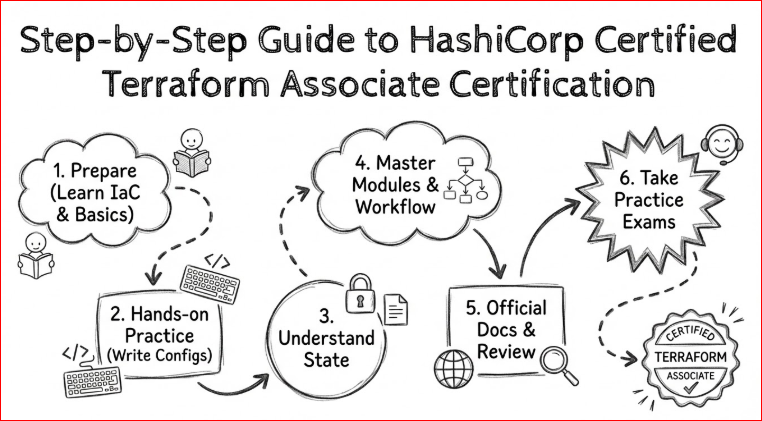
Introduction
In the modern landscape of cloud computing, “Infrastructure as Code” (IaC) is no longer a luxury—it is the bedrock of scalable operations. Having navigated the evolution from manual server racking to automated cloud provisioning over the last two decades, I have seen many tools come and go. However, Terraform has stood the test of time as the industry standard. The Hashicorp Certified Terraform Associate is a vital credential for anyone looking to prove they can manage cloud resources safely and efficiently. This guide will walk you through everything you need to know to master this certification and elevate your career.
What is the Hashicorp Certified Terraform Associate?
The Hashicorp Certified Terraform Associate is a foundational certification that validates your knowledge of basic infrastructure automation using Terraform. It proves you understand the differences between Terraform Cloud, Terraform Enterprise, and the open-source version, and that you can execute the core workflow (Write, Plan, Apply).
Who should take it?
This certification is designed for Cloud Engineers, DevOps Engineers, and SREs who are responsible for provisioning and managing infrastructure. It is also highly valuable for Engineering Managers who need to understand the technical constraints and capabilities of the tools their teams use daily.
Skills you’ll gain
- Understanding of Infrastructure as Code (IaC) principles.
- Proficiency in HashiCorp Configuration Language (HCL).
- Ability to manage Terraform state effectively.
- Knowledge of how to use Terraform modules for reusable infrastructure.
- Skill in using Terraform CLI commands for day-to-day operations.
Real-world projects you should be able to do
- Multi-Cloud Deployment: Provisioning a web server on AWS and a database on Azure using a single workflow.
- Infrastructure Versioning: Using Git to version control your infrastructure and roll back changes if needed.
- Modular Networking: Creating a reusable VPC module that can be used across multiple environments (Dev, QA, Prod).
Certification Overview Table
| Track | Level | Who it’s for | Prerequisites | Skills Covered | Recommended Order |
| Infrastructure | Associate | DevOps, SRE, Cloud Eng | Basic Cloud Knowledge | IaC, Terraform CLI, State, Modules | 1st |
Preparation Plan
Success in this exam depends on your current familiarity with command-line tools and cloud providers. Here is a tiered approach:
7–14 Days (Fast Track)
For those already using Terraform in their daily jobs. Focus purely on the “theoretical” aspects you might skip in practice, such as Terraform Cloud features and specific workspace behaviors. Review the documentation for complex functions and state locking.
30 Days (Standard Path)
Spend the first two weeks building. Create a project from scratch. In the third week, focus on the HCL syntax and modularization. Use the final week for practice exams and refining your understanding of the Terraform workflow.
60 Days (Beginner Path)
The first month should be dedicated to learning a cloud provider (like AWS) alongside Terraform. If you don’t understand the “target” (the cloud), you won’t understand the “tool” (Terraform). The second month should be hands-on labs every single day.
Common Mistakes to Avoid
- Ignoring the State File: Many candidates fail to realize how critical (and sensitive) the state file is. Never check it into public version control.
- Over-complicating HCL: Beginners often try to use complex logic where simple declarations would suffice. Keep your code “human-readable.”
- Skipping Terraform Cloud: The exam includes several questions on the features of Terraform Cloud vs. Open Source. Don’t ignore the managed service options.
Choose Your Path: 6 Specialized Learning Tracks
Infrastructure automation is the starting point for various specialized career paths. Here is how you can pivot after getting certified.
1. DevOps Path
Focuses on continuous integration and delivery. Terraform is used to spin up ephemeral environments for testing, ensuring that the environment where code is tested is identical to production.
2. DevSecOps Path
Integrates security into the IaC workflow. This involves using tools to scan Terraform code for vulnerabilities (like open ports or unencrypted disks) before the infrastructure is even built.
3. SRE (Site Reliability Engineering) Path
Focuses on availability and performance. Terraform helps SREs maintain “Error Budgets” by allowing for rapid recovery and consistent environment scaling.
4. AIOps/MLOps Path
Automation for data science. Here, Terraform is used to provision high-compute GPU clusters and managed ML services (like SageMaker or Vertex AI) in a repeatable way.
5. DataOps Path
Managing the “Data Factory.” Terraform handles the infrastructure for data lakes, warehouses (Snowflake, BigQuery), and orchestration tools, treating data pipelines as code.
6. FinOps Path
Cloud financial management. Using Terraform to tag resources correctly is essential for cost allocation. Automation can also be used to shut down non-essential resources during off-hours to save money.
Role → Recommended Certifications
- DevOps Engineer: Terraform Associate → Certified Kubernetes Administrator (CKA).
- SRE: Terraform Associate → Professional Cloud Architect.
- Platform Engineer: Terraform Associate → HashiCorp Vault Associate.
- Cloud Engineer: Terraform Associate → AWS/Azure/GCP Associate level.
- Security Engineer: Terraform Associate → HashiCorp Vault Professional.
- Data Engineer: Terraform Associate → Google Professional Data Engineer.
- FinOps Practitioner: Terraform Associate → FinOps Certified Practitioner.
- Engineering Manager: Terraform Associate → Cloud Digital Leader.
Where to Get Training and Certification Support
DevOpsSchool This platform offers an extensive curriculum tailored for the Terraform Associate exam, emphasizing real-world infrastructure scenarios. Their programs are led by industry veterans and include comprehensive study guides, practice tests, and interactive sessions to ensure you understand the “why” behind the code.
Cotocus Specializing in technical upskilling, Cotocus provides a lab-heavy approach to Terraform training. They focus on bridging the gap between basic automation and enterprise-grade deployment, making them an excellent choice for engineers who want to apply their skills immediately in a production environment.
Scmgalaxy As a long-standing community and training hub, Scmgalaxy offers deep dives into Software Configuration Management and automation tools. Their Terraform modules are known for being highly detailed, covering everything from basic HCL syntax to complex state management and multi-cloud orchestration.
BestDevOps BestDevOps focuses on delivering streamlined, result-oriented training for modern engineering teams. Their Terraform Associate program is designed to be concise yet thorough, focusing on the core competencies required by HashiCorp while integrating industry best practices for scalable architecture.
devsecopsschool.com For those looking to integrate security into their automation, this institution offers Terraform training with a heavy emphasis on “Security as Code.” You will learn how to use Terraform alongside security scanning tools to build compliant and hardened infrastructure from the start.
sreschool.com This school approaches Terraform through the lens of Site Reliability Engineering. The training focuses on using automation to improve system availability and reliability, teaching you how to manage infrastructure in a way that minimizes downtime and optimizes performance.
aiopsschool.com Catering to the future of automated operations, this platform teaches Terraform within the context of AI-driven environments. You’ll learn how to provision the complex, high-compute resources required for AI and Machine Learning models using repeatable Terraform workflows.
dataopsschool.com DataOpsSchool provides specialized training for data engineers who need to manage data lakes and warehouses as code. Their Terraform courses focus on automating data infrastructure, ensuring that your data pipelines are as scalable and version-controlled as your software.
finopsschool.com This institution focuses on the intersection of cloud engineering and financial accountability. Their Terraform training highlights how to use infrastructure tagging and resource management to maintain visibility into cloud spend and optimize organizational costs.
Next Certifications to Take
Once you have mastered the Terraform Associate level, consider these three directions:
- Same Track: Terraform Professional (Deep dive into enterprise features).
- Cross-Track: HashiCorp Vault Associate (Focus on security and secrets management).
- Leadership: Certified Cloud Manager or specialized architectural certifications.
FAQs: Hashicorp Certified Terraform Associate
1. How difficult is the exam?
It is considered an entry-level professional exam. If you have 3–6 months of hands-on experience, it is very manageable. For beginners, it requires diligent study of the documentation.
2. How long does the certification last?
The certification is valid for two years, reflecting the fast-paced nature of the tool’s updates.
3. Are there any prerequisites?
There are no official prerequisites, but a basic understanding of cloud providers (AWS, Azure, or GCP) and terminal usage is highly recommended.
4. What is the format of the exam?
The exam consists of multiple-choice, multiple-answer, and “fill-in-the-blank” style questions.
5. Does it help in getting a job?
Yes. In the current market, Terraform is the most requested IaC tool. This certification acts as a verified stamp of your technical capability.
6. Can I take the exam online?
Yes, the exam is proctored online, allowing you to take it from the comfort of your home or office.
7. What is the passing score?
While HashiCorp does not publish an exact passing percentage, it is generally understood to be around 70%.
8. Is the exam version-specific?
The exam is updated regularly to reflect the latest stable versions of Terraform. Ensure your study materials are current.
9. How much time should I dedicate to study?
If you are new, plan for 40–60 hours of total study and lab time.
10. Is Terraform Cloud covered in the exam?
Yes, a significant portion of the exam covers the benefits and basic operations of Terraform Cloud and Enterprise.
11. What if I fail?
You can retake the exam, but you will need to pay the exam fee again. There is usually a waiting period between attempts.
12. Why choose Terraform over CloudFormation or Bicep?
Terraform is cloud-agnostic. Learning it allows you to manage any cloud provider, making you much more versatile in the job market.
Frequently Asked Questions: HashiCorp Certified Terraform Associate
As someone who has navigated the shifting tides of infrastructure for two decades, I’ve seen many certification programs. These are the eight questions I am most frequently asked by engineers and managers looking to validate their Terraform expertise.
1. How much hands-on experience do I really need before taking the exam? While you can pass with theoretical knowledge, I recommend at least 3 to 6 months of consistent, hands-on use. The exam tests your understanding of CLI behavior and state management, which are much easier to grasp if you have actually “broken” and fixed a few environments yourself.
2. Is the Terraform Associate certification worth it for a Senior Engineer? Absolutely. Even for veterans, this certification serves as a standardized “sanity check.” it proves to global clients and stakeholders that your methods align with HashiCorp’s current best practices rather than outdated legacy workflows.
3. What is the most difficult topic covered in the exam? Most candidates struggle with Terraform State and Modules. Understanding how state locking works in a team environment and how to call child modules while managing input/output variables are the areas where the most mistakes happen.
4. How does this certification differ from cloud-specific ones like AWS SysOps or Azure DevOps? Cloud-specific certifications focus on what services you can use within that ecosystem. The Terraform Associate focuses on how to deploy those services programmatically. It is a “meta-skill” that makes you valuable across any cloud provider.
5. Can I pass the exam using only the open-source version of Terraform? Not quite. You must also understand the features of Terraform Cloud and Terraform Enterprise, such as Sentinel (Policy as Code), Workspace management, and the Private Module Registry. These represent about 15–20% of the exam content.
6. What is the best way to handle the “Fill-in-the-blank” questions? These questions usually target specific CLI commands or HCL syntax. Pay close attention to command flags (like -auto-approve or -target) and the exact spelling of block types. Practice in a terminal; muscle memory is your best friend here.
7. How long should I study if I am completely new to Infrastructure as Code? If you are starting from zero, give yourself 60 days. Spend the first 30 days learning basic cloud architecture (VPCs, EC2, IAM) and the next 30 days learning how to automate those specific components using Terraform.
8. Does this certification expire?Yes, it expires after two years. Because the HashiCorp ecosystem evolves so rapidly, this timeframe ensures that certified professionals are up-to-date with the latest syntax (like the shift from 0.11 to 1.0+ versions) and features.
Testimonials
“I had been using Terraform for a year, but the certification prep taught me nuances about state management that saved our production environment from a major drift issue last month.” — Senior DevOps Engineer, Bangalore.
“As a manager, taking this exam helped me understand the ‘why’ behind my team’s sprint cycles. It’s the best way to speak the same language as your engineers.” — Engineering Manager, London.
Conclusion
Infrastructure as Code is the future of IT operations, and Terraform is its leading language. Whether you are an engineer looking to solidify your technical standing or a manager aiming to guide your team through a digital transformation, the Hashicorp Certified Terraform Associate is a powerful tool in your professional arsenal. Start your journey today, build consistently, and lead the way in the era of automation.