Introduction
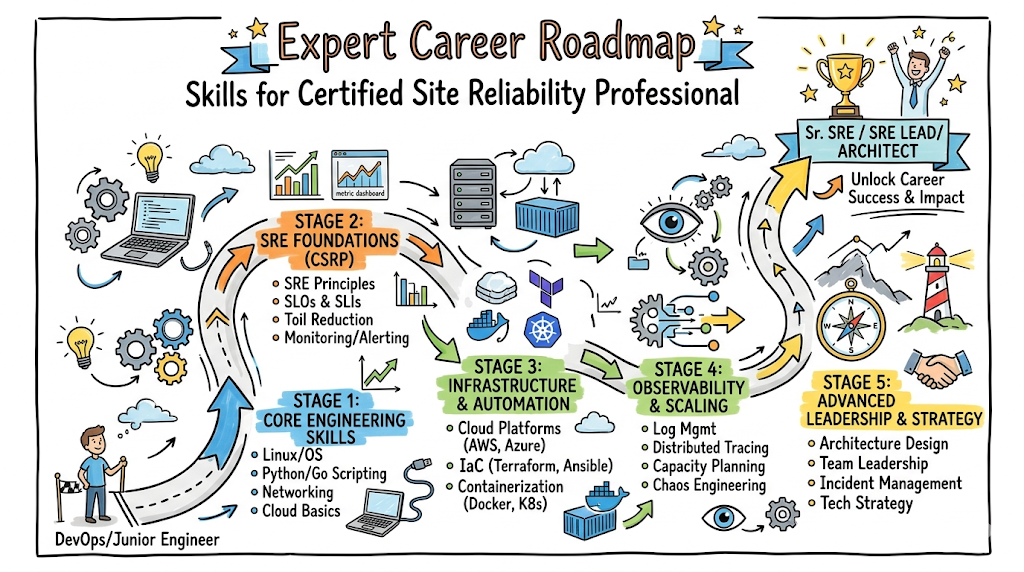
The modern technology landscape demands more than just basic coding or administrative skills; it requires a deep understanding of system resilience and operational excellence. This guide explores the Certified Site Reliability Professional designation, a comprehensive program designed to bridge the gap between software development and IT operations. Whether you are a junior engineer or a seasoned technical lead, this certification provides the framework needed to navigate complex cloud-native environments and platform engineering challenges. By choosing to pursue this path through Sreschool, professionals can validate their expertise in maintaining high-availability systems while fostering a culture of automation. This guide is specifically crafted for engineers and managers who want to understand the strategic value of this certification and how it maps to real-world career progression. We will break down the curriculum, the preparation strategies, and the tangible impact this credential has on your professional standing in the global market.
What is the Certified Site Reliability Professional?
The Certified Site Reliability Professional is a rigorous credential that validates an engineer’s ability to apply software engineering principles to solve infrastructure and operations problems. It represents a shift from traditional reactive monitoring to proactive system reliability, focusing on how to build and scale massive distributed systems. The certification exists to standardize the language of SRE across industries, ensuring that professionals can handle the complexities of modern, high-traffic production environments.
Unlike theoretical exams, this program emphasizes real-world applications, covering topics like error budgets, service level objectives, and incident management. It aligns with contemporary engineering workflows by teaching participants how to integrate reliability into the continuous integration and continuous deployment (CI/CD) lifecycle. For an enterprise, having a team of these certified professionals means having a staff capable of reducing downtime and increasing the velocity of software delivery through data-driven decisions.
Who Should Pursue Certified Site Reliability Professional?
This certification is ideal for software engineers who want to move into the operations space without losing their coding edge, as well as DevOps practitioners looking to specialize in reliability. Cloud architects, security professionals, and data engineers will also find significant value, as reliability is a foundational pillar for all modern cloud workloads. Even engineering managers and technical leaders should consider this path to better understand how to structure their teams and set realistic performance targets for their products.
The program is designed to be inclusive, offering entry points for beginners who are just starting their cloud journey and advanced modules for veterans managing global-scale infrastructure. In India and other growing tech hubs, the demand for certified SREs is skyrocketing as companies migrate from legacy monolithic systems to microservices. This certification acts as a bridge, allowing professionals from diverse backgrounds to pivot into high-demand roles that offer competitive compensation and long-term career stability.
Why Certified Site Reliability Professional is Valuable and Beyond
In an era where digital presence is the primary driver of business value, the demand for high system reliability has never been greater. Companies are moving away from generalist roles toward specialized engineers who can ensure that systems are not only functional but also resilient and scalable. The Certified Site Reliability Professional credential provides a long-term advantage by focusing on fundamental principles rather than just fleeting tool-specific knowledge.
Enterprise adoption of SRE practices is increasing across finance, healthcare, and e-commerce sectors, making this certification a highly relevant asset for the future. It helps professionals stay ahead of the curve as automation and observability become standard requirements for every software project. The return on investment for this certification is reflected in the increased confidence from employers and the ability to lead complex transformation projects that directly impact a company’s bottom line.
Certified Site Reliability Professional Certification Overview
The certification program is delivered via the official portal at Certified Site Reliability Professional and is hosted on the Sreschool platform. This educational ecosystem provides a structured approach to learning, combining theoretical modules with practical, hands-on labs that simulate real-world production outages. The program is owned and updated by industry experts who ensure the content reflects current industry standards and the latest developments in cloud-native technologies.
The assessment approach is designed to be comprehensive, testing both the conceptual understanding of SRE principles and the practical application of troubleshooting techniques. Candidates are evaluated through a mix of objective questions and scenario-based challenges that require a deep understanding of system architecture. The structure is modular, allowing learners to progress through different stages of expertise at their own pace while maintaining a consistent standard of excellence throughout the process.
Certified Site Reliability Professional Certification Tracks & Levels
The program is divided into three distinct levels: Foundation, Professional, and Advanced. Each level is designed to build upon the previous one, ensuring a logical progression of skills and responsibilities. The Foundation level introduces the core concepts of SRE, such as SLIs and SLOs, making it perfect for those new to the field. The Professional level dives deeper into automation, observability, and incident response, targeting engineers who are actively working in production environments.
Specialization tracks are also available, allowing professionals to align their certification with specific career paths such as DevOps-focused SRE, FinOps for cost-effective reliability, or DevSecOps for secure operations. These tracks ensure that the learning experience is tailored to the individual’s role and the specific needs of their organization. By following this tiered structure, engineers can demonstrate a clear path of growth and a commitment to mastering the complexities of modern site reliability.
Complete Certified Site Reliability Professional Certification Table
| Track | Level | Who it’s for | Prerequisites | Skills Covered | Recommended Order |
| Core SRE | Foundation | Beginners & Junior Engineers | Basic Linux & Networking | SLOs, SLIs, Error Budgets | 1st |
| Core SRE | Professional | Mid-level Engineers | 2+ Years IT Experience | Automation, Toil Reduction | 2nd |
| Core SRE | Advanced | Senior SREs & Architects | Professional Level Cert | Disaster Recovery, Scaling | 3rd |
| Reliability Ops | Specialization | DevOps & Platform Engineers | Foundation Knowledge | CI/CD Integration, IAC | 4th |
| Business SRE | Leadership | Managers & Leads | Experience in Leadership | Team Structure, ROI of SRE | 5th |
Detailed Guide for Each Certified Site Reliability Professional Certification
Certified Site Reliability Professional – Foundation
What it is
This certification validates a professional’s understanding of the basic principles and terminology of Site Reliability Engineering. It confirms that the candidate can contribute effectively to an SRE-led team and understands the cultural shift required for reliability.
Who should take it
It is suitable for junior developers, system administrators, and recent graduates who want to start their career in SRE. It is also beneficial for project managers who need to speak the same language as their technical teams.
Skills you’ll gain
- Understanding the difference between DevOps and SRE.
- Defining Service Level Indicators (SLIs) and Service Level Objectives (SLOs).
- Calculating and managing Error Budgets.
- Identifying “Toil” and understanding its impact on productivity.
Real-world projects you should be able to do
- Create a basic monitoring dashboard for a web application.
- Draft an initial SLO document for a non-critical internal service.
- Conduct a basic post-mortem for a minor system interruption.
Preparation plan
- 7-14 Days: Review the core SRE handbook and familiarize yourself with the basic definitions and terminology.
- 30 Days: Complete the official Foundation course modules and participate in community discussion forums.
- 60 Days: Not typically required for this level, but useful if transitioning from a completely non-technical background.
Common mistakes
- Focusing too much on specific tools rather than the underlying principles.
- Underestimating the importance of the cultural and organizational aspects of SRE.
Best next certification after this
- Same-track option: Certified Site Reliability Professional – Professional
- Cross-track option: DevOps Foundation
- Leadership option: Technical Project Management
Certified Site Reliability Professional – Professional
What it is
This mid-level certification focuses on the practical application of SRE tools and techniques in a production environment. It validates that the holder can automate repetitive tasks and manage complex incidents with minimal supervision.
Who should take it
This is designed for engineers with at least two years of experience in operations or development. It is the gold standard for practitioners who are responsible for the uptime of business-critical applications.
Skills you’ll gain
- Implementing advanced observability and distributed tracing.
- Automating infrastructure using code (IaC) and configuration management.
- Developing robust incident response protocols and on-call rotations.
- Managing capacity planning and performance tuning.
Real-world projects you should be able to do
- Build an automated failover system for a multi-region cloud deployment.
- Develop a custom exporter for Prometheus to monitor unique business metrics.
- Lead a complex incident response and write a detailed, blameless post-mortem.
Preparation plan
- 7-14 Days: Intensive review of automation scripts and observability tool configurations.
- 30 Days: Hands-on practice in a lab environment simulating various production failure scenarios.
- 60 Days: Deep dive into distributed systems architecture and advanced networking concepts.
Common mistakes
- Neglecting the “human” element of incident management and communication.
- Over-engineering automation solutions that become difficult to maintain.
Best next certification after this
- Same-track option: Certified Site Reliability Professional – Advanced
- Cross-track option: Certified DevSecOps Professional
- Leadership option: SRE Team Lead Certification
Certified Site Reliability Professional – Advanced
What it is
The Advanced level is the highest tier of the program, focusing on architectural patterns for global scalability and disaster recovery. It validates the expertise required to design and lead SRE initiatives across an entire enterprise.
Who should take it
This is reserved for principal engineers, architects, and senior SREs who have extensive experience in managing large-scale, high-concurrency systems. It is for those who shape the long-term reliability strategy of an organization.
Skills you’ll gain
- Designing for high availability and zero-downtime deployments at scale.
- Mastering chaos engineering and resilience testing methodologies.
- Leading organizational change and establishing SRE as a core business value.
- Evaluating and selecting complex technology stacks for reliability.
Real-world projects you should be able to do
- Design a global traffic management system for a low-latency application.
- Implement a company-wide chaos engineering program to identify hidden risks.
- Create a multi-year reliability roadmap for a Fortune 500 enterprise.
Preparation plan
- 7-14 Days: Review case studies of major system failures and successful architectural designs.
- 30 Days: Focus on the strategic aspects of SRE, including budgeting and executive communication.
- 60 Days: Engage in peer reviews and contribute to the SRE body of knowledge through white papers or talks.
Common mistakes
- Failing to align technical reliability goals with the financial objectives of the business.
- Losing touch with the day-to-day operational challenges faced by junior staff.
Best next certification after this
- Same-track option: Fellowship or Mentor level status
- Cross-track option: Cloud Solutions Architect Professional
- Leadership option: Chief Technology Officer (CTO) Program
Choose Your Learning Path
DevOps Path
This path focuses on the integration of SRE principles within a DevOps culture. Engineers learn how to bridge the gap between development and operations by emphasizing automation and continuous improvement. The goal is to create a seamless pipeline where reliability is built into the code from day one. Professionals on this path will master tools for CI/CD, container orchestration, and configuration management while maintaining an SRE mindset.
DevSecOps Path
The DevSecOps path incorporates security into the reliability lifecycle, ensuring that systems are not only available but also secure from threats. This requires understanding how to automate security checks and monitor for vulnerabilities without slowing down the release cycle. Professionals learn to treat security as a component of reliability, recognizing that a security breach is essentially a major reliability failure. This is a high-demand path for regulated industries like finance and healthcare.
SRE Path
The core SRE path is dedicated to the pure application of software engineering to operational tasks. It focuses heavily on observability, incident management, and the reduction of toil through smart automation. This path is ideal for those who want to become specialists in keeping high-traffic systems running smoothly under any conditions. It emphasizes the use of data to drive decisions and the creation of systems that are self-healing and resilient.
AIOps Path
AIOps focuses on using artificial intelligence and machine learning to automate the monitoring and management of IT operations. Professionals on this path learn how to use algorithmic data analysis to predict potential failures before they occur and automate root cause analysis. This is the future of SRE, where the volume of data generated by modern systems exceeds the capacity of human analysis. It requires a blend of data science and traditional systems engineering skills.
MLOps Path
The MLOps path is specialized for those managing the production lifecycle of machine learning models. It applies SRE principles to the unique challenges of ML, such as data drift, model retraining, and specialized hardware management like GPUs. This path ensures that AI-driven applications remain reliable and performant as they scale in production. Engineers learn how to automate the deployment and monitoring of models to ensure consistent business value.
DataOps Path
DataOps applies the principles of SRE to data pipelines and big data infrastructure. It focuses on ensuring the reliability, quality, and speed of data delivery to analysts and business stakeholders. Professionals learn how to monitor data flow, manage large-scale data stores, and automate the testing of data transformations. In a world where data is the new oil, ensuring the reliability of the “refineries” is a critical and highly valued technical skill.
FinOps Path
The FinOps path focuses on the intersection of cloud financial management and system reliability. It teaches engineers how to optimize cloud costs without compromising on performance or availability. Professionals learn to view cloud spend as a metric that needs to be managed just like latency or error rates. This path is essential for organizations looking to maximize their return on cloud investment while maintaining a high standard of operational excellence.
Role → Recommended Certified Site Reliability Professional Certifications
| Role | Recommended Certifications |
| DevOps Engineer | Foundation, Professional, Reliability Ops Specialization |
| SRE | Foundation, Professional, Advanced, SRE Path |
| Platform Engineer | Foundation, Professional, Reliability Ops Specialization |
| Cloud Engineer | Foundation, Professional, FinOps Specialization |
| Security Engineer | Foundation, Professional, DevSecOps Specialization |
| Data Engineer | Foundation, Professional, DataOps Specialization |
| FinOps Practitioner | Foundation, FinOps Specialization, Business SRE |
| Engineering Manager | Foundation, Business SRE, Advanced |
Next Certifications to Take After Certified Site Reliability Professional
Same Track Progression
For those looking to deepen their expertise within the SRE domain, the focus should be on reaching the Advanced level and then moving toward specialized architectural certifications. Deep specialization involves mastering specific environments, such as multi-cloud strategies or high-performance edge computing. This path leads to becoming a subject matter expert who can troubleshoot the most complex issues and design the most resilient systems in the industry.
Cross-Track Expansion
Broadening your skill set by pursuing certifications in related fields like DevSecOps or DataOps can make you a more versatile professional. This cross-pollination of skills allows an SRE to understand the unique constraints of security or data engineering, leading to better collaboration and more robust system designs. It is a strategic move for those who want to move into high-level architect roles where a broad understanding of the entire technology stack is required.
Leadership & Management Track
If you are looking to transition from a hands-on technical role into leadership, focus on certifications that emphasize team management, financial oversight, and strategic planning. The transition involves moving from managing systems to managing the people and processes that build those systems. Certifications in technical leadership and business administration can provide the necessary framework to lead large engineering departments and align technical goals with business outcomes.
Training & Certification Support Providers for Certified Site Reliability Professional
DevOpsSchool
DevOpsSchool has established itself as a leading provider of technical training, offering a wide range of courses that cater to the modern engineer. Their approach to the Certified Site Reliability Professional curriculum is deeply rooted in practical, project-based learning. They provide extensive resources, including recorded sessions, live labs, and a vibrant community of practitioners who share real-world insights. Their instructors are typically industry veterans who bring a wealth of experience from diverse sectors, ensuring that students receive a well-rounded education that goes beyond the textbook.
Cotocus
Cotocus focuses on providing specialized consulting and training services that help organizations and individuals bridge the skill gap in emerging technologies. Their training for SRE professionals is known for its intensity and focus on production-grade environments. They offer customized learning paths that can be tailored to the specific needs of a team or an individual’s career goals. By emphasizing hands-on workshops and real-world simulations, Cotocus ensures that their graduates are not just certified but are truly capable of handling the pressures of a live production outage.
Scmgalaxy
Scmgalaxy is a prominent community-driven platform that offers a vast array of tutorials, blogs, and training programs for DevOps and SRE enthusiasts. Their support for the Certified Site Reliability Professional program includes comprehensive study guides and practice exams that are updated regularly to reflect the latest trends. They foster a collaborative learning environment where students can engage with experts and peers to solve complex technical challenges. For those who prefer a mix of self-paced learning and community support, Scmgalaxy provides a robust foundation for success.
BestDevOps
BestDevOps is dedicated to delivering high-quality training materials and certification support for professionals looking to excel in the operations space. Their curriculum for the SRE certification is designed to be accessible yet challenging, ensuring a thorough understanding of the core principles. They provide detailed feedback on lab exercises and offer career coaching to help students navigate the job market. Their focus on quality over quantity has made them a trusted partner for many engineers seeking to validate their skills through the Certified Site Reliability Professional program.
devsecopsschool.com
As the name suggests, devsecopsschool.com specializes in the integration of security within the DevOps and SRE lifecycles. Their training for the SRE certification includes a strong emphasis on secure coding practices and automated security testing. They believe that reliability and security are two sides of the same coin, and their courses reflect this holistic philosophy. Students learn how to build resilient systems that are also hardened against modern cyber threats, making them highly valuable assets to any security-conscious organization.
sreschool.com
sreschool.com is the primary hosting site and authority for the Certified Site Reliability Professional program. As the originators of the curriculum, they provide the most direct and up-to-date training experience available. Their platform is built specifically for SRE education, featuring sophisticated lab environments that mimic complex distributed systems. By choosing to train directly with the provider, students ensure they are receiving the most accurate information and are perfectly aligned with the certification’s rigorous standards and expectations.
aiopsschool.com
aiopsschool.com is at the forefront of the shift toward automated, intelligent operations. Their support for the SRE certification path includes specialized modules on machine learning and data analytics for system monitoring. They teach students how to move beyond manual intervention by leveraging AI to identify patterns and predict failures. For engineers looking to stay ahead of the curve in an increasingly automated world, aiopsschool.com provides the cutting-edge skills needed to lead the next generation of SRE initiatives.
dataopsschool.com
dataopsschool.com focuses on the critical task of ensuring the reliability of data infrastructure. Their contribution to the SRE training ecosystem involves teaching professionals how to apply SRE principles to data pipelines, databases, and big data platforms. They provide hands-on experience with tools used for data observability and quality assurance. As organizations become increasingly data-driven, the skills taught at dataopsschool.com are becoming essential for SREs who want to ensure the integrity and availability of their company’s most valuable asset.
finopsschool.com
finopsschool.com addresses the growing need for financial accountability in cloud operations. Their training for SREs includes a deep dive into cloud cost management and optimization techniques. They teach professionals how to build reliable systems that are also cost-efficient, a skill that is highly prized by executive leadership. By integrating financial metrics into the SRE framework, finopsschool.com helps engineers demonstrate the clear business value of their work, making them effective leaders in both technical and financial discussions.
Frequently Asked Questions (General)
- How difficult is the Certified Site Reliability Professional exam?
The difficulty level ranges from moderate for the Foundation level to very challenging for the Advanced level. It requires a solid understanding of both software engineering and systems administration.
- How much time do I need to prepare for the certification?
Depending on your experience, preparation can take anywhere from 30 to 90 days. Professionals with an existing background in DevOps may find they can move through the initial levels more quickly.
- Are there any strict prerequisites for the Foundation level?
There are no formal prerequisites for the Foundation level, although a basic understanding of Linux, networking, and at least one programming language is highly recommended.
- What is the return on investment for this certification?
The ROI is significant, often leading to salary increases, promotions to leadership roles, and the ability to work on more high-impact projects within an organization.
- In what order should I take the certifications?
It is recommended to start with the Foundation level, move to the Professional level, and then choose a specialization track before attempting the Advanced level.
- Is the certification recognized globally?
Yes, the Certified Site Reliability Professional is recognized by major technology companies and enterprises around the world as a valid measure of SRE expertise.
- Does the certification expire?
Most certifications in this field require renewal or continuing education every two to three years to ensure that the professional stays current with evolving technology.
- Can I take the exam online?
Yes, the certification exams are typically offered through a secure online proctoring system, allowing you to take them from anywhere in the world.
- Are there hands-on labs in the exam?
The Professional and Advanced levels often include scenario-based questions that simulate hands-on troubleshooting and system design challenges.
- How does this differ from a standard DevOps certification?
While DevOps focuses on the collaboration between dev and ops, this certification focuses specifically on the engineering principles used to ensure system reliability.
- Do I need to be a developer to become a Certified Site Reliability Professional?
You don’t need to be a full-time developer, but you do need to be comfortable with coding and automation scripts to succeed at the higher levels of the program.
- What kind of support is available if I fail the exam?
Most training providers offer retake options and additional study resources to help you identify and strengthen your weak areas before your next attempt.
FAQs on Certified Site Reliability Professional
- What specific tools are covered in the Certified Site Reliability Professional curriculum?
The curriculum focuses on tool-agnostic principles but provides practical experience with industry standards like Kubernetes, Prometheus, Terraform, and various cloud platforms.
- How does the certification handle the concept of Error Budgets?
It treats Error Budgets as a core decision-making tool, teaching professionals how to balance the need for new features with the requirement for system stability.
- Is there a focus on incident management?
Yes, a significant portion of the Professional level is dedicated to modern incident response, including on-call rotations and the creation of blameless post-mortems.
- Does the program cover legacy systems or only cloud-native ones?
While the focus is on modern cloud-native architectures, the principles taught are applicable to any complex system, including hybrid and legacy environments.
- How is “Toil” defined and addressed in the training?
Toil is defined as manual, repetitive work that provides no long-term value. The certification teaches strategies for identifying and automating this work away.
- Are Service Level Objectives (SLOs) a major part of the exam?
Yes, defining, measuring, and defending SLOs is a fundamental skill tested at every level of the Certified Site Reliability Professional program.
- Does the certification include chaos engineering?
The Advanced level includes a deep dive into chaos engineering, teaching professionals how to proactively inject failures into systems to test their resilience.
- How does this certification help with career progression into management?
By teaching the business value of reliability and how to manage technical debt, it prepares engineers to take on strategic roles with greater organizational impact.
Conclusion
When you strip away the industry buzzwords, the core of our job as engineers is to build things that work and keep them working. The Certified Site Reliability Professional is not just another badge to put on a resume; it is a framework for thinking about complex systems in a way that prioritizes stability without sacrificing innovation. In my 20-plus years in this industry, I have seen many tools come and go, but the principles of reliability engineering have only become more critical.
For the individual engineer, this certification provides a structured path to mastering one of the most difficult and rewarding roles in tech. For the manager, it provides a standard by which to build high-performing teams. If you are serious about a career in modern operations, this investment in your skills is one of the most practical decisions you can make. It moves you from being someone who just reacts to problems to someone who builds the systems that prevent those problems from happening in the first place.