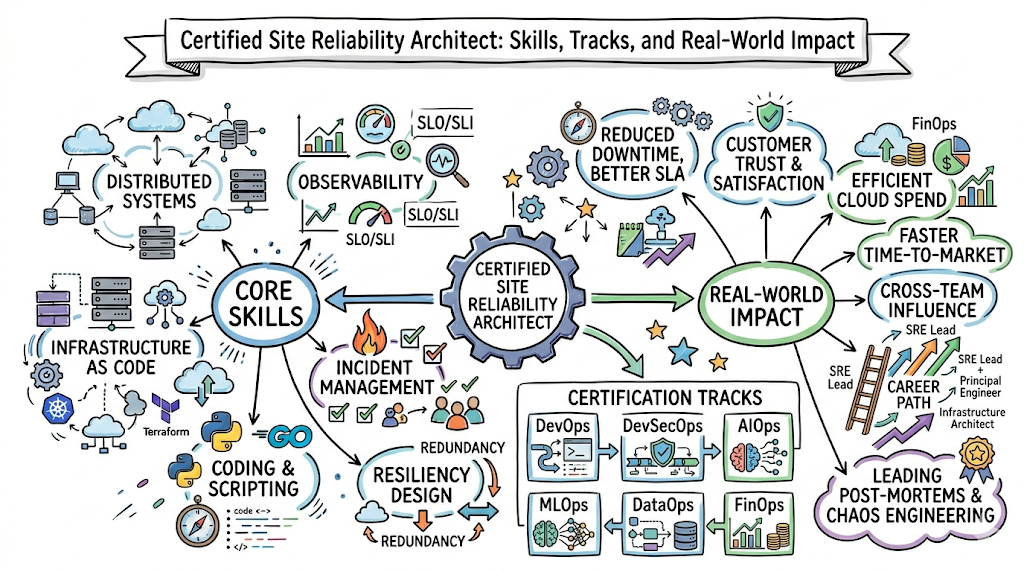
Introduction
Modern software delivery is no longer just about writing code; it is about ensuring that code survives the harsh reality of production. The Certified Site Reliability Architect credential provided by Sreschool serves as a definitive blueprint for engineers who want to move beyond basic operations. This guide is designed for professionals navigating the shift from traditional infrastructure management to high-scale platform engineering. By focusing on architectural resilience, we help you understand how to build systems that are inherently stable, scalable, and secure.
What is the Certified Site Reliability Architect?
The Certified Site Reliability Architect is a professional standard that emphasizes the “design” aspect of system reliability. It exists because many organizations find that patching systems after deployment is a losing battle against technical debt. This program teaches engineers to treat operations as a software problem, utilizing architectural patterns that minimize failure points. It aligns closely with the needs of global enterprises that require their systems to be self-healing and capable of handling massive traffic spikes without manual intervention.
Who Should Pursue Certified Site Reliability Architect?
This path is intended for those who find themselves at the intersection of development and operations, looking to formalize their expertise in distributed systems. Senior developers who want to understand the lifecycle of their code and systems administrators transitioning into cloud-native roles will find this particularly rewarding. In regions like India, where digital infrastructure is scaling at an unprecedented rate, having a specialized architect-level certification provides a significant competitive edge. It is also highly beneficial for security professionals and data engineers who need to ensure their specialized workloads remain available and resilient.
Why Certified Site Reliability Architect is Valuable and Beyond
In an increasingly complex cloud landscape, the ability to architect for reliability is a skill that offers immense professional longevity. As organizations move toward serverless, microservices, and multi-cloud strategies, the foundational principles of SRE become more critical than ever. This certification ensures that you are not just a tool user, but a system designer who understands the trade-offs between cost, performance, and availability. By mastering these principles, you ensure your career remains relevant regardless of which specific cloud provider or automation tool becomes the industry standard in the future.
Certified Site Reliability Architect Certification Overview
The program is a rigorous learning journey hosted on the Sreschool platform, focusing on the end-to-end lifecycle of reliable systems. It breaks away from purely academic learning by providing practical frameworks for measuring and managing service health in real-time. The curriculum covers everything from initial design and capacity planning to incident response and post-mortem analysis. By the end of the program, participants are expected to be able to lead the architectural vision for a reliability-first engineering organization.
Certified Site Reliability Architect Certification Tracks & Levels
To cater to a wide range of experience levels, the certification is divided into three progressive tiers: Foundation, Professional, and Advanced. The Foundation tier is designed to establish a common language and understanding of SRE metrics and cultural shifts. The Professional tier moves into the technical weeds, focusing on the automation of deployment and monitoring stacks. Finally, the Advanced or Architect level focuses on the strategic orchestration of complex systems, preparing senior leaders to handle organizational-wide reliability challenges and cross-team integration.
Complete Certified Site Reliability Architect Certification Table
| Track | Level | Who it’s for | Prerequisites | Skills Covered | Recommended Order |
| SRE Core | Foundation | New DevOps Engineers | Basic IT knowledge | SLOs, SLIs, Toil reduction | First |
| SRE Implementation | Professional | Experienced SREs | Foundation level | Automation, Incident Management | Second |
| SRE Strategy | Advanced | Principal Architects | Professional level | Capacity Planning, Multi-region | Third |
| SRE Culture | Management | Engineering Leads | Leadership experience | Team Dynamics, Risk Policy | Optional |
Detailed Guide for Each Certified Site Reliability Architect Certification
Certified Site Reliability Architect – Foundation Level
What it is
This entry-level certification validates a practitioner’s understanding of the core philosophy of Site Reliability Engineering. It ensures that the candidate understands why modern systems fail and how to use error budgets to balance innovation with stability.
Who should take it
This is perfect for system administrators, junior developers, and QA engineers who are new to the world of SRE. It also serves as an excellent primer for product managers who need to understand why “100% uptime” is an unrealistic and expensive goal.
Skills you’ll gain
- Identification of the “Golden Signals” of monitoring.
- Ability to differentiate between SLIs, SLOs, and SLAs.
- Understanding the impact of manual “toil” on team morale and system health.
- Basic principles of incident response and communication.
Real-world projects you should be able to do
- Create a basic monitoring dashboard for a multi-tier web application.
- Draft an initial Service Level Objective (SLO) document for a new feature.
Preparation plan
- 7-14 Days: Read the fundamental SRE literature and familiarize yourself with cloud terminology.
- 30 Days: Practice setting up basic health checks and alerts on a small-scale application.
- 60 Days: Review case studies on common cloud outages to understand the role of SRE in mitigation.
Common mistakes
- Treating SRE as just another name for “Ops” without changing the underlying culture.
- Setting overly ambitious SLOs that are impossible for the engineering team to meet.
Best next certification after this
- Same-track option: Certified Site Reliability Architect – Professional Level
- Cross-track option: Certified DevOps Associate
- Leadership option: Associate Engineering Manager
Certified Site Reliability Architect – Professional Level
What it is
The Professional level focuses on the “engineering” part of SRE, validating a candidate’s ability to build and maintain automated systems. It moves beyond theory into the practical implementation of observability and self-healing infrastructure.
Who should take it
This is designed for DevOps engineers and SREs who have been in the field for at least two years. It is for those who are actively managing production workloads and are responsible for the day-to-day stability of services.
Skills you’ll gain
- Advanced automation using scripting and configuration management.
- Implementation of full-stack observability and distributed tracing.
- Conducting blameless post-mortems and identifying systemic root causes.
- Management of large-scale infrastructure using Infrastructure as Code (IaC).
Real-world projects you should be able to do
- Build an automated pipeline for rolling back deployments based on health check failures.
- Implement a centralized logging and tracing system for a microservices architecture.
Preparation plan
- 7-14 Days: Deep dive into specific monitoring and automation toolsets like Prometheus and Terraform.
- 30 Days: Participate in hands-on workshops that simulate real-world service outages.
- 60 Days: Master the networking and security constraints of distributed cloud environments.
Common mistakes
- Building automation scripts that are too fragile or poorly documented for others to use.
- Focusing on alerts for every metric instead of focusing on user-impacting signals.
Best next certification after this
- Same-track option: Certified Site Reliability Architect – Advanced Level
- Cross-track option: Certified Cloud Security Professional
- Leadership option: SRE Team Lead
Certified Site Reliability Architect – Advanced Level
What it is
This certification is the ultimate validation for architects who design high-availability systems from the ground up. It focuses on the strategic and cultural aspects of reliability at an enterprise scale, including financial and risk management.
Who should take it
Principal engineers, senior architects, and technical directors are the primary audience for this level. It is for those who make the high-level decisions regarding technology stacks and organizational processes.
Skills you’ll gain
- Design of multi-region and multi-cloud architectures for maximum resilience.
- Long-term capacity planning and forecasting for massive infrastructure growth.
- Cultural leadership to drive reliability-first thinking across multiple departments.
- Implementation of advanced chaos engineering and disaster recovery drills.
Real-world projects you should be able to do
- Design a 99.99% available architecture for a global fintech platform.
- Lead a cross-functional team through a full-scale disaster recovery exercise.
Preparation plan
- 7-14 Days: Review high-level whitepapers on distributed consensus and system architecture.
- 30 Days: Analyze your own organization’s architecture and identify single points of failure.
- 60 Days: Mentor junior staff and present a strategic reliability roadmap to stakeholders.
Common mistakes
- Over-complicating architectures with redundant components that increase cost without adding value.
- Failing to align reliability goals with the actual business requirements of the organization.
Best next certification after this
- Same-track option: Industry-wide Fellow Status
- Cross-track option: Certified Data Architect
- Leadership option: Chief Technology Officer (CTO) Program
Choose Your Learning Path
DevOps Path
The DevOps path focuses on the lifecycle of a product from the developer’s laptop to the production server. It is about speed, efficiency, and removing the barriers between coding and shipping. Engineers on this path learn how SRE principles can be used to build better CI/CD pipelines and deployment strategies. This ensures that as the company scales its delivery speed, the stability of the system remains high. It is a path of continuous improvement and internal tool development.
DevSecOps Path
In the DevSecOps track, the focus is on integrating security as a core pillar of reliability. You will learn how to automate security checks and compliance into the standard engineering workflow. This ensures that the system is not just up, but also protected from vulnerabilities and data breaches. This path is essential for engineers in security-conscious industries where a breach is considered a fatal system failure. It bridges the gap between traditional security and modern cloud-native engineering.
SRE Path
This is the “Pure Reliability” path, where you focus almost exclusively on the health and performance of the system in production. You will dive deep into the internals of the operating system, networking protocols, and database management. It is a highly technical path that rewards those who enjoy troubleshooting complex problems and building robust systems. As an SRE, you are the final line of defense for the user experience, ensuring that services remain fast and available.
AIOps Path
AIOps explores the application of artificial intelligence to IT operations to handle the massive amounts of data generated by modern systems. You will learn how to use machine learning to detect anomalies, predict failures, and automate incident response. This path is for engineers who want to be at the cutting edge of operational technology, using data to drive automated decisions. It helps in reducing the noise from monitoring systems and focusing on what truly matters for system health.
MLOps Path
MLOps is the application of SRE and DevOps principles specifically to the machine learning lifecycle. It addresses the unique challenges of deploying and monitoring ML models, such as data drift and model decay. On this path, you will learn how to build pipelines that are as reliable as traditional software while handling the variability of data science. This is a critical role in data-driven companies that rely on AI for their core products and services.
DataOps Path
DataOps focuses on the reliability and speed of data delivery within an organization. It applies SRE concepts to data engineering, ensuring that data pipelines are monitored, tested, and automated. You will learn how to manage large-scale data systems and ensure that downstream users can trust the data they receive. This path is perfect for data engineers who want to move away from manually fixing broken pipelines and toward a more architected approach.
FinOps Path
FinOps is the practice of bringing financial accountability to the variable spend model of the cloud. This path teaches you how to optimize the cost of your infrastructure while maintaining the required levels of reliability. You will learn how to bridge the gap between engineering, finance, and business teams to ensure that cloud investments are driving maximum value. It is an essential skill set for senior engineers who need to manage large cloud budgets effectively.
Role → Recommended Certified Site Reliability Architect Certifications
| Role | Recommended Certifications |
| DevOps Engineer | SRE Foundation, Professional SRE, CI/CD Specialist |
| SRE | SRE Professional, Advanced SRE, AIOps Foundation |
| Platform Engineer | SRE Advanced, DevSecOps Specialist, Infrastructure Architect |
| Cloud Engineer | SRE Foundation, Multi-Cloud Specialist, FinOps Foundation |
| Security Engineer | DevSecOps Specialist, SRE Foundation, Security Architect |
| Data Engineer | DataOps Specialist, SRE Professional, ML Foundation |
| FinOps Practitioner | FinOps Specialist, SRE Foundation, Cloud Optimization |
| Engineering Manager | SRE Foundation, Leadership Specialist, FinOps Specialist |
Next Certifications to Take After Certified Site Reliability Architect
Same Track Progression
Once you have achieved the Architect level, the focus shifts toward staying current with emerging patterns in distributed systems. This might involve deep-diving into specific technologies like Service Meshes, Global Database consistency, or advanced Chaos Engineering. You should focus on becoming a thought leader within your organization, contributing to internal best practices and mentoring the next generation of engineers. Continuous learning in the SRE track means staying at the absolute edge of system performance and resilience.
Cross-Track Expansion
An SRE who understands the nuances of Security or Data Engineering is a powerful asset to any company. Expanding your skills into DevSecOps or DataOps allows you to apply reliability principles to different domains, making you a more versatile architect. This cross-pollination of skills is highly valued in modern “platform” teams that provide services across the entire engineering department. It allows you to see the “big picture” of how different technologies interact and affect overall system health.
Leadership & Management Track
For those who wish to move away from individual technical contribution, the management track offers a way to influence the entire engineering culture. This involves moving into roles where you build and scale SRE teams, set company-wide SLOs, and manage the technical risk of the organization. This path requires a focus on communication, strategic planning, and people development. It is a rewarding way to use your technical expertise to build an environment where other engineers can thrive and build reliable systems.
Training & Certification Support Providers for Certified Site Reliability Architect
DevOpsSchool is a prominent educational institution that has dedicated itself to transforming the workforce for the modern era of software delivery. They provide a comprehensive range of training modules that cover everything from basic automation scripts to advanced architectural design. Their teaching methodology is built on the belief that engineering is best learned through doing, which is why their courses are packed with hands-on labs and real-world simulations. With a strong presence in the global tech community, they have helped thousands of professionals transition into high-paying DevOps and SRE roles. Their trainers are active practitioners who bring the latest industry trends and best practices directly to the students, ensuring the education is always relevant.
Cotocus stands out in the training landscape as a provider of high-end, specialized engineering education. They focus on the most challenging aspects of modern infrastructure, such as Kubernetes orchestration, cloud-native security, and large-scale site reliability. Their training programs are often used by large enterprises to upskill their entire engineering teams, speaking to the quality and depth of their curriculum. They offer an immersive learning environment where students are challenged with complex architectural problems and encouraged to find efficient, scalable solutions. By focusing on the “why” as much as the “how,” Cotocus ensures that their graduates are capable of making sound technical decisions in high-pressure environments.
Scmgalaxy has evolved from a popular community portal into a vital resource for training and professional development in the SCM and DevOps domains. They host a vast repository of technical content, including deep-dive blogs, how-to guides, and troubleshooting tips that are used by engineers daily. Their training arm leverages this community knowledge to provide courses that are grounded in actual practitioner experience. The platform also serves as a networking hub, allowing students to connect with peers and mentors across the globe. This community-driven approach ensures that learners have a support system that lasts long after their formal training is complete, making Scmgalaxy a cornerstone of the DevOps education ecosystem.
BestDevOps is committed to providing high-quality, standardized training for professionals looking to master the art of modern software operations. Their curriculum is carefully designed to align with the requirements of major industry certifications, ensuring that students are well-prepared for their exams. They focus on providing a clear and logical progression through the various DevOps and SRE tracks, making it easy for learners to track their progress. Their commitment to quality is reflected in their up-to-date content and their focus on providing a seamless learning experience. For those who want a structured and reliable path to career advancement, BestDevOps provides the necessary tools and guidance to succeed.
devsecopsschool.com is the go-to resource for engineers who want to specialize in the critical field of security-driven operations. They provide a unique curriculum that blends the agility of DevOps with the rigor of modern security practices. Their courses cover essential topics such as automated threat modeling, secure CI/CD pipelines, and infrastructure compliance. By focusing on this intersection, they help engineers build systems that are not just reliable but also fundamentally secure. The platform is an essential destination for anyone looking to stay ahead of the curve in a world where security threats are constantly evolving and becoming more sophisticated.
sreschool.com is the specialized host for the Certified Site Reliability Architect program, offering a laser-focused curriculum on the discipline of reliability engineering. They understand that SRE is a distinct practice with its own set of tools and cultural requirements, and they reflect this in their deep-dive training programs. The platform provides a comprehensive roadmap for anyone looking to go from SRE beginner to Advanced Architect. Because they are the primary hosts of the certification, their training is the most direct and accurate way to prepare for the assessment. Their focus on the specific nuances of the SRE role makes them a unique and valuable resource for professionals in this field.
aiopsschool.com is at the forefront of the next wave of operational technology, focusing on the integration of artificial intelligence into IT operations. They provide training on how to handle the data deluge of modern monitoring systems using machine learning and predictive analytics. Their courses are designed to help engineers move from reactive troubleshooting to proactive system management. By learning how to build and implement AIOps solutions, professionals can significantly reduce the time and effort required to maintain complex systems. This platform is ideal for those who want to be pioneers in the use of AI to drive operational excellence and organizational efficiency.
dataopsschool.com addresses the growing need for reliability and speed in the management of large-scale data systems. They apply the proven principles of SRE to the world of data engineering, providing a framework for building robust and scalable data pipelines. Their training covers the entire data lifecycle, from ingestion and processing to storage and analysis. This is a vital resource for data professionals who need to ensure their systems can handle the demands of modern, data-driven businesses. By providing a structured approach to data operations, dataopsschool.com helps engineers build systems that provide high-quality, trustworthy data to the entire organization.
finopsschool.com is a dedicated training provider focused on the intersection of cloud engineering and financial management. They provide the skills necessary to manage and optimize cloud spending in a variable cost environment. Their curriculum helps engineers understand the financial impact of their architectural decisions and provides them with the tools to drive cost-efficiency without sacrificing performance. This is a critical skill set as more organizations look to align their technical growth with their business goals. Through their training, finopsschool.com empowers technical professionals to become better stewards of their organization’s cloud resources, making them invaluable assets to the management team.
Frequently Asked Questions (General)
1. What is the main goal of the Certified Site Reliability Architect program?
The primary objective is to equip engineers with the architectural skills needed to design and manage highly available and resilient digital systems.
2. Does this certification cover specific cloud providers?
While it focuses on universal SRE principles, the labs and examples often use major providers like AWS, Azure, or GCP to demonstrate practical application.
3. Is there a technical background required for the Foundation level?
A basic understanding of IT infrastructure, Linux, and how web applications work is recommended to get the most out of the course.
4. How is the certification exam structured?
The exam typically includes a mix of multiple-choice questions and practical, scenario-based assessments that test your ability to apply SRE concepts.
5. Can I skip the Foundation level if I have experience?
While it is possible, it is recommended to start with the Foundation to ensure you are aligned with the specific terminology and frameworks used in the program.
6. What is the career impact of becoming a Certified Site Reliability Architect?
Professionals with this certification often see higher demand for their skills, leading to more senior roles and significantly increased compensation packages.
7. How long does it take to get the full Architect-level certification?
Most professionals take between 6 months to a year to work through all the levels, depending on their existing experience and study time.
8. Are the study materials provided by the training providers?
Yes, most authorized training providers like Sreschool offer comprehensive study guides, practice exams, and lab environments.
9. Is this certification recognized globally?
Yes, the principles of Site Reliability Engineering are universal, and the CSRA is recognized by major technology firms across the world.
10. What is the difference between SRE and DevOps in this certification?
This certification views SRE as a specific implementation of DevOps focused on the “reliability” and “operability” of the system in production.
11. Is coding required for the Professional and Advanced levels?
Yes, you will need a working knowledge of scripting or programming to complete the automation and architectural labs successfully.
12. Does the certification focus on culture?
Absolutely; the program emphasizes that technical tools alone cannot achieve reliability without a supporting culture of accountability and blamelessness.
FAQs on Certified Site Reliability Architect
1. How does the CSRA differ from a general Cloud Architect certification?
While a Cloud Architect focuses on all cloud services, the CSRA focuses specifically on the reliability, performance, and uptime of those services.
2. Why is the “Architect” title used for this certification?
It signifies a shift from just maintaining systems to designing systems that are inherently resilient to failure and capable of scaling.
3. What is the importance of error budgets in this program?
Error budgets are taught as a critical tool for managing the balance between the pace of development and the stability of the production environment.
4. How does the program address multi-cloud reliability?
It provides architectural patterns that allow services to remain available even if an entire cloud provider or region experiences a significant outage.
5. Is chaos engineering a mandatory part of the curriculum?
Yes, the program emphasizes proactive failure testing through chaos engineering as a way to prove that architectural designs actually work.
6. How does this certification help with managing “toil”?
It provides a framework for identifying manual, repetitive tasks and gives engineers the automation skills needed to eliminate that toil.
7. What kind of observability practices are taught?
The focus is on moving beyond simple monitoring to a deep understanding of system state through logs, metrics, and distributed tracing.
8. Are the labs conducted on real production-like environments?
Yes, the training providers use sandbox environments that mimic the complexity and scale of real-world production systems.
Conclusion
From my perspective as a long-time mentor in this space, I can say that the era of “throwing code over the wall” is over. The engineers who will thrive in the coming years are those who understand the intricate relationship between architecture and reliability. The Certified Site Reliability Architect program is not an easy path, but it is a necessary one for anyone who wants to be at the top of their field. It provides a level of depth that you simply cannot get from a weekend workshop or a few online tutorials. If you want to be the person who can stay calm during a major outage because you know your system was designed to handle it, then this certification is the best investment you can make for your career.