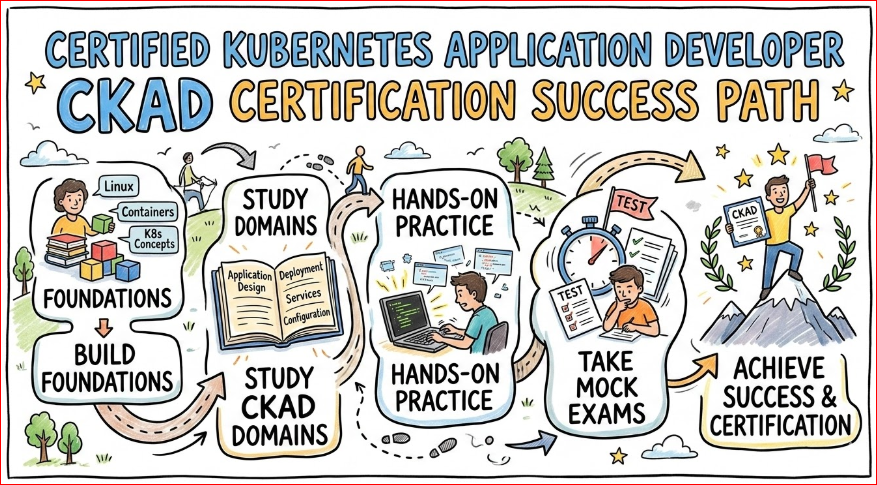
Introduction
I have watched the software landscape shift from bare-metal racking to virtual machines, and now, to the age of container orchestration. Today, Kubernetes is not just an operational tool; it is the platform upon which modern application development is built. If you are a Software Engineer in Bangalore, a Platform Manager in London, or an Engineering Director in Silicon Valley, you have likely realized that knowing “some Docker” is no longer enough. The industry needs developers who can design, build, and troubleshoot applications directly within Kubernetes environments. That is where the Certified Kubernetes Application Developer (CKAD) program comes in. This guide is my attempt to cut through the noise and give you a straight-talking, expert view of what this certification is, why it matters, and exactly how to conquer it.
Why Kubernetes Certification Matters Now
Years ago, we managed applications with shell scripts and hope. Today, we define them declaratively. The shift to microservices means the barrier between infrastructure and code has dissolved. For a developer, Kubernetes knowledge is no longer “optional infrastructure stuff.” If your code runs in a container, you need to understand the ecosystem that hosts it. The CKAD is important because it is not a multiple-choice memory test. It is a performance-based exam. You have to solve real problems on live clusters. Holding this certification proves you possess the practical, hands-on skills required in modern development teams.
The Kubernetes Certification Landscape
Kubernetes Certification Overview Table
| Certification | Track | Level | Who it’s for | Prerequisites | Skills covered | Recommended order |
| Certified Kubernetes Application Developer (CKAD) | Development | Associate/ Professional | Software Engineers, Developers, DevOps Engineers | Basic knowledge of Docker/ OCI containers & Linux command line. | Designing, building, configuring, and troubleshooting cloud-native applications on Kubernetes. | Usually taken first or second (alongside CKA). |
| Certified Kubernetes Administrator (CKA) | Operations/ Admin | Professional | SREs, SysAdmins, DevOps Engineers | Strong Linux administration knowledge. | Cluster installation, networking, storage, security, and troubleshooting. | Taken alongside or before CKAD. |
| Certified Kubernetes Security Specialist (CKS) | Security | Expert | Security Engineers, DevSecOps | Must hold a current CKA. | Cluster hardening, system hardening, minimizing microservices vulnerabilities. | Taken after earning CKA. |
| Kubernetes and Cloud Native Associate (KCNA) | General | Entry | Managers, Juniors, Sales/Recruiters | None. | High-level conceptual overview of Kubernetes and cloud-native ecosystem. | Taken first for absolute beginners. |
Deep Dive: Certified Kubernetes Application Developer (CKAD)
What it is
The CKAD is a practical, performance-based exam. You are given a set of problems to solve at a command line environment. You are not choosing ‘A’ or ‘B’; you are creating pods, fixing broken deployments, and configuring networking on a live cluster within a strict time limit.
Who should take it
This certification is designed primarily for:
- Software Engineers and application developers who are moving into cloud-native development.
- DevOps Engineers who need to focus on the application lifecycle within the cluster.
- Engineering Managers who want a deep, practical understanding of what their teams are dealing with daily.
Skills you’ll gain
Preparing for the CKAD will force you to master critical areas. By the end of your study, you will know how to:
- Work confidently with the Kubernetes API primitives.
- Define and utilize application resources (Pods, Deployments, Services).
- Implement ConfigMaps and Secrets for application configuration.
- Manage storage using PersistentVolumes and Claims.
- Troubleshoot application-level failures within the cluster.
- Optimize container images for Kubernetes deployment.
Real-world projects you should be able to do after it
Once certified, you should have the confidence to handle tasks like:
- Setting up a CI/CD pipeline that builds containers and updates Kubernetes Deployments.
- Migrating a monolithic legacy application into a set of microservices running on a cluster.
- Configuring high availability and auto-scaling for web applications based on traffic.
- Designing health checks (Liveness/Readiness probes) to ensure app self-healing.
- Managing application configurations securely across dev, stage, and prod environments.
Preparation plan
How long you need to prepare depends heavily on your existing experience. Be honest with yourself.
The 14-Day “Crash Course” Plan
- Who for: Experienced engineers using
kubectland Docker daily in production. - Week 1: Review all domains in the official curriculum. Focus heavily on speed. Practice imperative commands (
kubectl run,kubectl create deployment) to save time writing YAML. - Week 2: Take at least 3-4 full simulator exams. Learn to use the documentation (the only resource allowed). Get your time under control. Focus only on gaps found in simulators.
The 30-Day “Standard” Plan
- Who for: Developers who know Docker well but are relatively new to Kubernetes concepts.
- Days 1-10: Theory and basic labs. Understand Pods, Namespaces, Deployments, and Services in detail.
- Days 11-20: Advanced topics. Storage (PV/PVC), Security (ServiceAccounts), and Troubleshooting. Start doing labs repeatedly without looking at solutions.
- Days 21-30: Practice and Speed. Move from YAML files to imperative commands. Take full simulator exams.
The 60-Day “Foundations First” Plan
- Who for: Software Engineers or managers with little container or Linux command-line experience.
- Days 1-15: Master Linux basics (file manipulation, pipes,
grep,viornano) and Docker basics (building images, running containers, volumes). - Days 16-30: Kubernetes basic concepts. Follow the “Standard Plan” from here, but take more time on labs.
- Days 31-45: Deep dive into the CKAD curriculum areas.
- Days 46-60: Intensive simulator practice.
Common mistakes
I have seen many smart engineers fail this exam not due to lack of knowledge, but due to poor strategy.
- Spending too much time on YAML: Typing YAML from scratch kills time. Use imperative commands to generate YAML templates and edit them.
- Not using the context: The exam gives you multiple clusters. If you solve a question in the wrong cluster context, you get zero points.
- Getting stuck: If a question is too hard, flag it and move on. You need to collect easy points quickly.
- Ignoring documentation: You are allowed one tab of official documentation. Learn how to search it efficiently before the exam.
Best next certification after this
Once you have the CKAD, you understand how to put apps in the cluster.
- If you want to understand how the cluster itself works, networking, and maintenance, your next step is CKA.
Strategizing Your Career: Roles and Paths
As a mentor, I don’t want you to just collect badges; I want you to build a career. Kubernetes is the foundation for many different specialized paths.
Choose your path
Here is how Kubernetes knowledge applies across different domain-specific paths:
- DevOps Path: Focuses on bridging dev and ops. Here, you use K8s to create automated, scalable, and reliable delivery pipelines (CI/CD).
- DevSecOps Path: Integrates security into the development lifecycle. This involves scanning container images, defining NetworkPolicies, and ensuring secrets management within Kubernetes.
- SRE Path: Focuses on reliability. SREs use Kubernetes to manage Service Level Objectives (SLOs), configure auto-scaling, set up robust monitoring, and handle incident response automatically.
- AIOps/MLOps Path: Running Machine Learning workloads. Kubernetes is essential here for orchestrating training jobs, managing GPUs as resources, and serving models at scale (using tools like Kubeflow).
- DataOps Path: Managing data pipelines. You will use Kubernetes to orchestrate containerized ETL jobs, manage distributed databases, and handle persistent storage for data applications.
- FinOps Path: Cloud cost management. Within K8s, this means understanding resource requests vs. limits, tagging resources for cost allocation, and optimizing cluster size to reduce waste.
Role → Recommended certifications mapping
| Current or Target Role | Entry Level (The Foundation) | Primary Certification (The Core) | Advanced/Specialized (The Mastery) |
| Software Engineer | KCNA | CKAD | CKA (for infrastructure depth) |
| DevOps Engineer | CKAD | CKA | CKS (Security focus) |
| SRE (Site Reliability) | CKA | CKAD | CKS or Prometheus/Observability |
| Platform Engineer | CKA | CKS | CKAD (to support dev teams) |
| Cloud Engineer | KCNA | CKA | CKAD |
| Security Engineer | CKA | CKS | DevSecOps specialized certs |
| Data Engineer | KCNA | CKAD | DataOps & Stateful workload certs |
| FinOps Practitioner | KCNA | CKA (Resource management) | FinOps Certified Practitioner |
| Engineering Manager | KCNA | CKAD (Technical empathy) | FinOps or Leadership Certs |
The “What’s Next?” Factor: Post-CKAD
Complacency kills careers. Once you pass your CKAD, what do you do next? You have three distinct options depending on your long-term goals.
Next certifications to take (3 options)
- Same track (Operations Focus): If you want to become the undisputed master of Kubernetes within your team, go for the Certified Kubernetes Administrator (CKA). It expands your view from “inside the pod” to the “entire infrastructure.”
- Cross-track (Security Focus): Security is the biggest concern in cloud computing right now. After CKA, take the Certified Kubernetes Security Specialist (CKS). It significantly boosts your market value.
- Leadership (Managerial Focus): If your goal is Engineering Management, Director level, or Architecture, you may not need more hands-on certs. Look into FinOps certifications to understand cloud economics or leadership training focused on digital transformation.
Top Institutions for CKAD Training cum Certification
Self-study works for some, but often, to bridge the gap between “knowing” and “doing,” structured training is necessary. Here are top-tier institutions recognized in India and globally that provide comprehensive training for CKAD.
- DevOpsSchoolDevOpsSchool is a leading global provider for DevOps and Kubernetes training. They offer instructor-led, hands-on courses specifically designed to pass the CKAD exam. Their approach focuses heavily on real-world scenarios and extensive lab work, which is crucial for a performance-based exam.
- CotocusCotocus provides specialized consulting and training in cloud-native technologies. Their CKAD preparation courses are known for deep technical drill-downs and instructors with active consulting experience in Kubernetes environments.
- ScmgalaxyScmgalaxy is a prominent platform focusing on Software Configuration Management and DevOps. They offer structured CKAD workshops and abundant community resources, making them a strong choice for engineers looking for end-to-end configuration management knowledge alongside Kubernetes.
- BestDevOpsTrue to its name, this institution focuses solely on DevOps best practices. Their CKAD training emphasizes the “Application Developer” aspect, ensuring that engineers learn not just
kubectl, but how to architect applications for containerization effectively. - devsecopsschool.comFor those already looking ahead to securing their applications, this institution integrates security best practices early into their Kubernetes developer training, providing a unique DevSecOps angle to CKAD prep.
- sreschool.comFocusing on the Site Reliability Engineering perspective, they train engineers to look at Kubernetes development through the lens of reliability, scalability, and observability, which aligns well with CKAD objectives.
- aiopsschool.comAs Kubernetes becomes the standard for running ML workloads, this school helps developers understand how to use CKAD skills as a stepping stone to AIOps and MLOps engineering.
- dataopsschool.comIf your focus is data engineering, this institution tailors Kubernetes training to help you understand how to manage containerized data pipelines and persistent storage effectively.
- finopsschool.comA unique option for developers moving into cloud cost management, helping engineers understand how their deployment decisions in Kubernetes impact the company’s cloud bill.
FAQs (General Career & Certification)
Q: Is CKAD worth it in 2024/2025?
Yes. Kubernetes is now the industry standard. The CKAD proves practical competency, not just memorization, making it highly valued by hiring managers.
Q: Which is harder, CKAD or CKA?
They are difficult in different ways. CKAD is about application logic, and the time limit is extremely tight. CKA has a broader scope (networking, security, installation) and requires stronger Linux system admin skills. Often, developers find CKA harder, and Ops folks find CKAD harder.
Q: Can I take CKAD without knowing Docker?
You can, but I highly discourage it. Kubernetes orchestrates containers. If you don’t understand container images, layers, volumes, and networks at the Docker level, you will struggle with Kubernetes concepts.
Q: How much time should I allocate for study?
For a working engineer, 1-2 hours a day for 4 to 6 weeks is a realistic average.
Q: I am from a non-coding background. Can I take CKAD?
While you don’t need to be a Python expert, you must understand how applications work. CKAD is for Application Developers. If you have zero IT experience, start with the KCNA first.
Q: Does CKAD help in getting a job abroad?
Yes. Global companies (US, Europe, APAC) value recognized, performance-based certifications as a benchmark for technical competency when hiring internationally.
Q: Is the exam proctored?
Yes, it is remotely proctored. You need a webcam and a quiet room. Someone is watching you on video throughout the exam.
Q: What is the passing score?
The passing score is typically 66%, but this can be adjusted by the Linux Foundation.
Q: What resource is allowed during the exam?
You are allowed one additional tab in your browser to access the official Kubernetes documentation (kubernetes.io/docs and associated subdomains). No other links or notes.
Q: Do I get a free retake?
Yes, generally, the Linux Foundation includes one free retake if you fail on your first attempt.
Q: How long is the CKAD certification valid?
It is valid for 3 years, after which you must renew it.
Q: I am an Engineering Manager. Should I take CKAD?
If your team is using Kubernetes, yes. Taking it gives you fundamental technical empathy for the challenges your developers face daily.
FAQs (Certified Kubernetes Application Developer – CKAD)
Specific questions relating to the CKAD provided through DevOpsSchool.
Q1: What is the exact exam format?
It is a 2-hour, performance-based exam consisting of 15-20 tasks on live Kubernetes clusters. There are no multiple-choice questions.
Q2: What are the main domains covered in the curriculum?
The exam usually covers: Application Design and Build (20%), Application Deployment (20%), Application Observability and Maintenance (15%), Application Environment, Configuration and Security (25%), and Services and Networking (20%).
Q3: What is the official URL for the CKAD certification?
The official URL for this specific program is: https://devopsschool.com/certification/certified-kubernetes-application-developer-ckad.html
Q4: Can I use vi in the exam?
Yes. vi (or vim) is available in the terminal environment. Mastery of vi is almost essential for speed in modifying YAML files. nano is usually available too.
Q5: Is speed really that important in CKAD?
Crucially important. The knowledge required is not insurmountable, but applying that knowledge under extreme time pressure is the real challenge of the CKAD. Practice imperative commands.
Q6: How do I access the training provider?
You can access the main provider page at: https://www.devopsschool.com/
Q7: Can I take the exam using a Windows machine?
Yes, as long as you can access the remote proctoring software via a supported browser (usually Chrome or Chromium-based). You will use a web-based terminal for the actual exam tasks.
Q8: Should I memorize YAML?
No. Memorize where to find examples in the official documentation, and memorize imperative kubectl commands that can generate YAML for you. Memorization is slower than practice.
Testimonials
Don’t just take my word for it. Here are experiences from engineers who took the leap.
“I thought I knew Kubernetes because I could run
kubectl apply. The CKAD training at DevOpsSchool showed me how much I didn’t know about storage and security. It was a tough exam, but I feel far more confident in my daily dev work now.”— Rajesh K., Senior Software Engineer (Bangalore)
“As a manager, I wanted to understand what my team was talking about. KCNA was too high-level. CKAD gave me the perfect mix of theory and hands-on practice. It’s rigorous, and it earned me a lot of respect from my engineering leads.”
— Sarah J., Engineering Manager (London)
“The time pressure is real. I failed the first time because I got stuck on one question. For my retake, I focused purely on speed and imperative commands. I passed with an 85. If you want a job in cloud-native, this is the cert to get.”
— Ahmed M., DevOps Engineer (Dubai)
Conclusion
The transition to cloud-native development is not a passing trend; it is the definitive trajectory of our industry. Kubernetes is at the heart of this shift. As a mentor with two decades watching technologies rise and fall, I can confidently tell you that Kubernetes skill is the soundest investment you can make in your technical career today. The Certified Kubernetes Application Developer (CKAD) program is not an easy journey. It requires discipline, hours of hands-on practice, and a strategic mind on exam day. But that difficulty is exactly what makes the certificate valuable. It proves to you, and to the industry, that you are ready for the modern era of development.