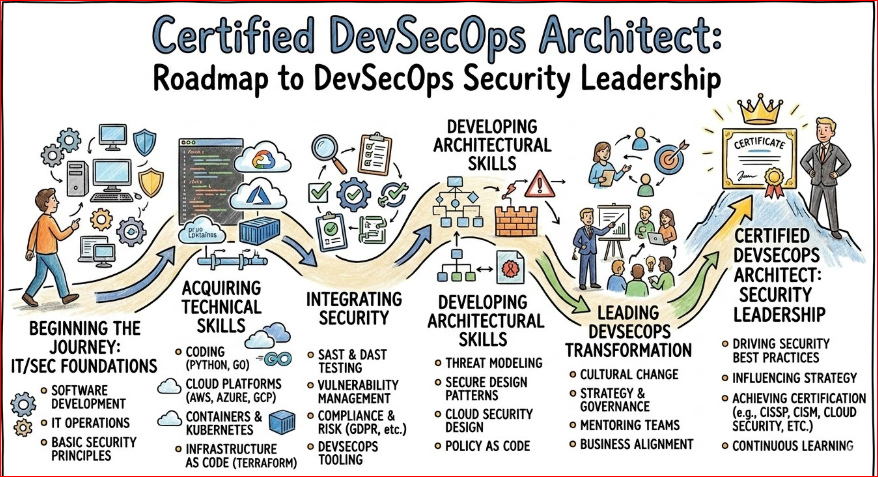
DevSecOps is no longer optional. Security, speed, and reliability must work together in every modern software team. Certified DevSecOps Architect helps you learn how to design systems where security is built-in from day one, not added at the end. If you are a working engineer, architect, or manager, this guide will help you understand what this certification is, who should take it, how to prepare, and how to use it to grow your career.
What is Certified DevSecOps Architect?
Certified DevSecOps Architect is an advanced certification focused on designing secure-by-default DevOps and cloud ecosystems. It goes beyond tools and teaches you how to think like an architect who can balance speed, safety, compliance, and cost. The program is offered by DevSecOpsSchool as part of a broader portfolio of DevSecOps and security-focused training.
Why this certification matters
Modern companies ship software faster than ever. At the same time, security breaches, compliance failures, and supply chain attacks are growing. A DevSecOps Architect sits in the middle of this tension and designs systems that are fast but also safe and compliant. With this certification, you show that you can design secure CI/CD pipelines, embed security into architecture, and lead DevSecOps practices across teams and platforms.
Deep dive: Certified DevSecOps Architect
What it is
Certified DevSecOps Architect teaches you how to architect secure CI/CD pipelines, cloud platforms, and application ecosystems with security baked into every stage.
It focuses on threat modeling, secure SDLC, automated security controls, cloud-native security, and compliance as code for real enterprise environments.
Who should take it
- DevOps engineers moving into security architecture roles
- Security engineers who want to influence pipelines, design, and platforms
- SREs, platform engineers, and cloud engineers who must ensure secure reliability
- Technical leads and managers responsible for governance, risk, and compliance in DevOps teams
Skills you’ll gain
- Designing secure CI/CD pipelines across hybrid and multi-cloud environments
- Applying shift-left security in design, code, and testing stages
- Architecting security for containers, Kubernetes, microservices, and serverless
- Implementing security as code and compliance as code
- Performing threat modeling and risk-based architecture reviews
- Aligning architectures with frameworks like NIST, OWASP SAMM, and SLSA
- Integrating vulnerability management, SAST, DAST, SCA into pipelines
- Leading DevSecOps adoption and cultural change programs
Real-world projects you should be able to do after it
- Design a secure CI/CD pipeline with automated SAST, DAST, SCA, and secrets management for a microservices application
- Build a security reference architecture for a multi-cloud or hybrid environment with Kubernetes and managed services
- Define and implement compliance as code for standards like ISO 27001 or SOC 2 across environments
- Create threat models for critical systems and propose mitigation strategies
- Lead a DevSecOps transformation roadmap for a product or business unit
Preparation plan
You can choose your study plan depending on your current experience.
- 7–14 days (fast track)
- 30 days (standard plan)
- Ideal for working engineers who can study consistently each week.
- Week 1: DevSecOps basics, secure SDLC, threat modeling.
- Week 2: CI/CD security, SAST, DAST, SCA, secrets management.
- Week 3: Cloud-native security, Kubernetes, containers, serverless.
- Week 4: Compliance as code, governance, and architecture case studies.
- 60 days (deep plan)
Common mistakes to avoid
- Treating this like a “tools-only” certification instead of an architecture and design program.
- Ignoring threat modeling and focusing only on scanners and dashboards.
- Over-focusing on one cloud or one toolchain instead of designing patterns that work across platforms.
- Not tying designs to business risk, compliance needs, and developer experience.
- Studying theory without doing at least a few end-to-end architecture exercises.
Best next certification after this
After Certified DevSecOps Architect, many professionals move into:
- More specialized DevSecOps or security engineering certifications (hands-on pipelines and tools)
- SRE or reliability-focused certifications to balance security and availability
- Cloud security or advanced architecture certificates from major clouds to deepen platform skills
Certification overview table
Below is a simple view of how Certified DevSecOps Architect fits into the broader DevOps and security career space. This is a conceptual guide, not an official catalog.
Choose your path: 6 learning paths
Once you understand DevSecOps architecture, you can grow your career along different paths. Here are six practical learning paths.
1. DevOps path
Focus: speed, automation, and platform engineering.
- Start: DevOps fundamentals and CI/CD practices
- Then: containerization, Kubernetes, infrastructure as code
- Add: monitoring, observability, incident response
- Finally: Certified DevSecOps Architect to make your DevOps work secure by design
2. DevSecOps path
Focus: end-to-end security in the SDLC and pipelines.
- Start: DevOps + basic application security concepts
- Then: DevSecOps practitioner or professional-level training
- Next: Certified DevSecOps Architect to move into architecture and leadership
- Later: Specialized certifications in cloud security, container security, or supply chain security
3. SRE path
Focus: reliability, performance, and resilience.
- Start: SRE practices, SLOs, error budgets, incident management
- Then: observability, logging, tracing, capacity planning
- Add: security considerations in reliability and incident response
- Use: Certified DevSecOps Architect to ensure reliability designs remain secure and compliant
4. AIOps/MLOps path
Focus: intelligent operations and production-grade machine learning.
- Start: basic MLOps concepts, pipelines, and monitoring
- Then: AIOps concepts, anomaly detection, event correlation
- Combine: DevSecOps principles so ML and AI systems are secure and compliant
- Use: DevSecOps architecture ideas to secure data pipelines, models, and deployment platforms
5. DataOps path
Focus: reliable, secure, and governed data pipelines.
- Start: data engineering basics, ETL/ELT, data warehousing
- Then: DataOps principles, testing, versioning, observability of data flows
- Add: DevSecOps architecture skills to secure data pipelines and govern access
- Outcome: design end-to-end secure data platforms for analytics and AI
6. FinOps path
Focus: cloud cost optimization with security and compliance in mind.
- Start: FinOps principles, cost allocation, budgeting
- Then: cloud usage optimization and multi-cloud cost governance
- Add: DevSecOps and security architecture to ensure cost strategies do not weaken security
- Result: you can design environments that are cost-efficient, secure, and compliant.
Role → Recommended certifications
Use this as a quick map from job role to recommended certification direction, with Certified DevSecOps Architect as a key advanced step.
Next certifications to take after Certified DevSecOps Architect
After you complete Certified DevSecOps Architect, you can grow in three strategic directions:
- Same-track (deep DevSecOps specialization)
- Advanced DevSecOps or DevSecOps Professional focused on hands-on labs and pipelines
- Cloud-native security or container security certifications to deepen platform security
- Cross-track (breadth across DevOps/SRE/Data)
- SRE or reliability-focused certifications to connect security with reliability
- DataOps or MLOps certifications if you work with data or ML-heavy systems
- Leadership (strategy and management)
- Architecture, governance, or security management programs that focus on policy, risk, and leadership
- Cloud or enterprise architecture tracks from major cloud providers
Top institutions for Certified DevSecOps Architect training
These institutions can help you with training, labs, and guidance related to DevSecOps and this certification space.
DevOpsSchool
DevOpsSchool provides structured training programs in DevOps, DevSecOps, SRE, and related areas, with a strong focus on hands-on labs and practical projects.
They run live, interactive classes and self-paced content aimed at working engineers who want real-world skills, not just theory.
Cotocus
Cotocus works as a consulting and enablement partner, helping organizations adopt DevOps and DevSecOps practices through training, workshops, and implementation support.
It focuses on role-based paths for engineers, architects, and managers who want to roll out modern delivery and security at scale.
Scmgalaxy
Scmgalaxy offers training and mentoring around source control, CI/CD, configuration management, and DevOps practices.
It is useful for engineers who want to strengthen their delivery pipelines before taking a DevSecOps architecture path.
BestDevOps
BestDevOps curates learning resources, articles, and programs related to DevOps, cloud, SRE, and DevSecOps.
It is a good place to stay updated with practices and trends while you prepare for advanced certifications.
devsecopsschool.com
DevSecOpsSchool is the dedicated provider of the Certified DevSecOps Architect program and related DevSecOps certifications.
They focus on secure-by-design architectures, pipelines, and governance for modern cloud-native and DevOps environments, with practice-oriented courses.
sreschool.com
SRESchool specializes in Site Reliability Engineering training and related reliability skills.
It is a natural companion if you want to combine security architecture with strong reliability and SRE practices.
aiopsschool.com
AIOpsSchool focuses on AIOps, automation, and intelligent operations.
This is useful if you plan to extend your DevSecOps skills into AI-driven monitoring, anomaly detection, and automated remediation.
dataopsschool.com
DataOpsSchool aims at training engineers on DataOps, data pipeline reliability, and governance.
If your systems are data-heavy, pairing Certified DevSecOps Architect with DataOps training gives you strong end-to-end coverage.
finopsschool.com
FinOpsSchool focuses on cloud cost management, budgeting, and financial operations in the cloud.
Combining FinOps and DevSecOps helps you design secure, compliant architectures that are also cost-optimized.
FAQs about Certified DevSecOps Architect (12+)
1. Is Certified DevSecOps Architect difficult?
It is challenging but manageable if you already work with DevOps, cloud, or security.
The hardest part is not memorizing tools but learning to think in architecture patterns and trade-offs.
2. How long does it take to prepare?
Most working engineers need between 30 and 60 days with steady effort.
If you are very experienced, you can complete focused preparation in 7–14 days.
3. Do I need prior DevSecOps experience?
You should be comfortable with DevOps basics, cloud platforms, and at least foundational security concepts.
Hands-on pipeline experience helps a lot, even if you have not worked as “DevSecOps” yet.
4. Should I do a DevSecOps practitioner/professional cert first?
If you are new to DevSecOps, yes, a practitioner or professional-level certification is a good first step.
If you already design or review pipelines and architectures, you can directly target the Architect level.
5. Is this useful for managers?
Yes. Engineering managers, security leaders, and architects can use this certification to better guide teams and make design decisions that balance security, speed, and cost.
6. How does it help my salary and career?
DevSecOps architect roles are in high demand and often command higher salaries than pure DevOps or security engineer roles.
The certification signals that you can own end-to-end security design, not just individual tools.
7. Is this more about tools or concepts?
It is both, but the focus is on concepts and architecture patterns that survive tool changes.
You will still work with common tools like SAST/DAST/SCA and cloud-native security services.
8. Can developers benefit from this?
Yes. Senior developers and tech leads can use this to design secure components, influence architecture decisions, and grow into architect roles.
9. Does it cover cloud security?
Yes, it includes multi-cloud security, secure reference architectures, and cloud-native patterns for containers and serverless.
10. Is hands-on practice required?
Strongly yes. You should design at least a few complete architectures, pipelines, and threat models during preparation.
11. How does it compare with other DevSecOps certifications?
Many DevSecOps certifications focus on tools and end-to-end pipelines, while Certified DevSecOps Architect emphasizes architecture, governance, and strategic design across systems.
12. What if my company is still early in DevOps?
Then this certification can position you as a change agent who can guide the move from traditional delivery to secure DevOps.
13. Is it relevant outside pure tech companies?
Yes. Any organization that builds or runs software—banks, telecoms, healthcare, SaaS, government—needs secure delivery systems and architectures.
14. Do I need to specialize in one cloud?
No, but you should be comfortable with at least one major cloud. The concepts apply across AWS, Azure, and GCP.
Additional FAQs focused only on this certification
1. What is the main outcome of Certified DevSecOps Architect?
You should be able to design secure DevOps architectures that integrate security into every stage of the SDLC and platform.
2. Is this certification vendor-neutral?
It focuses on principles and patterns that can be applied across tools and clouds, while still showing common toolchains.
3. Can I take it if I am only a developer today?
Yes, if you are a mid-level or senior developer with exposure to CI/CD and cloud, you can prepare and grow into an architect mindset.
4. Do I need formal architecture experience?
Formal “architect” titles are not mandatory, but you should be comfortable thinking in systems, components, and trade-offs.
5. How practical is the content?
The program includes real-world scenarios, case studies, and projects that map closely to actual enterprise environments.
6. Does it cover compliance and regulations?
Yes, you will learn how to align architectures with standards like ISO 27001, GDPR, HIPAA, and SOC 2 using compliance as code.
7. Can this help me move into a security leadership role?
It is a strong step if you want to move into security architecture, DevSecOps leadership, or head of platform/security roles.
8. Do I need to code deeply for this exam?
You should understand code, pipelines, and automation, but the focus is more on design, integration, and policy than on writing complex algorithms.
Conclusion
Certified DevSecOps Architect is a powerful step for engineers and managers who want to move from “using security tools” to “designing secure systems.” It helps you connect DevOps, security, cloud, reliability, and governance into one clear architecture view that supports real business outcomes. If you are already working with CI/CD, cloud, or security and want more influence, this certification can be a turning point in your career.