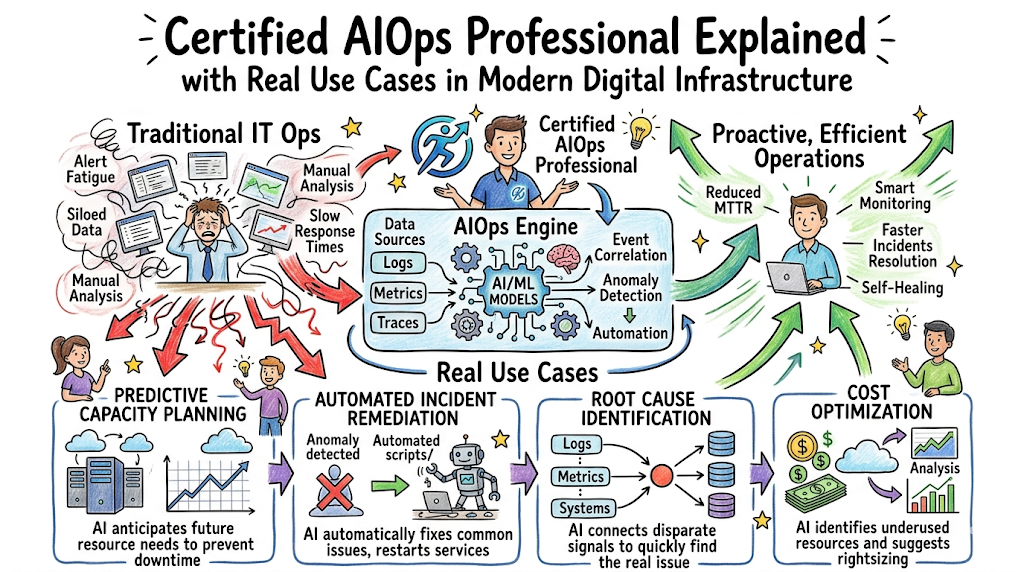
In the current landscape of cloud-native systems, the role of operations is undergoing a massive transformation toward intelligence and automation. This guide is designed for engineering professionals who want to understand the Certified AIOps Professional program and its impact on their career trajectory. As infrastructure grows in complexity, manual management is no longer feasible, making AIOps a mandatory skill set for SREs and DevOps leads. By following this roadmap, you will learn how to transition from reactive monitoring to proactive, AI-driven observability. The program, primarily supported by Aiopsschool, helps professionals navigate the intersection of big data, machine learning, and infrastructure management. This comprehensive guide will help you decide which path aligns best with your existing skills and future goals.
What is the Certified AIOps Professional?
The Certified AIOps Professional is a global benchmark for engineers who aim to apply artificial intelligence to IT operations. It represents a shift from traditional, human-led monitoring to autonomous, self-healing systems. The certification exists to validate an engineer’s ability to handle massive telemetry data and use algorithmic models to predict and resolve incidents. It focuses on real-world production environments where data quality and model accuracy directly impact business uptime. By moving beyond theoretical machine learning, it aligns with modern engineering workflows that require speed and reliability.
Who Should Pursue Certified AIOps Professional?
This certification is ideal for a wide range of professionals, including DevOps engineers, Site Reliability Engineers, and Platform Architects. Cloud professionals who manage distributed systems and security analysts looking to automate threat detection will also find it highly relevant. It is particularly beneficial for engineering managers who need to oversee the digital transformation of their operations teams. Beginners can use the foundation level to enter the field, while experienced seniors use the advanced tracks to solidify their architectural expertise. The relevance of this certification is significant for the global tech market, providing a clear competitive edge in both India and international markets.
Why Certified AIOps Professional is Valuable in the Future and Beyond
The value of this certification lies in its focus on the next generation of IT operations, where AI is the core driver of efficiency. Enterprise adoption of AIOps is accelerating as companies realize that manual observability cannot scale with microservices. This program ensures that professionals stay relevant even as specific tools change, by teaching the underlying principles of algorithmic operations. It offers a high return on time investment because it bridges the gap between infrastructure engineering and data science. Professionals with this credential are often prioritized for leadership roles in digital-first organizations that value autonomous stability.
Certified AIOps Professional Certification Overview
The program is a comprehensive educational journey delivered via the official Certified AIOps Engineer course and hosted on the Aiopsschool platform. It is structured into practical modules that cover the entire lifecycle of an AIOps project, from data ingestion to automated remediation. The certification approach is heavily focused on assessments that test practical skills rather than just rote memorization of concepts. It provides a clear ownership of skills, ensuring that candidates can independently design and deploy AIOps solutions. The structure is designed to be flexible, allowing professionals to progress at their own pace while maintaining a high standard of technical mastery.
Certified AIOps Professional Certification Tracks & Levels
The certification is organized into three primary levels: Foundation, Professional, and Advanced. The Foundation level is the starting point, focusing on core concepts such as noise reduction, event correlation, and the AIOps maturity model. The Professional level dives into the technical implementation of algorithmic models for anomaly detection and root cause analysis. The Advanced level is geared toward architects and technical leaders responsible for designing global-scale AIOps platforms. These levels are designed to align with career progression, helping an engineer move from basic execution to high-level strategic planning.
Complete Certified AIOps Professional Certification Table
| Track | Level | Who it’s for | Prerequisites | Skills Covered | Recommended Order |
| Core AIOps | Foundation | Beginners, Managers | Basic IT Knowledge | Telemetry, Noise Reduction | 1 |
| Core AIOps | Professional | SREs, DevOps Engineers | 2+ Years Experience | Anomaly Detection, RCA | 2 |
| Core AIOps | Advanced | Architects, Tech Leads | Professional Cert | System Design, Governance | 3 |
| SRE Focus | Professional | Site Reliability Leads | Foundation Level | SLIs/SLOs via AI | 1 |
| FinOps Focus | Professional | Cloud Cost Managers | Foundation Level | Cost Prediction Models | 1 |
| SecOps Focus | Professional | Security Engineers | Foundation Level | Automated Threat Hunting | 1 |
Detailed Guide for Each Certified AIOps Professional Certification
Certified AIOps Professional – Foundation Level
What it is
This certification validates a foundational understanding of how artificial intelligence transforms traditional IT operations into intelligent, autonomous systems. It confirms that the holder understands the primary terminology, the data lifecycle, and the core pillars of the AIOps maturity model.
Who should take it
It is suitable for IT generalists, system administrators, and technical project managers who need to understand the strategic value of AIOps. It is also the ideal starting point for experienced DevOps engineers who are new to machine learning concepts.
Skills you’ll gain
- Understanding the difference between Big Data and Machine Learning in IT.
- Techniques for alert noise reduction and event correlation.
- Fundamentals of anomaly detection in time-series data.
- Knowledge of the AIOps implementation roadmap for enterprises.
Real-world projects you should be able to do
- Categorize and clean a dataset of unstructured system logs.
- Identify patterns in historical performance metrics using basic analysis.
- Create a proposal for an AIOps pilot project within a small team.
Preparation plan
- 7–14 days: Review the official course modules and master the core AIOps terminology and definitions.
- 30 days: Spend time in the virtual labs practicing data ingestion and simple alert configuration.
- 60 days: Study real-world case studies and take multiple practice exams to ensure conceptual mastery.
Common mistakes
- Skipping the fundamental data science concepts that underpin operational algorithms.
- Focusing too much on specific monitoring tools rather than the underlying AIOps principles.
Best next certification after this
- Same-track option: Professional Level Certified AIOps Professional.
- Cross-track option: Certified SRE Professional.
- Leadership option: Technical Team Lead Certification.
Certified AIOps Professional – Professional Level
What it is
This level focuses on the practical application of machine learning models to solve complex infrastructure problems. It validates the ability to build, deploy, and maintain AIOps pipelines that provide real-time insights and automated responses.
Who should take it
This is designed for SREs and DevOps engineers who have at least two years of experience in production environments. Candidates should be comfortable with scripting and have a basic understanding of data manipulation using Python.
Skills you’ll gain
- Implementing automated root cause analysis (RCA) frameworks.
- Tuning anomaly detection algorithms to reduce false positives in high-scale systems.
- Developing self-healing scripts triggered by AI-driven insights.
- Integrating AIOps tools with existing ITSM and CI/CD pipelines.
Real-world projects you should be able to do
- Deploy a machine learning model that predicts potential system outages before they occur.
- Build a centralized dashboard that correlates events across multi-cloud environments.
- Implement a noise-suppression engine that reduces alert fatigue by at least fifty percent.
Preparation plan
- 7–14 days: Review Python for data science and learn about popular ML frameworks used in operations.
- 30 days: Complete all advanced lab exercises focusing on model deployment and integration.
- 60 days: Build a comprehensive portfolio project that demonstrates a full AIOps pipeline from data to action.
Common mistakes
- Ignoring the importance of data quality, which leads to inaccurate “garbage in, garbage out” models.
- Over-engineering simple problems with complex neural networks when simpler models would suffice.
Best next certification after this
- Same-track option: Advanced Level Certified AIOps Professional.
- Cross-track option: MLOps Engineer Certification.
- Leadership option: Senior Engineering Manager Program.
Certified AIOps Professional – Advanced Level
What it is
The advanced level focuses on the architecture, governance, and long-term strategy of AIOps at an enterprise scale. It validates the skills needed to lead a complete organizational transition toward AI-driven autonomous operations.
Who should take it
This is for principal engineers, cloud architects, and senior managers who are responsible for the overall technical direction of their company. It requires a deep understanding of both technical implementation and business strategy.
Skills you’ll gain
- Designing scalable, multi-tenant AIOps platform architectures.
- Establishing data governance, privacy, and ethics policies for AI in operations.
- Calculating and presenting the ROI of AIOps to non-technical stakeholders.
- Leading organizational change to adopt an AI-first operations culture.
Real-world projects you should be able to do
- Design a multi-cloud observability strategy powered by a custom AIOps platform.
- Implement a global event correlation engine for a Tier-1 enterprise environment.
- Lead a migration from legacy monitoring to a modern, self-healing platform.
Preparation plan
- 7–14 days: Study enterprise architecture patterns for big data and high-scale streaming.
- 30 days: Conduct a mock technical audit of an AIOps implementation to identify gaps.
- 60 days: Write a detailed technical roadmap or whitepaper on solving a specific AIOps challenge.
Common mistakes
- Neglecting the cultural and human aspects of moving toward autonomous operations.
- Focusing only on the technical stack while ignoring the financial and legal implications of AI.
Best next certification after this
- Same-track option: AI Research Fellow in Operations.
- Cross-track option: FinOps Certified Practitioner.
- Leadership option: Chief Technology Officer (CTO) Program.
Choose Your Learning Path
DevOps Path
The DevOps path focuses on integrating AIOps into the continuous delivery pipeline to increase release velocity. You will learn how to use AI to analyze test results and deployment metrics to prevent broken code from reaching production. This path emphasizes “Smart Pipelines” that can automatically roll back or pause deployments based on real-time risk assessment. It is perfect for engineers who want to automate the friction between dev and ops teams.
DevSecOps Path
In the DevSecOps path, the priority is using AI to enhance the security posture of an organization. You will study how machine learning can detect unusual access patterns, potential vulnerabilities, and malware traffic in real-time. This path teaches how to automate security responses within the infrastructure, moving toward an “Auto-SOC” model. It is ideal for security professionals who want to apply AIOps to threat hunting and compliance.
SRE Path
The SRE path is dedicated to system reliability and managing error budgets with extreme precision. You will learn how to use predictive analytics to forecast potential SLI breaches and automate the remediation of recurring issues. This path focuses on the mathematical side of AIOps, using algorithms to optimize system performance and minimize downtime. It is the definitive choice for those responsible for the stability of high-traffic, global services.
AIOps Path
The dedicated AIOps path is for those who want to become specialists in building the AI platforms themselves. This involves deep knowledge of data science platforms, streaming data architectures, and the orchestration of machine learning models. You will focus on the underlying infrastructure that enables other teams to use AI for their specific operational needs. It is best for engineers who love the “plumbing” of big data and advanced algorithms.
MLOps Path
The MLOps path bridges the gap between data science and production engineering by managing the machine learning lifecycle. You will learn how to version models, monitor for data drift, and ensure that AI models remain accurate over time. This path is essential for organizations that are deploying their own custom ML models for business or operational use cases. It is perfect for engineers who want to specialize in the operationalization of AI at scale.
DataOps Path
DataOps focuses on the automated, policy-based management of data to improve its quality and delivery speed. In this path, you will learn how to build robust data pipelines that feed into AIOps engines, ensuring high data integrity. It applies DevOps principles to data management, focusing on reducing the time it takes to turn raw data into actionable insights. This path is ideal for data engineers who want to support the AI transition.
FinOps Path
The FinOps path applies AIOps to the world of cloud financial management to optimize spending and resource utilization. You will learn how to use machine learning to predict cloud costs and identify wasted resources across multi-cloud environments. This path blends technical expertise with financial acumen, helping organizations maximize the value of their cloud investment. It is a critical path for those responsible for the business side of infrastructure.
Role → Recommended Certified AIOps Professional Certifications
| Role | Recommended Certifications |
| DevOps Engineer | Certified AIOps Foundation, Professional (DevOps Track) |
| SRE | Certified AIOps Professional, Advanced (SRE Track) |
| Platform Engineer | Certified AIOps Professional, Advanced |
| Cloud Engineer | Certified AIOps Foundation, Professional |
| Security Engineer | Certified AIOps Professional (SecOps Track) |
| Data Engineer | Certified AIOps Professional (DataOps Track) |
| FinOps Practitioner | Certified AIOps Professional (FinOps Track) |
| Engineering Manager | Certified AIOps Foundation, Advanced |
Next Certifications to Take After Certified AIOps Professional
Same Track Progression
Deep specialization within the AIOps field involves mastering specific platforms or advanced data science techniques. After achieving the advanced level, you should look into certifications for specialized AIOps tools like Dynatrace, Datadog, or New Relic. These certifications will allow you to apply your broad architectural knowledge to the specific interfaces and features of industry-leading software. This ensures you remain the primary expert for the specific stack used by your organization.
Cross-Track Expansion
Broadening your expertise into related “Ops” domains is a great way to become a versatile technical leader. Moving into MLOps after AIOps is a natural progression, as it allows you to manage the very models that power your automated operations. Alternatively, a move into DevSecOps can help you apply your AI knowledge to the critical area of cybersecurity. These cross-track expansions make you more valuable in a market that increasingly demands interdisciplinary skills.
Leadership & Management Track
For those looking to move into high-level management, the next step is to pursue certifications focused on engineering leadership and digital strategy. Understanding AIOps provides you with the technical credibility to lead large-scale digital transformation initiatives. You can transition into roles such as Director of Platform Engineering or CTO by demonstrating how AI-driven operations drive business value. This track focuses on people management, budgeting, and long-term technical roadmaps.
Training & Certification Support Providers for Certified AIOps Professional
DevOpsSchool
DevOpsSchool is a premier destination for engineers looking to master modern operational technologies. They offer an extensive range of courses that blend theoretical knowledge with high-intensity practical labs. Their AIOps curriculum is designed by industry veterans who have spent decades managing large-scale infrastructure. They provide 24/7 access to cloud labs and a robust community of learners and mentors. Their focus is on ensuring that students don’t just pass the exam but gain the skills needed to solve real production issues immediately. DevOpsSchool is widely recognized for its high success rate and its commitment to keeping its content updated with the latest industry trends and tool updates.
Cotocus
Cotocus is a specialized consulting and training organization that works closely with global enterprises to modernize their IT practices. Their training programs are unique because they are led by active consultants who bring real-world corporate challenges into the classroom. They offer a white-glove learning experience with small batch sizes and personalized mentorship. For the Certified AIOps Professional, Cotocus provides a deep dive into architectural patterns and enterprise-scale implementations. They focus on the strategic value of AIOps, making their training ideal for senior engineers and architects who need to lead team-wide transitions. Their reputation for excellence makes them a top choice for professionals seeking high-end technical training.
Scmgalaxy
Scmgalaxy is one of the most respected community-driven platforms in the DevOps and AIOps space. It serves as a massive repository of free resources, tutorials, and open-source project guides that supplement formal training. Their certification support is built around a “learning by sharing” philosophy, where experts and students interact to solve complex technical problems. Scmgalaxy is the perfect place for engineers who want to go beyond the syllabus and understand the community-vetted best practices for AIOps. They offer specialized workshops and webinars that focus on the “how-to” of implementing AI in diverse infrastructure environments. Their long-standing presence in the industry makes them a trusted voice for operational excellence.
BestDevOps
BestDevOps is known for its career-focused bootcamps that help professionals transition into high-growth roles like AIOps Engineer. Their training is characterized by its rigorous practical focus, where students spend the majority of their time building and troubleshooting real AIOps pipelines. They emphasize the use of open-source stacks like ELK and Prometheus to ensure that students have a versatile skill set. BestDevOps provides excellent career support, including resume reviews and mock interviews tailored to the AIOps market. Their programs are designed for efficiency, helping busy professionals gain deep technical mastery in a relatively short amount of time. They are an ideal choice for those who want a results-oriented learning path.
devsecopsschool.com
Devsecopsschool.com is the leading authority on integrating security into the modern DevOps lifecycle. Their AIOps training is uniquely tailored to the needs of security professionals, focusing on how AI can be used for automated threat detection and response. They provide deep technical training on using machine learning to identify anomalies in network traffic and system behavior. Their instructors are experts in both cybersecurity and automated operations, providing a balanced perspective that is rare in the industry. For anyone pursuing the DevSecOps track within the AIOps certification, this school offers the most relevant and specialized content available. They are dedicated to building the next generation of intelligent security engineers.
sreschool.com
Sreschool.com focuses exclusively on the principles and practices of Site Reliability Engineering. Their approach to AIOps training is centered on how AI can be used to maintain high availability and performance in distributed systems. They teach students how to manage error budgets, SLOs, and incident response using algorithmic models. The training here is highly analytical, making it perfect for engineers who love deep-diving into system metrics and performance tuning. Sreschool.com provides a structured roadmap for SREs to move from manual monitoring to advanced observability. Their focus on reliability makes them an essential partner for anyone responsible for the uptime of critical digital services.
aiopsschool.com
Aiopsschool.com is the official home and primary delivery platform for the Certified AIOps Professional certification. They provide the most direct and comprehensive curriculum, designed specifically to meet the requirements of the certification exam. Their courses cover all levels from Foundation to Advanced, ensuring a seamless journey for any professional. By learning directly from the source, students are guaranteed to receive the most accurate and up-to-date information regarding the certification standards. Aiopsschool.com offers a variety of learning formats, including self-paced modules and instructor-led sessions. Their platform is the gold standard for anyone serious about achieving and maintaining their AIOps credentials.
dataopsschool.com
Dataopsschool.com addresses the critical need for high-quality data pipelines in the AI-driven world. They teach the “plumbing” of AIOps, focusing on how to collect, clean, and transport massive amounts of telemetry data with high reliability. Their training is essential for data engineers who want to support AIOps initiatives by ensuring that the underlying data is of the highest quality. They apply DevOps principles to the data lifecycle, emphasizing automation and speed. At dataopsschool.com, students learn how to build the robust foundations that make AI models successful in a production environment. Their specialized focus makes them a key resource for the data-centric side of modern operations.
finopsschool.com
Finopsschool.com is dedicated to the growing field of cloud financial management and its integration with automated operations. They provide specialized training on using AIOps to predict cloud costs, identify waste, and optimize resource utilization. This school is unique in its blend of technical, financial, and business training. They help professionals understand the economic impact of their technical decisions, making them more effective leaders. For those looking to master the FinOps track of the AIOps certification, this school offers the most focused and practical curriculum. They are the premier destination for anyone looking to drive business value through cloud-native financial intelligence.
Frequently Asked Questions (General)
- What is the level of difficulty for the Certified AIOps Professional exam?The exam difficulty is considered moderate to high, as it requires both theoretical knowledge of AI and practical experience with infrastructure. It is designed to test your ability to apply these concepts in real-world scenarios.
- How long should I expect to study for this certification?Depending on your background, preparation typically takes between one and three months. Most professionals find that sixty days of dedicated study is sufficient to master the professional level concepts.
- Are there any specific prerequisites for the foundation level?There are no formal prerequisites for the foundation level, though a basic understanding of IT operations and Linux is highly recommended. It is built to be accessible for those just starting their AIOps journey.
- Is the Certified AIOps Professional exam conducted online?Yes, the exam is available online through a proctored environment, allowing you to take it from any location globally. This makes it convenient for working professionals with busy schedules.
- Does the certification expire, and how often do I need to renew?The certification is generally valid for two to three years, after which you may need to renew it by taking an updated assessment. This ensures that your skills stay current with the rapidly evolving AIOps landscape.
- What is the typical return on investment for this program?The ROI is seen in both salary growth and career advancement, with many graduates moving into senior SRE and architectural roles. Organizations value the ability to reduce operational costs through intelligent automation.
- Does the program require deep knowledge of mathematics or data science?While you don’t need to be a data scientist, you should have a basic grasp of statistical concepts and how algorithms function. The focus is more on the application of these tools than on deep mathematical theory.
- Is this certification recognized by large global tech firms?Yes, the Certified AIOps Professional is highly regarded by major cloud providers and enterprise IT organizations worldwide. It is a recognized benchmark for modern, AI-driven operational excellence.
- What is the difference between this and a standard DevOps cert?A standard DevOps certification focuses on CI/CD and cultural shifts, while this one focuses specifically on using AI to automate operations. It adds a layer of intelligence to traditional DevOps practices.
- Are there hands-on labs included in the training?Yes, all levels of the training include access to virtual lab environments where you can practice real-world scenarios. This hands-on experience is a core part of the learning and assessment process.
- Can I jump straight to the Advanced level if I have experience?It is generally recommended to follow the levels sequentially to ensure you have no gaps in your foundational knowledge. However, those with significant experience can often move through the early levels very quickly.
- How does this certification help an engineering manager?It provides managers with the technical vocabulary and strategic understanding needed to lead AI-driven transitions. It helps them make informed decisions about tool selection, budgeting, and team structure.
FAQs on Certified AIOps Professional
- What are the core technical pillars of the Certified AIOps Professional curriculum?The curriculum is built around four main pillars: Data Selection, Pattern Discovery, Event Correlation, and Automated Remediation. You will learn how to manage the entire flow of data from ingestion to final action.
- Does the certification cover specific tools like Splunk, Datadog, or Dynatrace?The certification is designed to be vendor-neutral, focusing on the architectural principles that apply to all major tools. This ensures your skills remain valuable regardless of which platform your company chooses to use.
- How does this certification address the issue of “Alert Fatigue”?A major part of the training focuses on noise reduction and event correlation techniques using machine learning. You will learn how to group related events into a single incident, significantly reducing the volume of alerts.
- Is there a specific track for professionals working in high-compliance industries?Yes, the advanced levels and the DevSecOps track address the governance and security requirements for regulated industries. This includes managing data privacy and ensuring transparency in AI-driven decision-making.
- How does AIOps help in reducing Mean Time To Resolution (MTTR)?By using automated root cause analysis, AIOps can identify the source of an issue much faster than a human operator. The certification teaches you how to build the systems that provide these rapid, accurate insights.
- What is the role of Python in the Certified AIOps Professional program?Python is used as the primary language for data manipulation and for writing the custom automation scripts taught in the professional level. You don’t need to be an expert, but basic coding skills are essential.
- Does the certification cover the ethical implications of AI in operations?Yes, the higher levels of the program include modules on AI ethics, focusing on transparency and the human-in-the-loop requirement. It is important to ensure that automated systems remain under human oversight.
- Can I apply AIOps principles to legacy, on-premise infrastructure?Absolutely, the principles of AIOps are applicable to both modern cloud-native stacks and legacy on-premise environments. The training covers how to ingest and analyze data from a wide variety of infrastructure types.
Final Thoughts
From the perspective of a senior mentor who has seen the evolution of operations from physical servers to complex microservices, the transition to AIOps is inevitable. The Certified AIOps Professional program is not just another badge to add to your profile; it is a fundamental shift in how you perceive and manage digital systems. It provides the structured learning path needed to move away from the “firefighting” culture that has plagued IT operations for decades. By embracing AI, you are not replacing yourself, but rather upgrading your role to that of an architect of intelligent systems.
The real value of this certification lies in its ability to ground you in practical, production-ready skills that have immediate impact. While the technology is advanced, the goals remain the same: reliability, performance, and efficiency. If you are willing to put in the effort to master these new tools, you will find yourself at the very top of the engineering talent pool. My advice is to start with the foundation, build your hands-on skills in the labs, and never stop looking for ways to make your systems smarter and more autonomous.