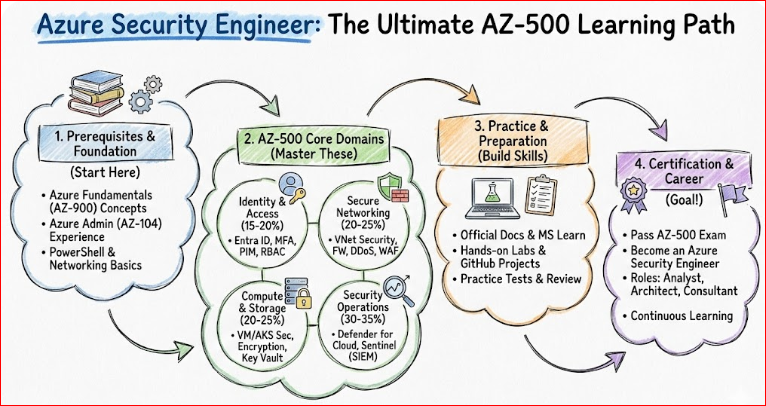
Introduction
Cloud security is no longer optional. As organizations move workloads to Azure, one breach can cost millions — and careers. The threat landscape is more sophisticated than ever, with ransomware, identity attacks, and supply chain vulnerabilities targeting cloud infrastructure daily. If you work with Azure environments and want to prove you can actually secure them, the Azure Security Engineer Associate (AZ-500) certification is one of the most respected credentials you can earn today. It validates that you are not just someone who uses Azure — you are someone who protects it. This guide covers everything — what the exam tests, who it is for, how to prepare, what real-world jobs it unlocks, and which certifications to take next. Whether you are a working engineer in Bengaluru, a cloud architect in London, or a security manager in New York, this guide is written for you. It is practical, honest, and based on what actually works — not just what sounds good on paper.
What is AZ-500?
The AZ-500 is a Microsoft certification that validates your ability to implement, manage, and monitor security controls across Azure, multi-cloud, and hybrid environments. It is not a theoretical exam — Microsoft expects you to demonstrate hands-on experience with real Azure services. The exam tests how well you can respond to real security scenarios: configuring identity protection, locking down networks, managing secrets, and detecting threats before they become incidents. It sits at the Associate level, meaning it requires foundational Azure knowledge but goes deep into security-specific skills like identity protection, network hardening, threat management, and compliance. Unlike entry-level certifications that focus on “what is this service,” AZ-500 asks “how do you secure it at scale.” That practical depth is exactly why hiring managers and security teams take this certification seriously.
Who Should Take AZ-500?
This certification is a strong fit if you are:
- A cloud or security engineer managing Azure infrastructure who wants to formalize their security knowledge
- A DevSecOps engineer who wants to embed security into pipelines and shift security left in the development lifecycle
- A platform engineer or SRE responsible for hardening cloud environments against misconfigurations and threats
- A software engineer building cloud-native applications who needs to understand secure coding, secrets management, and identity patterns in Azure
- A cloud architect who needs to validate security best practices while designing enterprise-grade solutions
- An IT manager who oversees Azure security posture and compliance and wants technical credibility when leading security reviews
If you already understand the basics of Azure (resource groups, VMs, networking) and want to go deeper into securing those resources, AZ-500 is the right next step. Even if you do not plan to be a dedicated security engineer, this certification sharpens your instincts around risk, compliance, and threat detection — skills that every cloud professional needs in 2026.
Certification at a Glance
| Field | Detail |
|---|---|
| Certification Name | Microsoft Certified: Azure Security Engineer Associate |
| Exam Code | AZ-500 |
| Track | Security |
| Level | Associate |
| Who It’s For | Cloud Engineers, Security Engineers, DevSecOps, Platform Engineers, SREs |
| Prerequisites | Familiarity with Azure fundamentals (AZ-900 recommended), basic networking & identity concepts |
| Key Skills Covered | Identity & Access, Secure Networking, Compute/Storage/DB Security, Defender for Cloud, Sentinel |
| Exam Format | 40–60 questions, 150 minutes, passing score 700/1000 |
| Recommended Order | After AZ-900 / AZ-104 |
Skills You Will Gain
After completing AZ-500, you will have hands-on proficiency in a wide range of Azure security domains. These are not theoretical concepts — they are skills you will use in real environments from day one on the job.
- Identity & Access Management — Configure Microsoft Entra ID (formerly Azure AD), implement granular RBAC policies, manage Privileged Identity Management (PIM) with just-enough access, enforce Multi-Factor Authentication (MFA) and Conditional Access policies across users and workloads. Understanding identity is the single most important skill in cloud security — most breaches today start with compromised credentials.
- Secure Networking — Implement Network Security Groups (NSGs) with precise inbound/outbound rules, deploy Azure Firewall with threat intelligence feeds, configure DDoS Protection plans, set up Application Gateway with Web Application Firewall (WAF), and implement Private Endpoints to eliminate public exposure of sensitive services.
- Compute Security — Harden Virtual Machines against vulnerabilities using Defender for Servers, secure AKS (Azure Kubernetes Service) clusters with pod-managed identities and network policies, manage container registry security, and enforce disk encryption using platform-managed and customer-managed keys.
- Storage & Database Security — Implement Azure Key Vault for secrets, certificates, and cryptographic key management; enable Transparent Data Encryption (TDE) for SQL databases; configure dynamic data masking and row-level security; deploy Defender for SQL; and generate time-limited Shared Access Signatures (SAS tokens) to restrict storage access.
- Security Operations — Work with Microsoft Defender for Cloud to manage Secure Score and workload protections; deploy and configure Microsoft Sentinel as a cloud-native SIEM/SOAR platform; create custom analytics rules and detection queries using KQL (Kusto Query Language); build automated playbooks using Logic Apps for incident response.
- Governance & Compliance — Apply Azure Policy to enforce organization-wide security standards automatically; manage regulatory compliance frameworks inside Defender for Cloud; use Microsoft Defender for Cloud’s recommendations to maintain continuous compliance against benchmarks like CIS, NIST, and ISO 27001.
Real-World Projects You Can Do After AZ-500
This is where the certification pays off. Theory gets you through the exam. Projects get you through the interview — and the first 90 days on the job. Once certified, you should be able to independently design, build, and operate these real-world security solutions:
- Set up a Zero Trust security architecture for an Azure subscription from scratch — defining trust boundaries, implementing microsegmentation, and ensuring no implicit trust exists between any services or users regardless of network location
- Configure Microsoft Sentinel with custom KQL-based detection rules, integrate data connectors from multiple sources (Azure AD, Office 365, third-party firewalls), and build automated incident response playbooks using Logic Apps to reduce mean time to respond (MTTR)
- Implement Just-In-Time (JIT) VM access to eliminate persistent RDP/SSH port exposure, require justification-based requests for elevated access, and maintain an audit trail of all administrative connections to virtual machines
- Secure a microservices application on AKS using pod-managed identities, Kubernetes RBAC, network policies, container image scanning with Defender for Containers, and namespaced secret management through Key Vault integration
- Build an end-to-end Key Vault integration for secrets, certificates, and keys — including soft-delete and purge protection configurations, access policy vs. RBAC mode decisions, and automatic certificate rotation for web applications
- Design a hybrid identity solution using Microsoft Entra Connect with PIM and Conditional Access policies — including configuring password hash sync, enabling Seamless SSO, and setting up risk-based authentication policies for high-privilege accounts
- Conduct a security posture assessment using Defender for Cloud’s Secure Score — prioritizing critical recommendations, remediating misconfigurations, and generating executive-level compliance reports across a multi-subscription environment
- Set up Log Analytics Workspaces with custom KQL queries to detect anomalous sign-in patterns, impossible travel events, and brute force activity, then configure automated alerting to your security operations team
Preparation Plan
Getting certified requires a plan — not just good intentions. Below are three structured plans based on your current level. Pick the one that fits your situation honestly, and stick to it.
7–14 Day Plan (Experienced Azure Professionals)
This plan works if you already have 1–2 years of Azure hands-on experience and are comfortable navigating the Azure portal independently. The goal is to fill security-specific gaps quickly rather than build from scratch.
- Days 1–2: Download and read the official Microsoft Learn AZ-500 study guide. Map each exam skill area against your current knowledge and mark your weakest domains. This self-assessment step saves enormous time by preventing you from studying what you already know.
- Days 3–5: Focus intensively on Microsoft Entra ID — configure PIM, set up Conditional Access policies with named locations and sign-in risk thresholds, and build a Key Vault lab with RBAC access control, soft-delete, and certificate rotation. These topics appear in nearly every exam iteration and cannot be skipped.
- Days 6–9: Deploy and configure Defender for Cloud on a subscription, enable all workload protection plans, and work hands-on with Microsoft Sentinel. Write at least 5 custom KQL queries, build one analytics rule, and create a basic Logic Apps playbook that auto-responds to a medium-severity alert.
- Days 10–12: Cover the full secure networking domain — configure a Hub-Spoke network topology with Azure Firewall in the hub, set up NSG flow logs with Traffic Analytics, and implement Private Link for a storage account and SQL database. Get comfortable distinguishing when to use each service.
- Days 13–14: Take two to three full-length practice exams under timed conditions. Do not just note wrong answers — read every explanation, even for questions you got right. Book the exam for within 48 hours to lock in your momentum.
30-Day Plan (Working Professionals)
Ideal for engineers with Azure basics but limited security exposure. This plan assumes you are studying 1.5–2 hours per day after work.
- Week 1: Identity and Access Management deep dive. Build a full Entra ID lab environment — configure user risk policies, MFA registration campaigns, Conditional Access with device compliance requirements, and PIM role activation workflows. Identity is the most tested domain and sets the foundation for everything else.
- Week 2: Secure Networking — deploy an Azure Firewall with DNAT, SNAT, and application rules. Configure a WAF policy on Application Gateway and test it against OWASP rules. Implement NSG flow logging and understand how Private Endpoints eliminate data exfiltration risks. Hands-on practice here is essential because many concepts are counterintuitive until you see them work.
- Week 3: Secure Compute, Storage, and Databases. Configure Defender for Servers, enable vulnerability assessment, and review recommendations. Build a Key Vault lab with TDE for a SQL database, data masking for sensitive columns, and a managed identity-based application accessing secrets without any stored credentials.
- Week 4: Microsoft Defender for Cloud + Microsoft Sentinel. Focus on Secure Score improvement, workload protection plans, and custom Sentinel analytics rules. Run at least three full practice exams and spend equal time reviewing explanations as taking tests. Adjust your weak areas and do targeted re-study before exam day.
60-Day Plan (Beginners to Cloud Security)
For software engineers or developers new to Azure security who need to build foundational knowledge before diving into security-specific topics. Rushing this plan is the single biggest mistake beginners make.
- Weeks 1–2: Do not start with AZ-500 content yet. Spend these two weeks completing the AZ-900 or AZ-104 Microsoft Learn path so you understand how Azure resources, VMs, virtual networks, storage accounts, and Azure AD work. Without this foundation, the security concepts will not stick.
- Weeks 3–4: Microsoft Entra ID and Zero Trust identity — configure users, groups, dynamic membership, App Registrations, service principals, PIM, and Conditional Access. These concepts are foundational and take time to internalize properly. Do the guided labs on Microsoft Learn for every topic.
- Weeks 5–6: Network security and compute hardening. Deploy and test Azure Firewall, NSGs, Application Gateway WAF, and Private Endpoints in a sandbox environment. Configure Defender for Servers and work through Secure Score recommendations on a personal subscription — real hands-on work accelerates learning faster than any video course.
- Weeks 7–8: Defender for Cloud, Microsoft Sentinel, governance, and compliance. Build a simple SIEM lab, write KQL queries to detect sign-in anomalies, and review every Azure Policy built-in definition relevant to the exam. Spend the final five days exclusively on full practice exams, reviewing each answer explanation carefully before booking your exam slot.
Common Mistakes to Avoid
Many engineers fail AZ-500 not because they lack knowledge, but because of these avoidable errors. Learning from others’ mistakes saves you time, money, and the frustration of a retake.
- Studying only theory — AZ-500 is deeply scenario-based. If you have not configured PIM role activation settings, deployed a Sentinel analytics rule, or set up Conditional Access with device compliance, you will find the exam questions feel foreign even if you know the concepts. Theory without hands-on practice is the most common reason candidates fail.
- Ignoring Microsoft Sentinel — Many candidates treat Sentinel as a minor topic and give it two days of attention. In practice, Sentinel — including KQL queries, analytics rules, data connectors, playbooks, and incident management — consistently carries significant exam weight and requires real practice to understand well.
- Confusing Entra ID P1 vs P2 features — Exam questions will ask you to recommend the right license tier for a specific requirement. Knowing that PIM, Identity Protection, and Access Reviews require Entra ID P2 while Conditional Access requires P1 is the kind of specific, practical detail the exam tests regularly.
- Skipping governance topics — Azure Policy, management groups, Blueprints, and regulatory compliance feel less exciting than firewalls and identity. But these topics carry real exam weight and are increasingly central to enterprise security operations where enforcement at scale matters as much as individual controls.
- Not reading the “why” behind wrong answers — Rushing through practice tests just to see a score is wasted effort. Every wrong answer (and even every right answer you were unsure about) should lead to 5–10 minutes of reading the explanation and testing the concept in a lab. This is the most efficient study technique available.
- Underestimating Key Vault — Soft delete, purge protection, access policies vs. RBAC mode, key rotation, certificate management, and managed identity integration — Azure Key Vault has more exam-relevant nuance than most candidates expect. Build a real lab and test every feature manually.
- Running out of time — With 40–60 questions in 150 minutes, time feels comfortable until you hit multi-part case studies that each require reading hundreds of words before answering. Practice full-length exams under strict time conditions so exam day does not bring any surprises.
Choose Your Learning Path
AZ-500 is a versatile certification that fits into multiple career tracks. Here is how it connects to each path and what comes before and after it depending on your specialization.
DevOps Path
AZ-900 → AZ-104 → AZ-500 → AZ-400 → Certified DevSecOps Professional
DevOps engineers are increasingly expected to own security alongside delivery speed. AZ-500 helps you understand the security implications of every pipeline, environment, and infrastructure decision you make, making you a significantly more complete DevOps practitioner.
DevSecOps Path
AZ-900 → AZ-104 → AZ-500 → SC-100 → DevSecOps Expert Certifications
DevSecOps is where AZ-500 fits most naturally. Security-as-code, threat modeling in CI/CD, container security, and identity federation all become tangible skills after this certification. SC-100 then elevates you to architect-level security design.
SRE Path
AZ-900 → AZ-104 → AZ-305 → AZ-500 → AZ-700
SREs are responsible for reliability — and a security incident is one of the fastest ways to destroy reliability. AZ-500 gives SREs the security operations context they need to design resilient, hardened systems and respond effectively when security events affect service availability.
AIOps / MLOps Path
AZ-900 → DP-100 → AZ-104 → AZ-500 → AI-102
AI and machine learning workloads in Azure require careful attention to data security, model access control, and network isolation. AZ-500 ensures your AI/ML infrastructure follows security best practices, particularly important as AI workloads begin handling sensitive organizational data.
DataOps Path
AZ-900 → DP-203 → AZ-500 → DP-300
Data pipelines touch an organization’s most sensitive assets — customer data, financial records, healthcare information. AZ-500 gives data engineers the tools to implement encryption at rest and in transit, manage access policies for data stores, and meet compliance requirements like GDPR and HIPAA in Azure environments.
FinOps Path
AZ-900 → AZ-104 → AZ-305 → AZ-500 → FinOps Certified Practitioner (FOCP)
Security and cost governance are deeply intertwined. Misconfigurations that create security risks often also create unnecessary spending. AZ-500 helps FinOps practitioners understand the security controls that protect organizational assets while maintaining the governance frameworks that keep cloud costs predictable and auditable.
Role → Recommended Certifications
| Role | Recommended Certifications |
|---|---|
| DevOps Engineer | AZ-900 → AZ-104 → AZ-400 → AZ-500 |
| SRE | AZ-900 → AZ-104 → AZ-305 → AZ-500 → AZ-700 |
| Platform Engineer | AZ-104 → AZ-305 → AZ-500 → SC-100 |
| Cloud Engineer | AZ-900 → AZ-104 → AZ-500 → AZ-305 |
| Security Engineer | AZ-900 → AZ-500 → SC-100 → SC-200 |
| Data Engineer | AZ-900 → DP-203 → AZ-500 → DP-300 |
| FinOps Practitioner | AZ-900 → AZ-104 → AZ-500 → FOCP |
| Engineering Manager | AZ-900 → AZ-305 → AZ-500 → SC-100 |
Best Next Certification After AZ-500
Earning AZ-500 is a significant milestone, but the most valuable professionals keep building. Here are the three strongest directions based on where you want your career to go.
1. Same Track — SC-100: Microsoft Cybersecurity Architect (Expert)
This is the Expert-level security certification and the most natural progression from AZ-500. It builds directly on your AZ-500 skills and requires you to design end-to-end security architectures across Microsoft’s entire security product portfolio — Azure, Microsoft 365, Defender suite, and Sentinel — at an enterprise scale. SC-100 is the certification that takes you from “I implement security controls” to “I design the security strategy for the organization.” It is the target for senior cloud security engineers, security architects, and anyone with aspirations toward a CISO or Security Director role.
2. Cross-Track — AZ-400: Azure DevOps Engineer Expert
If you want to combine security with DevOps — which is increasingly non-negotiable in DevSecOps roles — AZ-400 is the most strategic cross-track move. It teaches you to embed security scanning into CI/CD pipelines, manage infrastructure-as-code with secure defaults, enforce policy-as-code using Azure Policy and Terraform Sentinel, and implement secrets management best practices in deployment workflows. Engineers who hold both AZ-500 and AZ-400 are rare, highly paid, and sought after by every organization that takes DevSecOps seriously. This combination signals that you understand both how software is delivered and how it must be secured throughout that process.
3. Leadership Track — SC-100 + CISSP or CISM
For managers and architects who lead security teams or advise on organizational security strategy, pairing SC-100 with a vendor-neutral certification like CISSP (Certified Information Systems Security Professional) or CISM (Certified Information Security Manager) creates a uniquely powerful credential combination. It signals deep Microsoft platform expertise alongside broad security governance, risk management, and compliance thinking — the exact combination valued at the Director, VP, and CISO level across enterprise organizations globally. This track is particularly valuable in India’s rapidly growing GCC (Global Capability Center) landscape where security leadership roles are expanding significantly.
Top Training Institutions for AZ-500
Choosing the right training partner makes a significant difference in how quickly and confidently you prepare. These institutions are known for their quality, practical approach, and ability to prepare working professionals for real-world Azure security roles — not just the exam.
DevOpsSchool
DevOpsSchool offers a structured, instructor-led AZ-500 course designed specifically for working professionals who cannot afford to spend months in a classroom. Their curriculum blends theory with real Azure lab environments, covering all four exam domains in a hands-on, practical way. Trainers bring real industry scenarios into the learning experience — the kind of “we actually solved this in production” context that makes concepts memorable and applicable. DevOpsSchool’s focused delivery model makes it ideal for engineers who want to get certified efficiently without compromising on depth or quality.
Cotocus
Cotocus provides enterprise-focused Azure security training with a strong emphasis on hands-on labs and real project simulations that mirror actual corporate environments. Their bootcamp-style delivery is particularly popular among organizations looking to get entire teams certified within a compressed timeframe, making group enrollments cost-effective and highly efficient. Cotocus trainers have strong backgrounds in enterprise IT environments, which gives their AZ-500 content a practical depth that self-study resources often lack.
SCMGalaxy
SCMGalaxy has built a well-respected reputation for DevOps and cloud certification training across India, with a community of thousands of certified professionals who credit their programs. For AZ-500, they offer both self-paced and live instructor-led formats, giving working professionals the flexibility to learn at their own schedule without sacrificing access to expert guidance. Their exam readiness focus — including scenario-based mock exams and question walkthroughs — is a distinguishing strength for candidates who want to walk into the exam room with genuine confidence.
BestDevOps
BestDevOps specializes in career-focused certification training, offering mentored learning paths for AZ-500 alongside active career coaching that helps engineers not just pass exams but land better roles. Their programs are designed for professionals who are either transitioning into cloud security or adding critical security skills to an existing DevOps or cloud engineering background. The mentored format means you always have an expert to ask when real-world questions come up that go beyond the official study guide.
DevSecOpsSchool
DevSecOpsSchool approaches AZ-500 from the perspective of security engineering embedded into the development and operations lifecycle, rather than treating security as a separate domain bolted on at the end. Their training content integrates AZ-500 topics with DevSecOps practices — securing pipelines, protecting containerized workloads, managing secrets in code repositories, and implementing compliance checks in automated workflows. This makes their program especially valuable for developers and DevOps engineers who are evolving their roles toward security-focused responsibilities.
SRESchool
SRESchool approaches AZ-500 from a reliability and operations lens, emphasizing the security practices that Site Reliability Engineers encounter most frequently in their day-to-day work. Their AZ-500 content gives particular depth to security monitoring, incident response workflows, Microsoft Sentinel configuration, and Defender for Cloud alerting — the operational side of Azure security that SREs interact with when incidents occur. If you are an SRE looking to add formal security credentials, SRESchool’s framing makes the material immediately relevant to your existing work.
AIOpsSchool
AIOpsSchool integrates AI-driven security monitoring and intelligent threat detection concepts into their cloud security training, preparing candidates for the rapidly evolving intersection of artificial intelligence and security operations. Their AZ-500 preparation covers automated anomaly detection, AI-powered threat intelligence in Defender for Cloud, and Sentinel’s machine learning-based detections — skills that are increasingly central to modern security operations centers (SOCs). Engineers preparing for AIOps or AI security roles will find their perspective uniquely aligned with where the industry is heading.
DataOpsSchool
DataOpsSchool covers data security within the AZ-500 scope in exceptional depth — including Azure Key Vault integration for data platforms, SQL database security (TDE, masking, auditing), Azure Storage encryption and access control, and data governance through Microsoft Purview. Their training is particularly valuable for data engineers, analytics engineers, and BI professionals who work with sensitive data daily and need to understand how to apply AZ-500-level security controls specifically to data infrastructure. If your workloads are data-heavy, DataOpsSchool’s perspective will help you connect AZ-500 topics directly to your real-world data environment.
FinOpsSchool
FinOpsSchool brings a governance, compliance, and cost-control perspective to cloud security training that is unique among AZ-500 training providers. Their content covers how security policies, Azure Policy enforcement, and compliance management intersect with organizational cost structures — critical knowledge for finance-facing cloud roles where security decisions have direct budget implications. For FinOps practitioners or cloud financial analysts who are adding security credentials to their profile, FinOpsSchool’s framing makes AZ-500 content immediately actionable in their specific context.
FAQs on Azure Security Engineer Associate (AZ-500)
Q1. How difficult is the AZ-500 exam?
AZ-500 is widely considered an intermediate-to-hard exam. It is significantly more challenging than AZ-104 because it requires not just knowing what Azure services exist, but understanding precisely how to secure them in complex, real-world scenarios where multiple controls interact. Candidates with genuine hands-on Azure environment experience tend to find it manageable with focused preparation; candidates who study only through videos and slide decks without lab work consistently struggle because the exam is built around applied judgment, not memorization. Most candidates who fail report that they underestimated the depth of Sentinel and identity topics specifically.
Q2. What are the prerequisites for AZ-500?
There are no mandatory formal prerequisites that Microsoft enforces at registration time. However, Microsoft recommends solid familiarity with Azure fundamentals at AZ-900 level and practical administrative experience with Azure resources at around AZ-104 level. Understanding core networking concepts (subnets, routing, firewalls), identity fundamentals (authentication vs. authorization, roles, tokens), and basic scripting helps significantly. Attempting AZ-500 without this foundation is possible but dramatically increases preparation time and the risk of failure.
Q3. How long does it take to prepare for AZ-500?
Preparation time varies significantly based on your starting point. Experienced Azure professionals with regular hands-on work in security-adjacent areas can realistically prepare in 2–4 weeks. Working professionals with solid Azure fundamentals but limited security exposure typically need 4–6 weeks of consistent daily study. Complete beginners to both Azure and security should plan for 8–12 weeks, including time dedicated to building the foundational Azure knowledge that makes the security topics comprehensible and applicable.
Q4. What is the exam format and passing score?
The AZ-500 exam consists of 40–60 questions with a 150-minute time limit and requires a passing score of 700 out of 1000. The exam format includes multiple choice questions, multi-select questions, case study scenarios requiring analysis of a complete environment, and drag-and-drop ordering questions. Case studies are the most time-consuming format and can easily consume 20–30 minutes, so practicing time allocation across question types before exam day is essential preparation.
Q5. Is AZ-500 valid for real hands-on roles?
Absolutely — and this is where AZ-500 differs from many certifications that are largely academic. AZ-500 certified engineers are expected to configure Defender for Cloud workload protections, build Sentinel analytics rules, implement and manage PIM activation workflows, secure AKS workloads with pod identities and network policies, and manage Key Vault lifecycle operations. These are not hypothetical skills — they are daily tasks in real cloud security engineering roles, making the certification a strong signal to employers that a candidate is job-ready.
Q6. What is the salary impact of AZ-500 in India and globally?
In India, AZ-500 certified professionals typically command salaries in the ₹12–25 LPA range depending on total experience level, role title, and employer. Senior cloud security engineers with AZ-500 at product companies and GCCs frequently earn at the upper end or beyond this range. Globally, Azure Security Engineers earn between $100,000–$150,000 USD annually, with the AZ-500 certification serving as a strong differentiator that justifies higher compensation offers and accelerates hiring decisions. Many certified professionals report meaningful salary increases within 6–12 months of certification.
Q7. How is AZ-500 different from AZ-104?
AZ-104 is a general Azure administrator certification that covers managing Azure resources broadly — VMs, storage, networking, identity basics, and monitoring. AZ-500 specifically focuses on securing those same resources at a much deeper level — identity protection against compromise, network isolation strategies, threat detection, compliance enforcement, and security operations. The practical relationship is that AZ-104 teaches you to build Azure environments and AZ-500 teaches you to protect them. Many professionals find AZ-500 concepts much more satisfying because they directly address the adversarial threats real organizations face.
Q8. What topics carry the most weight in the AZ-500 exam?
The official exam outline distributes weight approximately equally across four domains: Manage Identity and Access (25–30%), Secure Networking (20–25%), Secure Compute, Storage, and Databases (20–25%), and Manage Security Operations (25–30%). In practice, Microsoft Sentinel and Defender for Cloud within the Security Operations domain tend to have the highest question density in recent exam versions, followed closely by Microsoft Entra ID and Conditional Access within the Identity domain. Candidates who shortchange these two areas in their preparation consistently report being caught off guard on exam day.
Q9. Can I take AZ-500 without AZ-104?
Yes, technically you can register and sit for AZ-500 without having completed AZ-104. However, in practice, most successful candidates have AZ-104-level knowledge either from the certification itself or from equivalent real-world experience. Without understanding how Azure VMs, virtual networks, storage accounts, and Azure AD fundamentals work, you will spend significant extra time during AZ-500 preparation trying to understand what you are securing before you can focus on how to secure it — dramatically increasing your preparation time.
Q10. How often does the AZ-500 exam content change?
Microsoft updates the AZ-500 exam periodically — typically every 6–12 months — to reflect new Azure security services, deprecated features, and evolving best practices. The exam update process involves retiring questions about features that are no longer current and adding questions about new capabilities like Defender for DevOps, Entra ID Governance features, and updated Sentinel detection capabilities. Always download the current version of the official Microsoft Learn study guide before beginning preparation, and verify the exam page has not been updated mid-study if your preparation spans several months.
Q11. Is AZ-500 worth it for software developers?
Yes — especially where security responsibility has genuinely shifted left to developers rather than remaining solely with dedicated security teams. Developers who understand Key Vault for secrets management, Managed Identity to eliminate credentials from code, secure API design in Azure API Management, container image scanning, and cloud-native identity patterns are significantly more valuable and employable than those who do not. AZ-500 gives developers the structured framework to understand cloud security as a system — not just a checklist — making them better engineers at every level of their career.
Q12. What is the best way to practice for AZ-500?
The most effective preparation consistently combines three components: Microsoft Learn’s free hands-on labs and learning paths (which walk you through real Azure configurations in a sandbox environment), a personal Azure subscription (the free tier is sufficient for most exam-relevant labs), and high-quality practice tests where you spend as much time reading answer explanations as you do answering questions. Watching video courses as your only preparation method is the most common path to a failed attempt — you need to have actually clicked through the Azure portal and seen configuration options firsthand to answer scenario questions with confidence.
FAQs: Azure Security Engineer Associate (AZ-500)
1) Is AZ-500 hard?
It’s considered medium to advanced because it tests real security decisions, not only definitions. If you have hands-on Azure experience (identity, networking, monitoring), it becomes very manageable.
2) What are the prerequisites for AZ-500?
There are no strict mandatory prerequisites, but you should be comfortable with core Azure services (VMs, storage, virtual networks) and basic security concepts. Knowing Azure identity and access (users, groups, roles) is especially important.
3) How long does it take to prepare?
If you work on Azure regularly, you can prepare in a few weeks with focused study and labs. If you’re new to Azure security, plan more time so you can practice configurations and not just read theory.
4) What topics should I focus on most?
Focus on identity & access, secure networking, securing compute/storage/database, and security operations (monitoring, alerts, incident response). Many candidates underestimate security operations, so give enough time to threat detection and response workflows.
5) How should I study to pass on the first attempt?
Use a lab-driven approach: read a topic, implement it in Azure, then answer scenario-based questions. Track your weak areas (for example, Conditional Access vs RBAC decisions) and revise those repeatedly.
6) Is AZ-500 useful for DevOps/SRE/Platform Engineers?
Yes—because modern roles often require shared ownership of security and compliance. AZ-500 helps you design safer defaults, reduce misconfigurations, and respond better to security incidents.
7) What are common mistakes that cause failure?
Relying only on videos/notes without hands-on labs is the biggest issue. Another common problem is shallow preparation on identity governance and security monitoring—these areas often appear in scenario questions.
8) What certification should I do after AZ-500?
If you want to stay in security, move toward an architect-level security path. If you want cross-skill growth, pair it with a DevOps or cloud architecture certification, or take a leadership-oriented security certification if you manage teams.
Testimonials
“I had been working with Azure for two years, but AZ-500 made me truly understand what ‘security by design’ means. Before the certification, I was reactive — waiting for alerts and patching issues. After it, I started designing environments with security built in from the first resource group. Got promoted to Cloud Security Lead within three months of clearing it, and honestly I felt I had earned it.”
— Rohit S., Cloud Security Engineer, Pune, India
“As an SRE, I thought security was ‘someone else’s job.’ AZ-500 changed that mindset completely. Sentinel, Defender for Cloud, PIM — these are now part of my daily workflow. I can trace an incident from a suspicious sign-in all the way through to an automated containment response, and that skill has made me genuinely irreplaceable on my team.”
— Priya M., Site Reliability Engineer, Hyderabad, India
“I managed a team of 12 cloud engineers and realized I could not properly evaluate their security work or challenge their assumptions in architecture reviews. AZ-500 gave me the technical credibility to lead security design discussions, participate in audit responses, and speak the same language as compliance officers and pen testers. It fundamentally changed how my team respects my technical judgment.”
— James K., Engineering Manager, London, UK
“DevOpsSchool’s AZ-500 course was the turning point. The hands-on labs were exactly what I needed — not just slides, but real scenarios I recognized from production. The trainer’s ability to connect exam topics to actual security incidents made everything click. Cleared the exam in 35 days alongside a full-time job, and received a job offer with a ₹4 LPA increase two weeks later.”
— Anil T., DevSecOps Engineer, Bengaluru, India
“As a software developer, I was skeptical that AZ-500 would be relevant to my work. It turned out to be one of the most practical things I have studied. Understanding Key Vault, Managed Identity, and how to secure APIs in Azure changed how I write and design applications. My code is genuinely more secure now, and my architect trusts my judgment on security decisions.”
— Sneha R., Software Engineer, Chennai, India
Conclusion
The AZ-500: Azure Security Engineer Associate is not just a certification — it is a statement. It tells your employer, your clients, and the industry that you can be trusted to protect critical cloud infrastructure in a threat environment that grows more hostile every year. In a world where identity breaches, ransomware attacks, and cloud misconfigurations make headlines weekly, organizations are not just looking for engineers who can build on Azure — they are urgently looking for engineers who can secure what gets built. Whether you are a DevOps engineer wanting to add security depth to your skillset, a software developer who wants to build more secure cloud-native applications, or a manager who needs the technical credibility to lead a security-first engineering culture, AZ-500 belongs on your professional roadmap. The certification validates real skills that real employers need right now — and the career outcomes for certified professionals in India and globally have been consistently strong.