Introduction
Security isn’t just a “team” anymore; it’s everyone’s job. In my two decades in this industry, I’ve seen the conversation shift from simple “firewalls” and perimeter defense to “identity-first security” and comprehensive cloud governance. If you are working in the cloud today, you are a security engineer, whether you realize it or not. The AWS Certified Security – Specialty (SCS-C02) is the gold standard for proving you can secure workloads in the world’s leading cloud platform. It doesn’t just teach you tools; it validates a security mindset that is critical for modern infrastructure. This guide is your definitive roadmap to mastering this certification and elevating your career.
Certification Overview
| Feature | Details |
|---|---|
| Certification Name | AWS Certified Security – Specialty |
| Exam Code | SCS-C02 |
| Track | Specialty |
| Level | Advanced / Expert |
| Who it’s for | Cloud Engineers, Security Engineers, DevOps/DevSecOps Engineers, SREs |
| Prerequisites | None official, but AWS Solution Architect Associate (SAA) is highly recommended. |
| Skills Covered | Threat detection, Identity management (IAM), Data protection, Infrastructure security, Incident response. |
| Recommended Order | SAA-C03 $\rightarrow$ SCS-C02 $\rightarrow$ DOP-C02 (DevOps Pro) |
Deep Dive: AWS Certified Security – Specialty
What it is
This certification validates your ability to secure data and workloads in the AWS Cloud at an expert level. It moves beyond basic configuration, challenging you to design secure architectures, automate complex security controls, and effectively respond to incidents in real-time environments. It provides a deep technical exploration of critical services like IAM, KMS, Security Hub, and GuardDuty, ensuring you can protect systems against modern threats.
Who should take it
- Security Engineers who need to validate their specialized skills in cloud defense and compliance.
- DevOps/DevSecOps Engineers responsible for integrating security into CI/CD pipelines and hardening infrastructure code.
- Cloud Architects who want to design bulletproof systems that are resilient to attacks and data leaks.
- SREs who need to manage security incidents, automate remediation, and ensure compliance without compromising reliability.
Skills you’ll gain
- Identity Mastery: Writing complex IAM policies, managing cross-account roles, and implementing federation with external identity providers.
- Data Protection: Implementing robust encryption strategies for data at rest using KMS and protecting data in transit with TLS/ACM.
- Detection & Response: utilizing CloudTrail, GuardDuty, and Config to proactively spot anomalies and automate incident response workflows.
- Infrastructure Security: Hardening VPC networking, deploying WAF/Shield for edge protection, and securing EC2 instances and containerized workloads.
- Compliance Automation: Leveraging AWS Config and Artifact to maintain continuous audit readiness and adhere to regulatory standards.
Real-world projects you should be able to do after it
- Automated Incident Response: Build a serverless solution using Lambda that automatically isolates a compromised EC2 instance when GuardDuty detects malware activity.
- Secure Multi-Account Strategy: Implement AWS Organizations with Service Control Policies (SCPs) to enforce guardrails and prevent permission escalation across production and development accounts.
- Pipeline Security: Integrate automated security scanners into a CI/CD pipeline that blocks deployments if sensitive keys or vulnerabilities are detected in the code.
- Forensic Analysis: Conduct a thorough investigation by analyzing VPC Flow Logs and CloudTrail history to trace the source and impact of a simulated data exfiltration attempt.
Preparation Plan
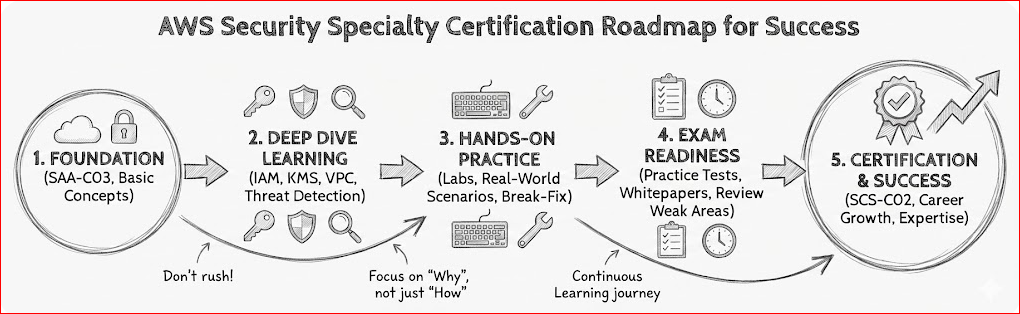
- 7-14 Days (The Sprint): Designed for experienced professionals who live in AWS Security daily. Focus entirely on “exam readiness” by taking practice tests and reading whitepapers on complex topics like KMS key policies and IAM evaluation logic.
- 30 Days (The Standard): Ideal for working professionals with some background. Week 1 covers IAM & Federation; Week 2 focuses on Infrastructure Security & VPCs; Week 3 tackles Monitoring & Logging; and Week 4 is for practice exams and reviewing weak areas.
- 60 Days (The Deep Dive): Best for those newer to security concepts. Spend the first month doing extensive hands-on labs and building the projects listed above. Use the second month to refine your theoretical knowledge and prepare specifically for the exam format.
Common mistakes
- Underestimating IAM: Many candidates fail because they don’t fully grasp the exact order of policy evaluation, confusing the interaction between SCPs, Identity-based policies, and Resource-based policies.
- Ignoring KMS Details: You must understand the specific differences between Customer Managed Keys (CMKs), AWS managed keys, and how automatic versus manual key rotation works.
- Focusing only on UI: The exam tests your ability to automate. You need to know how to perform actions via the CLI and how to script automated responses with Lambda and EventBridge, not just click buttons.
- Skipping Logging Nuances: You need to know exactly which logs (e.g., S3 access logs vs. CloudTrail data events) show which specific data points to effectively troubleshoot and audit.
Best Next Certifications After AWS Certified Security – Specialty
Once you have mastered the AWS Certified Security – Specialty, the path forward depends on whether you want to deepen your current expertise, broaden your skill set, or move into leadership. Here are the top recommendations:
- Same Track (Deepen): Certified Kubernetes Security Specialist (CKS)
If you work with containers, this is the perfect companion to AWS Security. It dives deep into securing the container orchestration layer, which is critical in modern cloud-native environments. Mastering this makes you a highly specialized expert in both cloud infrastructure and container security. - Cross-Track (Broaden): AWS Certified Advanced Networking – Specialty
Security and Networking are twins. Mastering VPCs, Direct Connect, and Transit Gateways makes you a “unicorn” who can design secure, high-performance network architectures. This certification ensures you understand the underlying plumbing that security controls rely on. - Leadership (Scale): CISSP (Certified Information Systems Security Professional)
If your goal is to move into a CISO or Head of Security role, this is the management-level validation you need. It covers the broader spectrum of information security governance, risk management, and compliance, going beyond just technical implementation.
Choose Your Path
Your career doesn’t stop at one certification. Here is how this certification fits into different career tracks.
1. DevOps Path
Focus: Automation and Speed.
Goal: Integrate security without slowing down deployment.
Path: Linux $\rightarrow$ AWS SAA $\rightarrow$ AWS Security Specialty $\rightarrow$ K8s (CKA) $\rightarrow$ AWS DevOps Pro.
This path ensures you can build fast, scalable systems that are secure by design, making you invaluable to agile teams.
2. DevSecOps Path
Focus: Security in the Pipeline.
Goal: Shift security left. Automate SAST/DAST and policy checks.
Path: Coding (Python/Go) $\rightarrow$ AWS SAA $\rightarrow$ AWS Security Specialty $\rightarrow$ CKS (Certified Kubernetes Security) $\rightarrow$ CISSP.
You will become the bridge between developers and security, ensuring code is secure before it ever reaches production.
3. SRE (Site Reliability Engineering) Path
Focus: Reliability and Incident Response.
Goal: Secure systems to prevent outages and recover fast.
Path: Linux/Networking $\rightarrow$ AWS SAA $\rightarrow$ AWS Security Specialty $\rightarrow$ Terraform Associate $\rightarrow$ AWS SysOps.
This track empowers you to build resilient systems where security incidents are treated as reliability issues to be automated away.
4. AIOps / MLOps Path
Focus: Secure Data & Models.
Goal: Protect training data and model endpoints.
Path: Python $\rightarrow$ AWS Data Analytics $\rightarrow$ AWS Security Specialty $\rightarrow$ AWS Machine Learning Specialty.
As AI grows, securing the data pipeline and the models themselves becomes critical; this path positions you at that cutting edge.
5. DataOps Path
Focus: Data Governance & Privacy.
Goal: Encrypt data lakes and manage fine-grained access.
Path: SQL/Python $\rightarrow$ AWS SAA $\rightarrow$ AWS Security Specialty $\rightarrow$ AWS Data Engineer Associate.
You will ensure that vast amounts of data are accessible to the right people while remaining compliant and secure against breaches.
6. FinOps Path
Focus: Cost Governance.
Goal: Prevent costly security mistakes (like open S3 buckets or unmanaged keys).
Path: AWS Practitioner $\rightarrow$ AWS Security Specialty (basics only) $\rightarrow$ FinOps Certified Practitioner.
Security breaches can be financially devastating; this path helps you audit environments to prevent expensive vulnerabilities and resource misuse.
Role $\rightarrow$ Recommended Certifications
| Role | Recommended Certifications |
|---|---|
| DevOps Engineer | AWS SAA + AWS Security Specialty + CKA. This combo ensures you can secure the platform and the pipelines you build. |
| SRE | AWS SysOps + AWS Security Specialty + Terraform Associate. Focuses on maintaining stability and security through infrastructure as code. |
| Platform Engineer | AWS DevOps Pro + AWS Security Specialty + CKA. Enables you to build internal platforms that are secure by default for developers. |
| Cloud Engineer | AWS SAA + AWS SAP (Professional) + AWS Security Specialty. Provides a comprehensive view of cloud architecture with a deep security focus. |
| Security Engineer | AWS Security Specialty + CKS + CISSP. The ultimate trifecta for cloud security, container security, and security management. |
| Data Engineer | AWS Data Engineer + AWS Security Specialty. Essential for securing data pipelines, lakes, and complying with data privacy regulations. |
| FinOps Practitioner | AWS Cloud Practitioner + AWS Security Specialty (Knowledge only). Helps in understanding the financial impact of security decisions and risks. |
| Engineering Manager | AWS SAA + AWS Security Specialty (High-level). key for understanding the security landscape to make informed risk and resource decisions. |
Top Institutions for Training & Certification
If you want hands-on help, these institutions are known for their practical, job-oriented training.
- DevOpsSchool
As an industry leader, DevOpsSchool offers a rigorous “Master” program for the AWS Certified Security – Specialty. Their curriculum is heavily project-based and mentor-led, ensuring you don’t just pass the exam but are also prepared to handle real-world security challenges from Day 1. Their focus on interview preparation and practical scenarios makes them a top choice for serious learners. - Cotocus
Cotocus specializes in high-end corporate training and consulting, making it an excellent option if your organization is sponsoring your certification. They provide a structured, professional learning environment with experienced trainers who bring enterprise-level insights. Their courses are designed to align with business objectives, ensuring immediate applicability of learned skills. - Scmgalaxy
Known for its strong community-driven approach, Scmgalaxy offers vast resources on SCM and DevOps processes that complement security training. Their AWS Security Specialty course is deeply integrated with CI/CD tools, giving you a holistic view of how security fits into the entire software delivery lifecycle. This is ideal for those who want to understand the “Sec” in DevSecOps. - BestDevOps
BestDevOps focuses on delivering concise, up-to-date content that aligns strictly with industry best practices and current exam patterns. Their training is perfect for professionals looking for efficient upskilling without unnecessary fluff. They frequently update their materials to reflect the latest AWS features and security standards, ensuring you are always exam-ready. - devsecopsschool
True to its name, this institution lives and breathes security, making it the premier destination for those who want to go beyond just AWS tools. Their training covers tool-agnostic DevSecOps principles alongside the AWS Security Specialty curriculum. This dual focus prepares you to be a versatile security engineer capable of securing any cloud environment, not just AWS. - sreschool
Sreschool approaches security from the perspective of Site Reliability Engineering (SRE), emphasizing reliability and uptime. Their course teaches you how to treat security incidents as reliability issues, integrating security automation into your observability and incident response workflows. This is the perfect choice for operations-focused engineers transitioning into security roles. - aiopsschool
This niche provider focuses on the intersection of Artificial Intelligence and IT Operations, offering a unique take on cloud security. Their training highlights how to utilize AI-driven tools for advanced threat detection and automated response within AWS. It’s an excellent choice for forward-thinking engineers who want to leverage AIOps for smarter, faster security management. - dataopsschool
Dataopsschool is highly recommended for professionals whose primary responsibility is securing data pipelines, lakes, and warehouses. Their AWS Security Specialty training bridges the gap between data engineering and security, teaching you how to protect sensitive data at scale. You’ll learn specific strategies for encryption, access control, and compliance in data-heavy environments. - finopsschool
While primarily focused on cloud financial management, FinOpsSchool teaches the critical security aspects that impact costs. Their training covers how to prevent financially devastating security breaches, such as crypto-jacking or unmanaged resources. This perspective is invaluable for engineers who need to justify security investments and audit environments for both risk and cost efficiency.
Next Certifications to Take
Once you have the Specialty, where do you go?
- Same Track (Deepen): Certified Kubernetes Security Specialist (CKS). If you work with containers, this is the perfect companion to AWS Security. It dives deep into securing the container orchestration layer, which is critical in modern cloud-native environments.
- Cross-Track (Broaden): AWS Certified Advanced Networking – Specialty. Security and Networking are twins. mastering VPCs, Direct Connect, and Transit Gateways makes you a unicorn who can design secure, high-performance network architectures.
- Leadership (Scale): CISSP (Certified Information Systems Security Professional). If you want to move into a CISO or Head of Security role, this is the management-level validation you need. It covers the broader spectrum of information security governance and risk management.
FAQs regarding AWS Certified Security – Specialty
- How hard is the AWS Security Specialty exam?
It is considered one of the tougher Specialty exams. It requires deep, specific knowledge of services like KMS and IAM. You cannot guess your way through it; you need to understand the underlying mechanics of AWS security services. - How much time do I need to prepare?
If you have working experience, 3-4 weeks is often sufficient. If you are new to AWS security, plan for 2-3 months of dedicated study and labs to build the necessary muscle memory and conceptual understanding. - Is there a prerequisite?
Officially, no. However, attempting this without passing the AWS Solution Architect Associate (SAA) first is risky. You need the foundation of general AWS architecture to understand the security context. - What is the passing score?
The passing score is 750 out of 1000. It uses a scaled scoring model, meaning different questions have different weights based on difficulty, so you can’t just count the number of correct answers. - Does this certification expire?
Yes, AWS certifications are valid for 3 years. You must recertify to keep it active, which ensures your knowledge stays current with the rapidly evolving AWS platform and security landscape. - Will this get me a job?
Alone? Maybe not. Combined with hands-on skills and a portfolio? Absolutely. It is highly valued by consulting firms and large enterprises looking for proof of specialized security expertise. - Is coding required?
You don’t need to be a developer, but you must be comfortable reading JSON (for policies) and understanding basic Python/Lambda logic for automation. Scripting skills are increasingly important for modern security roles. - What is the cost of the exam?
The exam costs 300 USD. This is a standard fee for AWS Specialty and Professional level exams, representing a significant investment in your professional credentials. - Can I take the exam from home?
Yes, via Pearson VUE online proctoring. However, ensure you have a stable internet connection and a clean desk, as the proctoring rules are strict and any violation can void your exam. - What happens if I fail?
You must wait 14 days before you can retake the exam. You will have to pay the full fee again, so it is crucial to be well-prepared before your first attempt. - How does this compare to the Solutions Architect Professional?
SA Pro is a mile wide and an inch deep, covering many services at a high level. Security Specialty is an inch wide and a mile deep, focusing strictly on security domains with intense detail. - Is it worth it for managers?
Yes, if you manage technical teams. It helps you understand the risks and resource requirements your team faces daily, allowing you to make better decisions about security prioritization and tooling.
Specific Certification FAQs
- Which AWS services are most critical?
IAM, KMS, CloudTrail, Config, S3 (policies), and Route53/CloudFront/WAF. You need to know these services inside and out, including their edge cases and integration points. - Do I need to know third-party tools?
Generally no, the exam focuses on native AWS tools. However, understanding how they integrate (e.g., via Security Hub) is useful for real-world scenarios, even if not strictly tested. - Is the exam multiple choice?
Yes, it consists of multiple-choice and multiple-response questions. There are no hands-on labs during the exam itself, but hands-on experience is vital to answer the scenario-based questions correctly. - How many questions are there?
There are 65 questions. You have 170 minutes to complete them, which gives you about 2.5 minutes per question—enough time if you know your stuff, but tight if you have to guess. - What is the difference between SAA security and this?
SAA asks what service to use for a general need. Security Specialty asks how to configure it precisely to meet a specific compliance requirement or mitigate a specific threat vector. - Where can I find official practice questions?
AWS provides a small set of sample questions, but third-party training providers like DevOpsSchool offer more comprehensive mock exams that better simulate the difficulty and format of the actual test. - Does it cover strict compliance standards like HIPAA/PCI?
You don’t need to memorize the text of HIPAA, but you need to know which AWS architecture patterns support those compliance standards and how to use AWS Config to audit for them. - Can I use my exam voucher for this?
Yes, standard AWS exam vouchers apply. If you passed a previous exam, you likely have a 50% discount voucher available in your AWS account, which is a great way to save money on this advanced certification.
Testimonials
“I had been working in AWS for 4 years, but I always felt unsure about my IAM policies. The training from DevOpsSchool didn’t just help me pass the SCS-C02; it completely changed how I write permissions at work. I felt confident from Day 1 after the course.”
— Rohan M., Senior Cloud Engineer
“The instructors at DevOpsSchool are actual practitioners. When I asked about a complex KMS multi-region issue, they didn’t give me a textbook answer; they showed me how they solved it in a real project. That value is unmatched.”
— Sarah Jenkins, DevSecOps Lead
“Passing this exam was the turning point in my career. I moved from a generalist admin role to a specialized Security Engineer role within 3 months. The structured path and projects made the difference.”
— Amit K., Security Consultant
Conclusion
The AWS Certified Security – Specialty is not just a badge; it is a declaration of competence. In a world where data breaches are daily news, the ability to secure infrastructure is one of the most recession-proof skills you can possess. Don’t rush it. Learn the concepts, build the labs, and break things in a sandbox so you don’t break them in production. This certification demands respect because it represents a serious commitment to mastering cloud security.