Introduction
Look around your room right now. Almost everything you see—from the smartphone in your hand to the car parked in your driveway, and even the laptop on your desk—was likely put together with the help of a robotic arm. These machines are the quiet, tireless workers of the modern world. They do not need sleep, they do not take lunch breaks, and they can perform the exact same motion a million times over without ever making a single mistake. They are the ultimate workhorses of modern manufacturing, quietly building almost everything we rely on daily.
But how do these amazing machines actually come to life? Building a machine that can weld a heavy steel truck frame one moment, and then gently pick up a fragile piece of glass the next, requires an incredible mix of mechanical design, electrical wiring, and smart software. If you are curious about the experts who manage and maintain these incredible systems in the real world, you can learn a lot more by checking out Robotsops .
In this guide, we are going to break down the entire process of how robotic arms are built. We will look at how engineers copy the human body, what kinds of “muscles” and “nerves” give the robot its strength and feeling, and how these machines go from a simple drawing on a computer screen to a fully working powerhouse on a factory floor.
The Anatomy of a Machine: Copying the Human Body
When scientists and engineers first decided to build a machine that could build other things, they did not have to look very far for inspiration. They looked right at their own bodies. The human arm is an absolute masterpiece of design. It can reach up high, swing in wide circles, bend in half, and twist around. To make a robot that could do human jobs, engineers realized they had to copy the structure of the human shoulder, elbow, and wrist.
Of course, a robot does not have bones made of calcium. Instead, the “skeleton” of a robotic arm is built using ultra-strong materials like high-grade steel, cast iron, and lightweight aircraft aluminum. The base of the robot acts like the human torso, bolting the machine firmly to the floor or the ceiling so it does not tip over when lifting heavy objects. From there, thick metal tubes and cast metal segments act as the upper arm and forearm.
To connect these metal “bones,” engineers use heavy-duty hinges and rotating cylinders, which act exactly like our joints. A typical industrial robotic arm has six of these joints. The “shoulder” joint lets the whole arm swing side to side and up and down. The “elbow” joint lets the arm bend in the middle to reach forward or pull back. Finally, the “wrist” joint gives the robot the ability to twist, tilt, and turn its tools in almost any direction.
This combination of sturdy metal links and flexible joints gives the robotic arm a full range of motion. Because of this clever design, an industrial robot can easily reach around a car door to paint the inside, flip completely upside down to tighten a bolt, or hold a heavy engine block perfectly steady in mid-air. It is simply a super-powered metal version of the arm you use every day.
The Muscles and Nerves: What Makes It Move?
Having a strong metal skeleton is great, but a skeleton cannot move on its own. It needs muscles to pull the joints, nerves to feel what is happening, and a brain to give the orders. In a robotic arm, engineers use electrical and mechanical parts to bring the metal bones to life.
Actuators: The Machine’s Muscles
In your body, your muscles tighten and relax to pull on your bones, allowing you to move. In a robotic arm, the muscles are called “actuators.” Most of the time, these are powerful electric motors placed directly inside the joints of the arm. When electricity flows into the motor, it spins, turning the gears that bend the metal elbow or twist the metal wrist. For extremely large robots that need to lift thousands of pounds, engineers might use hydraulic actuators, which use pressurized oil to push heavy pistons back and forth with incredible force.
Sensors: Feeling the Environment
If a robot only had muscles, it would be blind and numb. It would smash into walls or crush whatever it tried to pick up. To solve this, engineers pack the arm with sensors, which act as the robot’s nervous system. “Encoders” are tiny sensors inside the joints that tell the robot exactly what angle its arm is bent at, down to the fraction of a millimeter. Pressure sensors act like a sense of touch; they allow the robot to squeeze a delicate glass tube just hard enough to hold it, but gently enough not to shatter it.
The End Effector: The Robot’s Hands
At the very end of the robotic wrist is the “end effector,” which is the industry term for the robot’s hand. Unlike a human hand, a robot’s hand can be swapped out depending on its job. If the robot is packing boxes, the hand might be a set of gentle vacuum suction cups. If the robot is working in a car factory, the hand might be a massive welding torch that shoots out sparks. If it is assembling microchips, the hand might be a pair of ultra-precise electronic tweezers. The brain of the operation, called the Controller, constantly talks to the sensors and motors to make sure the hand does its job perfectly every single time.
Comparing a Human Arm vs. A Robotic Arm
To really understand how impressive these machines are, it helps to see exactly how they stack up against the natural human arm. While humans are incredibly adaptable and creative, robots win when it comes to raw power, endless endurance, and perfect repetition.
| Feature | The Natural Human Arm | The Industrial Robotic Arm |
| Lifting Strength | Can safely lift around 50 to 100 pounds on average. | Can easily lift anywhere from 10 pounds to over 5,000 pounds. |
| Precision & Accuracy | Good, but hands shake slightly; hard to repeat exact motions perfectly. | Microscopic perfection; can hit the exact same spot a million times. |
| Need for Rest (Fatigue) | Gets tired quickly; needs sleep, food, water, and frequent breaks. | Never gets tired; can work 24 hours a day, 7 days a week for years. |
As you can see in the table, a human arm is simply not built for factory work. If you ask a human to hold a heavy welding torch and weld the exact same spot on a car frame a thousand times a day, their muscles will burn, their hands will start to shake, and eventually, they will make a dangerous mistake. Humans get tired, bored, and distracted.
A robotic arm, on the other hand, does not know what it means to be tired. You can bolt it to the floor of a car factory, hand it a welding torch, and it will perform the exact same weld with perfect accuracy, twenty-four hours a day, for ten years straight. This difference in strength and stamina is exactly why factories use robots for all the heavy, dirty, and dangerous jobs.
However, this doesn’t mean robots are better at everything. A human arm is still much better at dealing with surprises. If a human drops a screw, they can easily look down, find it, and pick it up. A traditional factory robot, if not programmed to know the screw fell, will just keep moving blindly, trying to put together a puzzle piece that isn’t there. That is why robots and humans often work best when they are used together in the same factory.
From Blueprint to the Factory Floor: The Building Process
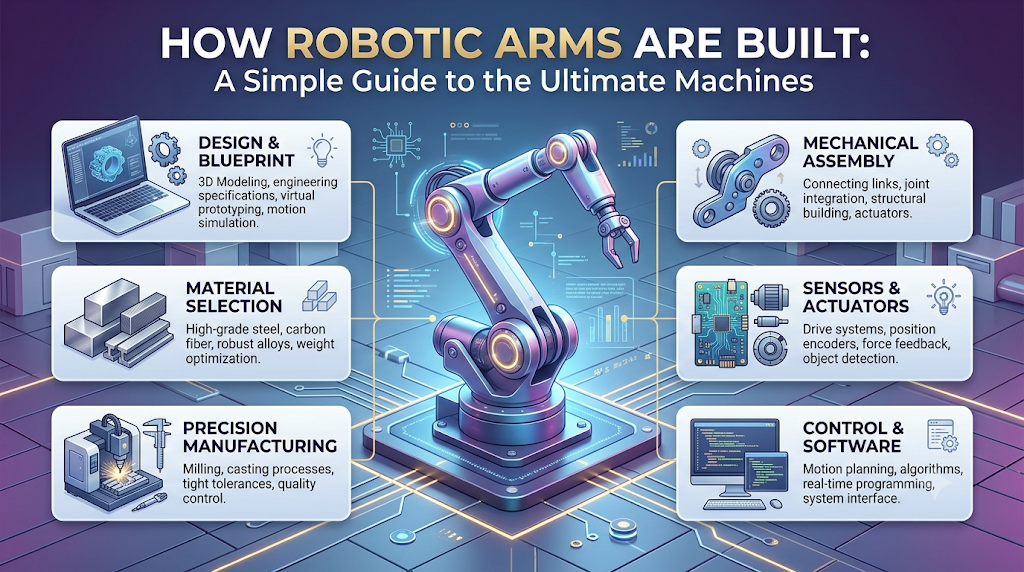
Building one of these mechanical marvels is a long and careful process that starts on a computer screen. Mechanical engineers spend months designing the arm using 3D software. They have to calculate exactly how thick the metal needs to be to support heavy weights without bending. At this stage, they are also deciding what the robot’s main job will be. A robot designed for delicate surgery will be designed to be small and lightweight, while a robot meant for a car factory will be drawn up as a massive, hulking giant.
Once the design is perfect, the actual physical manufacturing begins. The heavy base and the large sections of the arm are usually made by melting down steel or aluminum until it is liquid, and pouring it into huge molds—a process called casting. Once the metal cools and hardens into the shape of an arm segment, it is polished and painted. Lighter parts, like the spinning joints, are carved out of solid blocks of aluminum by very precise cutting machines to make sure they fit together perfectly.
Next comes the nervous system. Technicians carefully thread miles of electrical wiring and sensor cables through the hollow insides of the metal arm segments. This is a very tricky step, because the wires have to be bundled tightly enough so they don’t get snagged, but loose enough that they don’t snap when the arm bends and twists at extreme angles. Then, the heavy electric motors are bolted into the joints.
Finally, before a robot is ever allowed to enter a real factory, it goes through a brutal testing phase. Software engineers load the robot’s “brain” with its programming and run it through hundreds of stress tests. The arm is forced to lift heavy weights, swing back and forth at top speed, and run continuously for days at a time. This guarantees that when the robot is finally boxed up and shipped to a manufacturing plant, it is completely safe and ready to work flawlessly from day one.
The Future of Robotic Limbs
For a very long time, industrial robotic arms had one major flaw: they were extremely dangerous. Because they were made of heavy steel, moved at lightning speeds, and were completely blind, they would accidentally hurt any human who got in their way. Because of this, traditional robotic arms always had to be locked inside thick metal cages on the factory floor. Humans stayed on the outside, and the robots stayed on the inside.
But the future of robotic arms is changing rapidly, shifting toward something called “cobots,” which is short for collaborative robots. Instead of being locked in cages, cobots are designed to work safely side-by-side with human beings. To make this possible, engineers are now building robot arms out of lighter materials like strong plastics and carbon fiber, and they are padding the outside of the robot with soft, squishy covers.
More importantly, the sensors inside these new cobots are incredibly advanced. If a traditional robot swings around, it will crash right through whatever is in its path. But if a modern cobot is swinging around and it lightly bumps into a human worker’s shoulder, its sensors instantly detect the unexpected resistance and freeze the motor in a fraction of a second, preventing any injury.
This leap in safety means that robotic arms are no longer just for massive car factories. In the near future, you will see smaller, safer robotic arms popping up in everyday life. We already see them in hospitals assisting doctors with highly precise surgeries. Soon, they might be in restaurant kitchens flipping burgers, in coffee shops pouring your morning latte, or even in your own home helping to fold the laundry. The ultimate machines are finally stepping out of their cages and into our world.
Conclusion
The journey of a robotic arm, from a 3D drawing on a computer to a tireless worker lifting heavy steel, is a brilliant showcase of human engineering. By looking at our own shoulders, elbows, and wrists, we figured out how to build metal skeletons capable of amazing movement. By using electric motors as muscles and advanced sensors as nerves, we gave those skeletons the power to lift thousands of pounds and the delicate touch needed to handle fragile electronics.
While they might seem like magic or something out of a science fiction movie, robotic arms are really just a perfect combination of strong materials, clever electronics, and smart programming. As they become lighter, smarter, and safer, these mechanical arms will continue to shape our world, moving out of heavily guarded factories and into our daily lives to help us build a better, faster, and more efficient future.
FAQs
1. What is the main purpose of a robotic arm?
A robotic arm is designed to perform tasks that are too heavy, too dangerous, or too repetitive for human beings. They are mostly used in manufacturing to assemble products, weld metal, paint cars, and package boxes quickly and perfectly.
2. How much weight can a typical robotic arm lift?
It depends on the size of the arm. Small desktop robots might only lift a few pounds, while massive heavy-duty industrial arms used in car factories can easily lift and move over 5,000 pounds.
3. Do robotic arms ever make mistakes?
Robotic arms are extremely accurate and rarely make mistakes on their own. If a mistake happens, it is usually because a human programmed it incorrectly, or the parts it is trying to pick up were put in the wrong place.
4. What materials are robotic arms usually made of?
The main body of an industrial robot is typically made from heavy-duty materials like cast iron, high-grade steel, and aircraft-grade aluminum to ensure it is strong and does not bend under pressure.
5. How does a robotic arm know where to move?
A robotic arm uses a computer “brain” called a controller, which sends electrical signals to the motors in its joints. Sensors inside those joints constantly send signals back to tell the brain exactly where the arm is currently positioned.
6. Are robotic arms dangerous to human workers?
Traditional industrial arms can be very dangerous because they move fast and carry heavy loads, which is why they are kept in metal cages. However, newer “cobots” are designed with advanced sensors to instantly stop if they bump into a human, making them very safe.
7. What is an end effector?
An end effector is the tool attached to the very end of the robotic arm, acting like its “hand.” It can be a welding torch, a claw gripper, a paint sprayer, or a vacuum cup, depending on the job it needs to do.
8. Can a robotic arm fix itself if it breaks down?
Currently, most robotic arms cannot physically fix themselves. However, they have smart software that can send an alert or an error code to a human mechanic to let them know exactly which motor or wire is starting to fail.
9. What makes a “cobot” different from a standard industrial robot?
A cobot (collaborative robot) is specially built to work right next to humans without safety cages. They are lighter, slower, often padded, and have sensitive sensors that make them freeze instantly if they touch a person.
10. Will robotic arms eventually replace all human workers?
No, robotic arms are meant to handle the dull, dirty, and dangerous physical jobs. Humans are still highly needed for tasks that require creativity, problem-solving, quality control, and managing the robots themselves.
