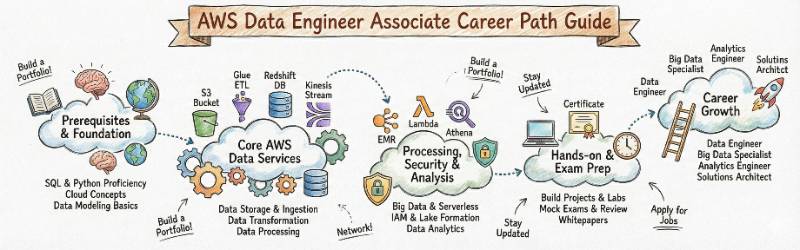
Introduction
Every company today runs on data. Whether it is an e-commerce platform processing millions of orders, a bank analyzing transactions in real time, or a healthcare company managing patient records, data is at the center of everything. But data alone is not enough. You need people who can collect it, clean it, move it, store it, and make it available to the right people at the right time — without breaking anything along the way. That is exactly what a Data Engineer does. And in the world of cloud computing, AWS is the platform where most of this work happens. AWS offers a powerful suite of data services — Glue, Kinesis, Redshift, S3, Athena, Lake Formation, DMS, and many more — and knowing how to use them together is a critical, in-demand skill. The AWS Certified Data Engineer – Associate is the certification designed to validate exactly these skills. It tells employers, teams, and clients that you understand how to engineer data solutions on AWS — not just theoretically, but in practice. This guide is written for working engineers and managers who want to understand this certification completely.
What Is AWS Certified Data Engineer – Associate?
The AWS Certified Data Engineer – Associate is an official certification from Amazon Web Services. Its exam code is DEA-C01, and it sits at the Associate level — which means it is designed for professionals with real-world AWS and data engineering experience, not complete beginners. This certification tests your ability to design and build data ingestion pipelines, manage structured and unstructured data stores, apply transformation logic using AWS-native tools, enforce data quality rules, and implement security and governance policies on a live AWS environment. What makes this certification different from other AWS exams is its very specific focus on data. It does not just ask you to know what S3 or Glue is — it asks you to know when to use Glue vs. EMR, how to design a streaming pipeline that handles late-arriving data, and how to apply column-level security using Lake Formation. The questions are scenario-based and practical. The certification has strong industry recognition. AWS certifications are trusted globally, and the data engineering track is particularly relevant right now because organizations everywhere are investing heavily in data platforms, real-time analytics, and machine learning pipelines built on AWS infrastructure.
Certification at a Glance
| Detail | Information |
|---|---|
| Certification Name | AWS Certified Data Engineer – Associate |
| Track | Data Engineering |
| Level | Associate |
| Exam Code | DEA-C01 |
| Who It’s For | Data Engineers, Cloud Engineers, Software Engineers, Analytics professionals |
| Prerequisites | 2–3 years data engineering experience; 1–2 years hands-on AWS experience |
| Skills Covered | Data ingestion, transformation, pipeline orchestration, data store design, quality, security, governance |
| Exam Duration | 130 minutes |
| Number of Questions | 65 (multiple choice + multiple response) |
| Passing Score | 720 out of 1000 |
| Exam Cost | $150 USD |
| Recommended Order | After AWS Cloud Practitioner or AWS Solutions Architect Associate |
Who Should Take This Certification?
This certification is built for people who work with data on a daily basis. If you write ETL jobs, manage data pipelines, configure data storage systems, or build analytics workflows on AWS, then this is the certification that speaks directly to your job.
It is also a strong choice for software engineers and cloud engineers who want to move into data engineering roles. Many engineers already use services like S3, Lambda, and DynamoDB in their work — this certification helps them understand how all these services connect together in a complete data architecture.
You should consider this certification if you are:
- A Data Engineer who builds or maintains data pipelines on AWS
- A Cloud Engineer who wants to move into data-focused engineering
- A Software Engineer working with AWS databases, event streams, or data APIs
- A Backend Developer who handles large-scale data movement and transformation
- An Analytics Engineer using Redshift, Athena, or Glue in their daily work
- An Engineering Manager who leads data teams and needs to understand cloud data architectures
- A Database Administrator transitioning from on-premise data systems to cloud-native AWS tools
If any of those descriptions match your current role or where you want to go next, this certification belongs on your roadmap.
Skills You’ll Gain
After clearing this certification, you will have hands-on, production-ready skills that you can apply immediately in your job. These are not just exam skills — these are engineering skills that real teams need every day.
- Data Ingestion – Collect data from multiple sources using Amazon Kinesis Data Streams, Kinesis Firehose, AWS DMS, AWS Glue, AWS AppFlow, and S3 Event Notifications; handle both batch and real-time ingestion patterns
- ETL and Data Transformation – Design and build transformation logic using AWS Glue (PySpark and visual ETL), AWS Lambda for lightweight transforms, Amazon EMR for large-scale distributed processing, and dbt-style patterns on Redshift
- Pipeline Orchestration – Automate multi-step workflows using AWS Step Functions, Amazon EventBridge Scheduler, and Amazon MWAA (Managed Apache Airflow on AWS); handle dependencies, retries, and failure notifications
- Data Store Design – Select the right storage solution for every use case: Amazon S3 for raw data lakes, Redshift for analytical warehousing, DynamoDB for key-value access patterns, RDS and Aurora for relational workloads, and OpenSearch for search-based queries
- Data Catalog and Schema Management – Organize and discover data assets using AWS Glue Data Catalog; automate schema discovery using Glue Crawlers; version and evolve schemas without breaking downstream consumers
- Data Quality – Apply validation rules and data quality checks inside Glue ETL jobs using Glue Data Quality; monitor pipeline health with CloudWatch metrics and alarms; detect and handle null values, duplicates, and schema drift
- Security and Governance – Apply IAM resource-based policies, KMS encryption at rest and in transit, column-level and row-level security through AWS Lake Formation, data masking, and CloudTrail-based audit trails
- Cost Optimization – Monitor and optimize spend on Glue jobs (DPU tuning), Athena queries (partition pruning, columnar formats like Parquet), Kinesis shards, and Redshift clusters (auto-scaling, concurrency scaling, WLM tuning)
Exam Structure and Domains
The DEA-C01 exam is divided into four domains. Understanding how much weight each domain carries is critical to knowing where to invest your study time.
| Domain | Topic | Weightage |
|---|---|---|
| Domain 1 | Data Ingestion and Transformation | 34% |
| Domain 2 | Data Store Management | 26% |
| Domain 3 | Data Operations and Support | 22% |
| Domain 4 | Data Security and Governance | 18% |
Domain 1 – Data Ingestion and Transformation (34%)
This is the most important domain and the one that tests your day-to-day data engineering skills the hardest. You need to know how to ingest data in both batch and real-time modes, how to transform it using Glue and Lambda, how to orchestrate multi-step pipelines, and how to handle late-arriving, malformed, or duplicate data. Know the difference between Kinesis Data Streams vs. Kinesis Firehose, and when to use Glue vs. EMR vs. Lambda for transformation.
Domain 2 – Data Store Management (26%)
This domain tests your ability to choose the right data storage solution for every scenario. Know S3 storage classes and lifecycle policies, Redshift distribution and sort keys, DynamoDB partition key design, Aurora vs. RDS trade-offs, and how to design a data lake with proper zone separation (raw, processed, curated). Data modeling and schema evolution questions also show up here.
Domain 3 – Data Operations and Support (22%)
This domain covers the operational side of data engineering — monitoring pipeline health, troubleshooting failed jobs, optimizing slow queries, and ensuring data freshness SLAs are met. Know how to use CloudWatch Logs and Metrics, Glue job monitoring, Athena query history, and Redshift Query Monitoring Rules to keep pipelines running smoothly.
Domain 4 – Data Security and Governance (18%)
Even though this domain carries the lowest weight, many candidates lose marks here because they underestimate its scope. Know IAM policies for S3 and Glue, Lake Formation tag-based access control, KMS key management, VPC endpoint configurations for private data access, and how to audit data access using CloudTrail and AWS Config.
Real-World Projects You’ll Be Able to Do
The best proof of a good certification is what you can build after it. After clearing this exam, you should be confident enough to deliver real-world data engineering projects in any team or organization.
- Batch ETL Pipeline – Extract structured data from Amazon RDS, apply business transformation rules using AWS Glue (PySpark), handle schema changes dynamically, and load the clean data into Amazon Redshift for BI reporting with Power BI or QuickSight
- Real-Time Streaming Pipeline – Ingest IoT sensor data or clickstream events using Amazon Kinesis Data Streams, process and filter records with Lambda or Kinesis Data Analytics (Apache Flink), and persist results into DynamoDB or S3 for dashboards
- Enterprise Data Lake – Design a three-zone S3 data lake (raw, processed, curated), automate ingestion from multiple sources using Glue and DMS, configure Lake Formation access controls for different user groups, and enable self-service querying via Amazon Athena
- Data Catalog and Discovery Platform – Use Glue Crawlers to auto-discover hundreds of datasets across S3 and databases, build a centralized Glue Data Catalog, and enable engineers and analysts to query data without knowing physical file locations
- Data Quality Enforcement System – Add multi-rule quality checks in Glue ETL pipelines, alert the team via SNS when quality thresholds are breached, quarantine failed records into a separate S3 path, and produce daily quality scorecards using CloudWatch Dashboards
- Secure Multi-Tenant Data Platform – Build a data platform serving multiple business units; apply Lake Formation tag-based policies to restrict access by department, role, and data classification; implement column masking for PII fields; and maintain full CloudTrail audit history for compliance
Preparation Plan
There is no single preparation plan that works for everyone. Choose the track that matches your current experience level and available study time.
7–14 Day Fast Track
(For engineers with strong AWS hands-on experience and daily data engineering work)
- Days 1–2: Read the official AWS DEA-C01 exam guide fully; map your knowledge to each domain; identify your weak areas honestly
- Days 3–5: Hands-on labs — build a Glue ETL job, set up a Kinesis stream, create a Redshift cluster, and configure S3 lifecycle policies
- Days 6–8: Practice data store design scenarios; go deep on Redshift tuning, DynamoDB design patterns, and Lake Formation access control
- Days 9–11: Work through orchestration patterns with Step Functions and EventBridge; study Glue Data Quality and pipeline monitoring
- Days 12–14: Take 2–3 full mock exams under timed conditions; review every wrong answer thoroughly; revise your top 10 weak topics before the exam
30-Day Recommended Plan
(Best fit for most working engineers with solid AWS fundamentals)
- Week 1: Refresh AWS core services (IAM, S3, VPC, Lambda, CloudWatch); study Domain 1 fundamentals in detail with hands-on ingestion labs
- Week 2: Deep dive into Glue ETL, DMS migrations, Kinesis streaming, and Lambda-based transformation patterns; build a small end-to-end pipeline project
- Week 3: Master data store selection and management (Redshift, DynamoDB, Aurora, S3 lake zones); cover Domain 3 pipeline operations and monitoring
- Week 4: Complete Domain 4 security and governance; take 3 full-length mock exams; analyze gaps; do targeted revision on your weakest domain; book the exam and go
60-Day Solid Preparation Plan
(For engineers newer to AWS data services or those changing tracks)
- Month 1, Week 1–2: Build AWS foundational knowledge through video courses and documentation; understand core services deeply before moving to data-specific services
- Month 1, Week 3–4: Study Domain 1 and Domain 2 in depth with one hands-on lab per day; start building your personal AWS data project in a free-tier account
- Month 2, Week 1–2: Study Domain 3 and Domain 4; add security controls and monitoring to your hands-on project; take 2 mock exams
- Month 2, Week 3–4: Full exam simulation under timed conditions; score at least 750+ on 2 consecutive mocks; identify last-mile gaps; final revision; schedule and sit the exam
Common Mistakes to Avoid
These are the mistakes that cause well-prepared candidates to fail or underperform. Learning from these will save you real time and money.
- Skipping hands-on practice entirely – This exam is scenario-based. If you only read theory, you will struggle with questions that require you to pick the right architecture from four plausible-looking options
- Treating all domains equally – Domain 1 is 34% of your exam. If you spend equal time on all domains, you are under-investing where it matters most
- Confusing similar services – Kinesis Streams vs. Kinesis Firehose, Glue vs. EMR vs. Lambda, Athena vs. Redshift Spectrum — these are classic trick question areas; know the exact trade-offs
- Ignoring cost optimization questions – Cost questions appear across multiple domains, not just in one section. Know how to reduce Glue DPU costs, optimize Athena query costs with partitioning and columnar formats, and right-size Redshift clusters
- Not reading the official exam guide – AWS publishes a detailed exam guide that tells you exactly what is in scope for each domain. Candidates who skip it often study the wrong things
- Rushing into the exam booking – Only book the exam after you are consistently scoring 750+ on full-length mock tests. Scoring 720 is the minimum to pass — do not risk a $150 retake fee
- Memorizing practice question dumps – AWS exam questions are updated regularly. Dump-based memorization will fail you. Understand the concept behind every answer
- Underestimating Lake Formation – Many candidates know Glue and S3 well but have shallow knowledge of Lake Formation. Tag-based access control and column-level security questions are increasingly common in the exam
Best Next Certification After This
Once you clear the AWS Certified Data Engineer – Associate, three clear paths open up in front of you. Choose based on where you want your career to go next.
| Path | Certification | Why |
|---|---|---|
| Same Track – Advanced | AWS Certified Machine Learning – Specialty | Extend your data pipelines into ML workflows; learn SageMaker feature stores, data labeling, and model training data patterns |
| Cross-Track – Architecture | AWS Certified Solutions Architect – Professional | Broaden from data engineering to full AWS architecture design for large-scale, multi-account enterprise environments |
| Leadership Path | AWS Certified Security – Specialty | Step into data security architecture leadership; master IAM policy design, KMS, compliance frameworks, and enterprise data governance |
Choose Your Learning Path
This certification is relevant across six major career tracks in modern technology. Here is how each path benefits from it.
DevOps Path
DevOps engineers who manage CI/CD pipelines increasingly deal with data pipeline automation. Knowing how to connect EventBridge, Step Functions, and Glue with a DevOps deployment workflow makes you a far more versatile engineer. This certification helps you understand the data layer of a platform, which is crucial when your pipelines power production analytics and reporting systems.
DevSecOps Path
Security in data systems is one of the fastest-growing areas in cloud security. This certification equips DevSecOps professionals with the specific knowledge to secure data in transit and at rest, enforce fine-grained access controls using Lake Formation, design data masking strategies for PII compliance, and audit all data access with CloudTrail. These skills directly support GDPR, HIPAA, and SOC 2 compliance initiatives.
SRE Path
Site Reliability Engineers who manage data-intensive platforms need to understand pipeline observability, failure recovery, and data freshness SLOs. Domain 3 of this certification maps directly to SRE responsibilities — you will learn how to monitor Glue jobs, set CloudWatch alarms for pipeline failures, and build reliable data processing systems that meet operational SLAs.
AIOps / MLOps Path
ML pipelines depend on high-quality, well-engineered data. AIOps and MLOps engineers who understand data ingestion, feature engineering, and data quality enforcement on AWS can build far more reliable model training workflows. The Glue-based data preparation and Kinesis-based real-time inference pipelines covered in this certification are directly applicable to SageMaker workloads.
DataOps Path
This is the most natural career path alignment for this certification. DataOps is all about combining data engineering, pipeline automation, quality assurance, and team collaboration to deliver reliable data products. All four exam domains — ingestion, stores, operations, and governance — map directly to DataOps practices. If you work in DataOps, this certification is a must-have credential on your profile.
FinOps Path
FinOps practitioners work to optimize cloud spending, and data services are often among the highest-cost items on an AWS bill. Understanding how to right-size Glue DPU configurations, optimize Athena query costs with proper partitioning and file formats, manage Kinesis shard costs, and tune Redshift clusters for cost efficiency is extremely valuable for FinOps work. This certification gives you the technical depth to have meaningful cost conversations with data engineering teams.
Role → Recommended Certifications
| Role | Recommended Certifications |
|---|---|
| DevOps Engineer | AWS Certified Data Engineer – Associate + AWS DevOps Engineer – Professional |
| SRE | AWS Certified Data Engineer – Associate + AWS Certified SysOps Administrator – Associate |
| Platform Engineer | AWS Certified Solutions Architect – Associate + AWS Certified Data Engineer – Associate |
| Cloud Engineer | AWS Certified Data Engineer – Associate + AWS Certified Solutions Architect – Professional |
| Security Engineer | AWS Certified Data Engineer – Associate + AWS Certified Security – Specialty |
| Data Engineer | AWS Certified Data Engineer – Associate (Primary) + AWS Certified Machine Learning – Specialty |
| FinOps Practitioner | AWS Certified Data Engineer – Associate + FinOps Certified Practitioner (FOCUS) |
| Engineering Manager | AWS Certified Data Engineer – Associate + AWS Certified Solutions Architect – Professional |
Top Training Institutions
Structured training makes all the difference between passing and failing this exam. These institutions offer programs specifically designed to help engineers and managers prepare for the AWS Certified Data Engineer – Associate with confidence.
DevOpsSchool
DevOpsSchool is one of the most recognized training providers in India for AWS and DevOps-related certifications. Their dedicated AWS Certified Data Engineer – Associate program covers all four exam domains with structured instructor-led sessions, hands-on AWS labs, and real-world project exercises. Their trainers bring strong industry experience, making sessions highly practical and immediately applicable to your daily engineering work. DevOpsSchool also offers mentorship support throughout your preparation journey, which is especially useful for working professionals managing preparation alongside a full-time job.
Cotocus
Cotocus is known for its job-focused training approach that bridges the gap between certification preparation and real industry work. Their AWS data engineering program is designed around real-world problem-solving rather than just exam cramming, which helps you build skills you can actually use on the job after passing. Their trainers have hands-on experience with AWS data platforms in production environments, making every concept taught grounded in real-world engineering practice. Cotocus is a strong choice for engineers who want to come out of preparation ready to contribute to live data engineering projects immediately.
Scmgalaxy
Scmgalaxy specializes in DevOps and cloud certification training with a very strong emphasis on practical lab work and tool-based learning. For the AWS Data Engineer certification, they provide structured lab environments where you can practice with Glue, Kinesis, Redshift, Lake Formation, and other core services covered in the exam. Their project-based approach means you are building actual data pipelines throughout your preparation, not just reviewing slides. Scmgalaxy is a well-regarded name in the Indian tech training community with a solid track record of helping candidates pass AWS certifications.
BestDevOps
BestDevOps takes a career-first approach to cloud and data engineering training. Their programs are designed not just to help you pass the exam but to help you grow into the role of a Data Engineer in a real organization. They offer structured learning paths, mentor-led sessions, and hands-on interview preparation that covers real data engineering scenarios beyond what the exam asks. For engineers who want certification plus career growth support, BestDevOps offers a well-rounded preparation experience.
DevSecOpsSchool
DevSecOpsSchool brings a security-first perspective to data engineering education. Their training is particularly valuable if you plan to combine data engineering skills with DevSecOps responsibilities — covering secure pipeline design, data access governance, compliance frameworks, and audit logging in detail. Domain 4 of the DEA-C01 exam aligns very closely with their curriculum, and candidates who train here tend to score well on the security and governance section that many others find challenging.
SRESchool
SRESchool specializes in site reliability engineering and platform observability, making their AWS data engineering curriculum especially strong for engineers managing data-intensive production systems. Their training covers pipeline reliability, monitoring, failure recovery, and performance tuning — skills that map directly to Domain 3 of the DEA-C01 exam. If you work as an SRE or are moving into a platform engineering role, SRESchool provides the most operationally-focused preparation for this certification.
AIOpsSchool
AIOpsSchool connects AWS data engineering skills with the broader world of AI operations and machine learning pipelines. Their curriculum is ideal for engineers who want to bridge data engineering with AIOps and MLOps practices — covering SageMaker data preparation workflows, feature engineering pipelines, and real-time data streams for ML inference. If your career path involves machine learning, AIOpsSchool’s training will help you understand the data engineering foundation that every ML system depends on.
DataOpsSchool
DataOpsSchool is arguably the most directly aligned training institution for this specific certification. Their programs are built around the core DataOps philosophy of treating data pipelines with the same engineering rigor as software delivery pipelines — covering automation, quality enforcement, testing, monitoring, and governance throughout the curriculum. All four DEA-C01 domains find direct representation in their training material, and they regularly update content to reflect changes in the AWS services covered by the exam.
FinOpsSchool
FinOpsSchool trains professionals in cloud financial management and cost optimization, and their AWS data engineering coverage specifically addresses the cost management side of building data platforms. Their training includes cost optimization strategies for Glue, Athena, Redshift, and Kinesis — all of which are tested in the DEA-C01 exam and directly relevant to FinOps practitioners managing cloud data spend. If you are on a FinOps track and want technical depth in the data engineering services you are analyzing, FinOpsSchool bridges that gap effectively.
Frequently Asked Questions (FAQs)
Q1. How difficult is the AWS Certified Data Engineer – Associate exam?
The exam is moderate in difficulty. It is not an entry-level certification — questions are scenario-based and test practical decision-making, not just memorization. That said, if you have 2–3 years of data engineering experience and 30 days of focused preparation with hands-on practice, the exam is very much passable. Most engineers who fail on their first attempt do so because they prepared only theoretically and skipped hands-on labs.
Q2. How long does it take to prepare?
Preparation time depends on your current experience level. A working engineer with solid AWS fundamentals and daily data engineering experience can be exam-ready in 30 days with 1–2 hours of daily study. Someone newer to AWS or transitioning from a different cloud platform may need 45–60 days. The key is consistent daily practice, especially hands-on labs, not just reading or watching videos.
Q3. Are there any mandatory prerequisites?
There are no mandatory prerequisites that AWS officially enforces. However, AWS recommends 2–3 years of data engineering experience and 1–2 years of hands-on AWS work before taking the exam. Having passed the AWS Cloud Practitioner or AWS Solutions Architect – Associate exam beforehand is not required but gives you a big advantage by solidifying your AWS fundamentals.
Q4. What is the passing score?
The passing score is 720 out of 1000. Scores are scaled, which means AWS adjusts slightly based on exam version difficulty. On your mock tests, aim to consistently score 750+ before booking the actual exam — this buffer accounts for exam-day pressure and slight variation in question difficulty.
Q5. How many questions are there in the exam?
The exam contains 65 questions total. These are a mix of multiple-choice (one correct answer) and multiple-response (two or more correct answers from a set of five options). You have 130 minutes to complete the exam, which gives you approximately 2 minutes per question on average. Time management is important, especially for the longer scenario-based questions.
Q6. What is the exam fee?
The standard exam fee is $150 USD. If you are taking the exam through Pearson VUE in India, the fee may be displayed in INR equivalent. Rescheduling within 24 hours of the exam or not showing up will result in forfeiting the fee, so confirm your preparation before booking.
Q7. Is this certification valuable in the Indian job market?
Yes, very much so. AWS-certified Data Engineers are in strong demand across Indian product companies, fintech startups, cloud consulting firms, and global captive centers in Bangalore, Hyderabad, Pune, Mumbai, and Delhi NCR. Having this certification on your profile significantly improves your chances of clearing initial HR and technical screening filters, and it also strengthens your negotiating position when discussing salaries or rate cards.
Q8. Can I take the exam online from home?
Yes. AWS offers an online proctored option through Pearson VUE OnVUE, which allows you to take the exam from your home or office. You need a quiet, private room, a reliable internet connection, and a working webcam and microphone. The proctor monitors you throughout the exam. You can also choose to visit an authorized Pearson VUE testing center near you if you prefer a physical exam environment.
Q9. Which domain should I focus on the most?
Domain 1 — Data Ingestion and Transformation — carries 34% of the total exam weight. This is the single most important domain and where most of your preparation time should go. If you master Glue, Kinesis, DMS, Lambda-based ETL, Step Functions, and EventBridge orchestration, you are already covering more than a third of the exam. Never neglect Domain 4 (Security and Governance) even though it is 18% — candidates often lose easy marks here by underestimating it.
Q10. How long is the certification valid?
All AWS certifications are valid for 3 years from the date you pass the exam. To maintain your certification, you can recertify by passing the current version of the DEA-C01 exam, or by passing a higher-level AWS certification before your expiry date. AWS occasionally offers discounts and promotions on recertification exams for existing certificate holders.
Q11. Does this certification help in getting a data engineering job?
Yes, it does — and it helps in two ways. First, it validates your AWS-specific skills to employers who are hiring for data engineering roles. Second, the process of preparing for this exam deepens your understanding of real-world AWS data architectures, making you a better engineer regardless of the job title. Many candidates report salary increases or successful role transitions within 3–6 months of earning this certification.
Q12. What is the best certification sequence for someone starting fresh?
If you are starting from scratch, the recommended sequence is: AWS Cloud Practitioner (understand AWS basics and cloud concepts) → AWS Solutions Architect – Associate (learn core AWS architecture, networking, and compute) → AWS Certified Data Engineer – Associate (go deep into data engineering on AWS). This sequence ensures you are not learning data services in isolation and that you have a strong architectural foundation before taking on the data-specific material.
FAQs on AWS Certified Data Engineer – Associate
Q1. What exactly is the AWS Certified Data Engineer – Associate certification?
It is an official AWS certification (exam code DEA-C01) at the Associate level that validates your ability to design, build, and manage data pipelines, data stores, data quality systems, and governance policies using AWS-native services. It is designed for professionals who work with data on AWS in their daily engineering roles and want formal recognition of those skills from Amazon Web Services.
Q2. What AWS services do I need to know for this exam?
The exam is heavily focused on a core set of AWS data services. The most important ones are AWS Glue, Amazon Kinesis Data Streams, Amazon Kinesis Firehose, Amazon Redshift, Amazon S3, Amazon DynamoDB, AWS Lambda, Amazon Athena, AWS Lake Formation, Amazon EMR, AWS Database Migration Service (DMS), Amazon EventBridge, and AWS Step Functions. You should also know supporting services like CloudWatch, CloudTrail, IAM, KMS, AWS Secrets Manager, and Amazon SNS.
Q3. Is there any recommended certification to take before this one?
There is no enforced prerequisite, but taking the AWS Solutions Architect – Associate first is strongly recommended. It gives you a solid understanding of AWS networking, IAM, storage, and compute — all of which provide the context you need to understand why data services work the way they do on AWS. Without that foundation, some Domain 2 and Domain 4 concepts can feel disconnected and harder to absorb.
Q4. What job roles benefit most from this certification?
Data Engineers, Cloud Data Architects, Analytics Engineers, ETL Developers, Data Platform Engineers, and Database Architects working on AWS will benefit the most from this certification. It is also valuable for engineering managers, technical leads, and solutions architects who work closely with data teams and need to evaluate and guide data engineering decisions in their organizations.
Q5. How is this different from the AWS Solutions Architect certification?
The AWS Solutions Architect certification covers broad AWS infrastructure design across compute, networking, storage, databases, and security from an architecture perspective. The AWS Certified Data Engineer – Associate goes far deeper into data-specific services and use cases — pipeline design, data store selection for analytics workloads, ETL transformation patterns, data quality enforcement, and data governance. If Solutions Architect is the map of all of AWS, the Data Engineer certification is a detailed blueprint for the data engineering floor of that building.
Q6. What is the exact format of the DEA-C01 exam?
The exam has 65 questions: a mix of multiple-choice (one correct answer) and multiple-response (two or more correct answers from five options). The total duration is 130 minutes. Scores are on a scaled range of 100 to 1000, and the passing score is 720. The exam is available at Pearson VUE authorized testing centers globally and through the Pearson VUE OnVUE online proctored platform.
Q7. Can a working professional prepare for this alongside a full-time job?
Absolutely, and many people do exactly that. The key is consistency over intensity. Committing 1–2 hours every weekday for study and theory, combined with 3–4 hours of hands-on lab practice on weekends, is enough to be exam-ready in 4–6 weeks. Plan your study schedule upfront, use a free-tier AWS account for all hands-on practice, and do not skip mock exams — they are the most reliable indicator of whether you are ready for the real thing.
Q8. Where can I register and start my preparation for this certification?
You can find comprehensive training programs, exam registration guidance, preparation resources, hands-on lab access, and mentorship support at: AWS Certified Data Engineer – Associate. This page gives you everything you need to start your preparation journey in one place.
Conclusion
The AWS Certified Data Engineer – Associate is more than just a badge on your LinkedIn profile. It is proof that you can engineer real data solutions on AWS — pipelines that run reliably, data stores that perform efficiently, security controls that protect sensitive information, and governance policies that keep organizations compliant.
Data engineering on AWS is one of the most in-demand skill sets in the global technology job market right now. Every company that runs on AWS needs engineers who can build and maintain its data infrastructure. This certification tells those companies that you are ready.