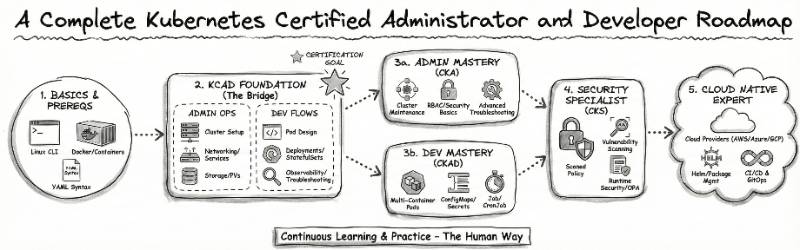
Introduction
In the current landscape of platform engineering and modern software development, Kubernetes is no longer an “optional” skill. It is the operating system of the cloud. Having spent years navigating the shifts from monolithic on-premise servers to microservices and serverless architectures, I have seen many technologies come and go. However, Kubernetes has remained the bedrock of reliable, scalable systems. The Kubernetes Certified Administrator & Developer (KCAD) program is a specialized combined training and certification path designed to bridge the gap between building applications and managing the infrastructure they run on. Whether you are an engineer in Bengaluru or a manager in New York, understanding how to orchestrate containers is the single most valuable asset in your professional toolkit today.
Kubernetes Certification Comparison
The following table breaks down the core certifications within the Kubernetes ecosystem, helping you understand where the KCAD program fits into your career journey.
| Track | Level | Who it’s for | Prerequisites | Skills Covered | Recommended Order |
| KCAD | Professional | All-rounders, Developers, SREs | Basic Linux & Docker | App Design, Deployment, Cluster Management, Troubleshooting | 1st (Full Spectrum) |
| CKA | Professional | SREs, Admins, Ops | KCAD or K8s Basics | Installation, Networking, Storage, Security, Troubleshooting | 2nd (Admin focus) |
| CKAD | Professional | App Developers | KCAD or K8s Basics | Cloud-native apps, Pod Design, ConfigMaps, Services | 2nd (Dev focus) |
| CKS | Specialist | Security Engineers | CKA Certified | Cluster Hardening, Supply Chain Security, Runtime Security | 3rd (Security focus) |
The KCAD Certification Deep Dive
The Kubernetes Certified Administrator & Developer (KCAD) is a comprehensive program that validates your ability to both manage a cluster and deploy high-performance applications on it.
What it is
The KCAD is a dual-focus curriculum that merges the operational rigors of administration with the agility required for application development. It ensures you can handle the full lifecycle of a containerized workload, from writing the YAML to fixing the network.
Who should take it
- Software Engineers who want to move beyond just writing code and start owning the deployment process.
- DevOps Engineers needing a unified certification that covers both “Dev” and “Ops” aspects of the orchestrator.
- System Administrators who are migrating legacy workloads to the cloud and need to understand container scheduling.
- Engineering Managers who need to speak the same language as their platform teams to make better technical decisions.
Skills you’ll gain
- Container Orchestration: Master the art of managing OCI-compliant container images and runtimes.
- Cluster Architecture: Understand how the Control Plane (etcd, API Server, Scheduler) interacts with Worker Nodes.
- Workload Management: Deploy complex applications using Deployments, StatefulSets, and DaemonSets.
- Network & Storage: Configure Ingress controllers, Services, Persistent Volumes (PVs), and Claims (PVCs).
- Observability: Implement Liveness and Readiness probes to ensure zero-downtime application health.
Real-world projects you should be able to do
- Microservices Deployment: Deploy a 3-tier app (Frontend, Backend, DB) with secure inter-pod communication.
- Auto-Scaling Clusters: Configure Horizontal Pod Autoscalers (HPA) to handle traffic spikes automatically.
- Production Troubleshooting: Diagnose “ImagePullBackOff” or “Pending” pods and repair broken node certificates.
- Storage Orchestration: Set up dynamic volume provisioning for a database running inside the cluster.
Preparation Plans
Choose a plan based on your current experience and available time:
The Sprint (7–14 Days)
- Focus: Purely on the CLI and
kubectlspeed. - Days 1–3: Rapid fire through core primitives (Pods, Deployments, Services).
- Days 4–7: Intensive hands-on labs with troubleshooting scenarios.
- Days 8–14: Mock exams under strict time limits.
- Best for: Engineers already using K8s daily who just need to polish their exam technique.
The Steady Climb (30 Days)
- Focus: Balancing theory with daily practice.
- Week 1: Master the “Architecture” and “Workloads” (15% of the focus).
- Week 2: Deep dive into Networking (Ingress, Services) and Storage.
- Week 3: Security (RBAC) and Troubleshooting (the most weighted section).
- Week 4: Final review and taking the “Killer.sh” simulator twice.
- Best for: Professionals with some Docker knowledge but new to K8s management.
The Mastery Path (60 Days)
- Focus: Building a “muscle memory” foundation.
- Month 1: Focus on Linux fundamentals, Docker internals, and basic YAML syntax.
- Month 2: Build 5+ end-to-end projects. Break your cluster on purpose and fix it.
- Final Week: Intense revision of the Kubernetes documentation structure to find answers fast.
- Best for: Beginners or those transitioning from entirely different domains.
Common Mistakes
- Manual YAML Writing: Never write YAML from scratch; always use
--dry-run=client -o yamlto generate it. - Wrong Context: Forgetting to switch to the correct cluster context (
kubectl config use-context) is an exam-killer. - Over-reliance on Aliases: Setting up too many aliases can confuse you; stick to the basics like
alias k=kubectl. - Ignoring the Official Docs: You aren’t supposed to memorize everything; you must learn how to search the official docs efficiently.
Best Next Certification
After completing the KCAD, the Certified Kubernetes Security Specialist (CKS) is the natural progression to master the security layer of your infrastructure.
Choose Your Learning Path
Kubernetes is the center of the modern tech galaxy. Depending on your career goals, here is how you should layer your learning:
- DevOps Path: Focus on CI/CD integration, Jenkins/GitLab with K8s, and Helm charts for package management.
- DevSecOps Path: Prioritize RBAC, Network Policies, and container scanning to build a “Secure by Default” pipeline.
- SRE Path: Focus on Observability (Prometheus/Grafana), SLIs/SLOs, and high-availability cluster design.
- AIOps/MLOps Path: Learn how to use Kubeflow to schedule and scale GPU-intensive machine learning workloads.
- DataOps Path: Master stateful sets and persistent storage to run large-scale databases and data pipelines.
- FinOps Path: Focus on resource quotas, limits, and cost-optimization tools like Kubecost to manage cloud spend.
Role → Recommended Certifications
| Role | Primary Recommendation | Secondary / Next Step |
| DevOps Engineer | KCAD | CKS (Security) |
| SRE | KCAD | PCA (Prometheus) |
| Platform Engineer | KCAD | CAPA (ArgoCD) |
| Cloud Engineer | KCAD | Terraform Associate |
| Security Engineer | KCAD | CKS (Essential) |
| Data Engineer | KCAD | DataOps Certification |
| FinOps Practitioner | KCAD | FinOps Practitioner |
| Engineering Manager | KCAD | KCNA (Foundational) |
FAQ: Kubernetes Certified Administrator & Developer (KCAD)
1. What happens if I don’t pass on my first attempt?
Don’t be discouraged—many experts didn’t pass their first time. Most reputable training providers (like those mentioned in this guide) offer a free retake. Treat the first attempt as a “reconnaissance mission” to understand your weak points, then hit the labs again.
2. How difficult is the KCAD exam compared to other IT certifications?
It is significantly more challenging than standard multiple-choice exams. Because it is 100% performance-based, you aren’t just memorizing facts; you are solving real-world problems in a live terminal. It requires “muscle memory” with kubectl and a deep understanding of how components interact.
3. What are the absolute prerequisites before starting this program?
You don’t need to be a coding wizard, but you must be comfortable with the Linux Command Line (navigating files, using editors like Vim/Nano) and understand basic Docker/container concepts. Familiarity with YAML syntax is also non-negotiable.
4. How much time should I realistically dedicate to preparation?
For a working professional, a 30-to-60-day window is ideal. This allows for roughly 10–12 hours of study per week. If you are already working in a K8s environment daily, you might shorten this to 14 days of intensive exam-specific practice.
5. What is the ideal sequence for taking Kubernetes certifications?
I recommend starting with KCAD. It gives you a 360-degree view of both development and administration. Once you have that foundation, you can specialize in the CKA (for deeper infrastructure focus) or move straight to the CKS (for security).
6. Is the KCAD certification worth the investment for a Software Engineer?
Absolutely. Modern software engineering is moving toward “full-cycle” ownership. Knowing how your code lives and breathes in a cluster allows you to write more resilient, cloud-native applications. It makes you a far more versatile asset to any high-tech team.
7. What are the primary career outcomes after getting KCAD certified?
This certification acts as a catalyst for roles like DevOps Engineer, Site Reliability Engineer (SRE), and Cloud Architect. Many professionals see immediate interest from recruiters and, in many regions, a noticeable jump in salary bracket due to the high demand for verified Kubernetes skills.
8. Do I need to be a Senior Engineer to pass this?
No. While experience helps, the exam tests technical proficiency, not years of service. Junior and mid-level engineers who put in the lab hours often pass with flying colors because they are closer to the “hands-on” details of the CLI.
9. What is the “value add” of KCAD over just CKA or CKAD individually? The KCAD training bridges the gap. Often, admins don’t understand the developer’s needs, and developers don’t understand the admin’s constraints. KCAD creates a “T-shaped” professional who understands the entire ecosystem, which is exactly what modern “Platform Engineering” teams look for.
10. Can I pass the exam using only the official Kubernetes documentation?
During the exam, you are allowed to access the official docs. However, you cannot rely on them to learn the material during the test. You should use the docs only as a reference for specific YAML syntax. If you have to “search” for how a Pod works during the exam, you will likely run out of time.
11. How does this certification help an Engineering Manager?
For managers, it’s about technical empathy and better decision-making. When you understand the complexity of cluster networking or stateful sets, you can set more realistic deadlines, hire the right talent, and better navigate conversations with your platform and security teams.
12. How long does the KCAD certification remain valid?
Like most Linux Foundation-backed certifications, it is valid for 2 years. Kubernetes moves fast, so recertifying ensures your skills haven’t become “stale” as the technology evolves.
Top Training & Certification Institutions
If you are looking for structured guidance to clear the KCAD, these institutions provide world-class training cum certification support.
- DevOpsSchool: This is the flagship institution for hands-on DevOps training. They provide an end-to-end KCAD program that focuses on “Learning by Doing.” Their curriculum is designed by industry veterans who prioritize practical lab work over boring slides, ensuring you are ready for both the exam and a real production environment.
- Cotocus: A specialized consulting and training firm that helps corporate teams master cloud-native technologies. Their KCAD training is highly customized for enterprise environments, focusing on scalability and governance.
- Scmgalaxy: A massive community platform that has been the backbone of SCM and DevOps education for years. They offer extensive free resources, deep-dive tutorials, and bootcamps that are perfect for those who want a community-driven learning experience.
- BestDevOps: Known for simplifying the most complex Kubernetes concepts. Their KCAD program is streamlined for busy professionals who need to gain maximum knowledge in minimum time, using clear, jargon-free instruction.
- DevSecOpsSchool: The authority on integrating security into the DevOps lifecycle. If you want to take the KCAD with a strong focus on security best practices right from the start, this is the place to be.
- Sreschool: Focusing strictly on reliability and observability, this institution helps you master the KCAD from the perspective of maintaining 99.99% uptime for your containerized applications.
- Aiopsschool: As AI transforms operations, this school prepares you to run AI workloads on Kubernetes. Their KCAD training includes insights into how the orchestrator handles heavy ML processing.
- Dataopsschool: If your goal is to manage data pipelines on K8s, this institution provides specialized KCAD training that focuses on stateful workloads, persistent storage, and data integrity.
- Finopsschool: This institution bridges the gap between engineering and finance. Their KCAD training includes modules on how to build clusters that are not just performant, but also cost-efficient.
Next Certifications to Take
- Same Track: Certified Kubernetes Security Specialist (CKS) – This is the final piece of the puzzle to prove you can secure what you’ve built and managed.
- Cross-Track: HashiCorp Certified: Terraform Associate – Infrastructure as Code is the standard way to provision the clusters you will manage with KCAD.
- Leadership: Cloud Solutions Architect (AWS/Azure/GCP) – Moving into a leadership role requires understanding how Kubernetes interacts with the broader cloud ecosystem and managed services.
Frequently Asked Questions (FAQ)
1. Is the KCAD exam multiple-choice?
No. It is a 100% performance-based exam where you are given a terminal and a set of tasks to complete within a live Kubernetes cluster.
2. How difficult is it compared to other certifications?
It is considered one of the more challenging certifications in tech because it tests your ability to solve real problems under a time limit, rather than just your memory.
3. Do I need to be a developer to take KCAD?
Not necessarily. While it covers “Developer” tasks, it is equally valuable for Administrators who need to understand how developers interact with the cluster.
4. What is the passing score for the exam?
Typically, you need a score of 66% or higher to pass, though this can vary slightly based on the specific provider’s requirements.
5. How long is the certification valid?
The certification is valid for 2 years. Since Kubernetes evolves quickly, you must recertify to show you are up-to-date with the latest features.
6. Can I take the exam from home?
Yes, it is an online proctored exam. You just need a quiet room, a stable internet connection, and a web camera.
7. Does the KCAD cover security?
It covers basic security like RBAC and Secrets. For advanced security, the CKS (Certified Kubernetes Security Specialist) is the dedicated track.
8. What happens if I fail the first attempt?
Most training providers, including DevOpsSchool, offer one free retake as part of the exam voucher, giving you a second chance to clear it.
Conclusion
Kubernetes is the engine of the modern digital world. Whether you are building the next big app or managing the infrastructure for a global enterprise, the Kubernetes Certified Administrator & Developer (KCAD) program provides the roadmap you need. It isn’t just a badge on your LinkedIn; it’s the proof that you can handle the most complex systems in tech today.
