Introduction
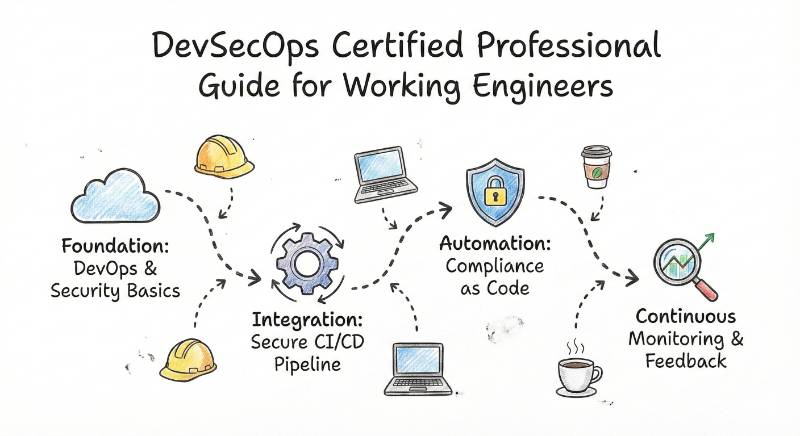
Modern software delivery is fast. Releases happen daily or even hourly. At the same time, security risks have increased. Teams deal with leaked secrets, vulnerable dependencies, misconfigured cloud resources, exposed APIs, and container security issues. This is where DevSecOps becomes practical. DevSecOps means security is not an “after work” task. It becomes part of the same delivery pipeline where code is built, tested, deployed, monitored, and improved. The DevSecOps Certified Professional (DSOCP) helps you learn how to build and run secure delivery systems in real projects. It is useful for working engineers and managers because it focuses on how teams actually work: CI/CD pipelines, cloud platforms, containers, Kubernetes, access control, monitoring, and incident response. This master guide expands every major point you need: what DSOCP is, who it is for, skills you gain, real projects you can do, preparation plans, common mistakes, best next certifications, learning paths, role mapping, and detailed FAQs.
What DSOCP really means in real work
DevSecOps is not a single tool. It is a way of working.
In real work, DevSecOps means:
- Security checks run automatically in the same pipeline as build and test.
- Developers get feedback early, not after release.
- Teams reduce risk before production, instead of fixing the same issues again and again.
- Evidence is generated continuously, so audits and reviews become easier.
- Security becomes measurable, like test coverage or deployment frequency.
In simple words: DSOCP helps you learn how to build secure, repeatable, and scalable delivery.
Why DSOCP matters for engineers and managers
Why it matters for engineers
Engineers often face these problems:
- A security review blocks the release at the last moment.
- Secrets are copied into build scripts and later leaked.
- Vulnerable libraries get deployed because no one noticed.
- Cloud permissions are too broad because “we needed to finish quickly.”
- Security tickets come back again and again with the same root cause.
DSOCP helps you fix these issues by learning security habits that work inside CI/CD.
After DSOCP, you can:
- Design secure pipelines with clear checks and gates.
- Reduce repeated vulnerabilities by shifting checks earlier.
- Handle secrets, access, and dependencies in a safer way.
- Speak clearly about risk without fear or confusion.
Why it matters for managers and leads
Managers and leads face a different set of problems:
- Security is seen as “slowing the team down.”
- Teams do not know what “secure enough” means.
- There is no clear ownership for vulnerabilities and fixes.
- Audits cause panic because evidence is missing.
- Incidents happen, and teams blame each other.
DSOCP helps managers by giving a clear framework:
- What checks should happen where (and why).
- How to set guardrails without blocking delivery.
- How to measure progress using practical signals.
- How to align Dev, Ops, and Security around one pipeline.
Who should pursue DSOCP
DSOCP is a strong choice if you are in one of these roles:
- DevOps Engineers responsible for CI/CD and deployments
- Platform Engineers maintaining shared platforms and pipelines
- Cloud Engineers managing IAM, networking, and cloud security posture
- Security Engineers moving into automation and engineering workflows
- Software Engineers who deploy and own production outcomes
- Tech Leads / Engineering Managers who want predictable and safe delivery
It is also useful if you are preparing for roles that demand “secure delivery ownership,” such as:
- DevSecOps Engineer
- Cloud Security Engineer (engineering-focused)
- Platform Security Engineer
- SRE with security responsibilities
Certification table
Below is a practical table for planning your learning path.
As requested, the Link column contains only the provided official certification link.
| Certification / Program | Track | Level | Who it’s for | Prerequisites | Skills covered | Recommended order |
|---|---|---|---|---|---|---|
| DevSecOps Certified Professional (DSOCP) | DevSecOps | Professional | DevOps, Cloud, Platform, Security engineers; leads | Basic CI/CD knowledge helps; basic cloud awareness helps | Secure CI/CD, secrets hygiene, dependency risk, container and Kubernetes security basics, access discipline, security monitoring mindset | 2 (after DevOps basics) |
| DevOps Certified Professional (DCP) | DevOps | Professional | Engineers moving into DevOps; CI/CD owners | Basic Linux and scripting helps | DevOps mindset, pipeline basics, automation practices, delivery flow | 1 (start here if new) |
| Site Reliability Engineering (SRE) | Reliability | Professional | Production owners; on-call engineers; platform teams | Monitoring basics helps | SLO thinking, incident response, reliability practices | 3 (after DevOps/DevSecOps) |
| Docker Certified Associate (DCA) | Containers | Intermediate | DevOps and developers using containers | Docker basics | Image lifecycle, container runtime, secure build habits | Parallel (early is best) |
| Certified Kubernetes Administrator (CKA) | Kubernetes | Professional | Platform/SRE/DevOps engineers running clusters | Docker + Linux basics | Cluster ops, workloads, networking and security basics | After DCA |
| Master in DevOps Engineering (MDE) | DevOps + DevSecOps + SRE | Advanced | Engineers/leads who want full coverage | No strict prerequisites if starting from basics | End-to-end delivery, security mindset, reliability thinking | 4 (capstone path) |
DevSecOps Certified Professional (DSOCP)
What it is
DSOCP is a professional-level certification focused on building secure software delivery using DevOps practices. It trains you to integrate security into CI/CD, cloud environments, container platforms, and operational workflows.
Who should take it
- Engineers building and maintaining CI/CD pipelines
- Engineers managing cloud infrastructure and permissions
- Engineers deploying containerized apps and Kubernetes workloads
- Security engineers who want to automate checks and controls
- Leads and managers who want predictable secure delivery, not last-minute surprises
Skills you’ll gain
Secure CI/CD design
- Where to place security checks in build, test, and deploy stages
- How to balance speed and safety without breaking developer workflow
- How to prevent risky deployments using clear pipeline rules
Secrets and credentials discipline
- How secrets leak in real pipelines
- Safe handling of tokens, passwords, keys, and environment variables
- Strong habits that reduce “copy-paste security”
Dependency and supply chain awareness
- Why third-party libraries create risk
- How to identify risky packages early
- How to reduce repeated issues from the same dependency patterns
Container security basics
- Why image size matters for risk
- How insecure base images create problems
- How scanning and minimal images reduce exposure
Kubernetes security basics
- Why cluster access is a high-value risk area
- RBAC hygiene concepts (least privilege thinking)
- Avoiding risky default settings and open services
Cloud security mindset
- IAM discipline: avoid “everyone is admin”
- Practical thinking for secure cloud configurations
- Understanding that misconfiguration is a major risk source
Security monitoring and operational readiness
- What to log and monitor for security signals
- How security links to incidents and outages
- How to improve visibility without noise
Real-world projects you should be able to do after it
Project 1: Secure CI/CD pipeline template
- Build a pipeline with automated checks before deployment
- Add clear fail conditions that stop risky releases
- Make results visible to developers early
Project 2: Secrets-safe delivery workflow
- Remove secrets from code and scripts
- Use safer injection patterns for runtime and pipeline stages
- Add policies like “no secrets in repo” and enforce it in pipeline
Project 3: Dependency risk control
- Add dependency scanning and review steps
- Create a triage method: which issues are urgent vs can wait
- Build a repeatable “update and verify” rhythm
Project 4: Secure container build
- Use minimal base images where possible
- Create a consistent build standard (pin versions, reduce packages)
- Scan images and block known severe risks before deployment
Project 5: Kubernetes guardrails basics
- Build safer defaults for namespaces and RBAC
- Reduce exposure from open services and risky settings
- Add basic policy checks before applying manifests
Project 6: Security evidence pack for audits
- Create an evidence trail from pipeline output
- Store results as part of release artifacts
- Make audits less painful by having proof ready
Preparation plan
7–14 days plan (fast-track)
Best for: engineers already doing CI/CD and cloud deployments.
- Days 1–2: DevSecOps fundamentals, risk basics, where issues happen
- Days 3–4: CI/CD security checkpoints (what to check and why)
- Days 5–6: Secrets handling and IAM discipline (top causes of incidents)
- Days 7–8: Dependency risk basics and secure build habits
- Days 9–10: Container security and secure image practices
- Days 11–12: Kubernetes security basics and common misconfig risks
- Days 13–14: Review everything, do mock tests, revise weak areas
Key success rule in fast-track:
Do not try to learn every tool deeply. Learn the pipeline flow, the checks, and the decision points.
30 days plan (best for most working professionals)
Best for: people who need time to practice without burnout.
- Week 1: DevSecOps fundamentals + secure pipeline design
- Week 2: Secrets + IAM + dependency risk and triage habits
- Week 3: Container security + Kubernetes guardrails basics
- Week 4: Monitoring mindset + evidence + review + mock tests
Each week, create one small output:
- One pipeline design diagram (simple)
- One checklist for secrets and IAM
- One container build standard
- One Kubernetes safety checklist
- One “release evidence pack” template
60 days plan (best for switchers or those new to DevOps security)
Best for: people who want strong fundamentals before going professional.
- Weeks 1–2: DevOps pipeline basics and cloud basics
- Weeks 3–4: Security basics for engineers (risk types, common failures)
- Weeks 5–6: Secure CI/CD, secrets, dependency discipline
- Weeks 7–8: Containers, Kubernetes basics, monitoring, review
Key success rule in 60 days:
Build habits slowly. Repeat the same skills until they feel natural.
Common mistakes
- Treating DevSecOps as a “tool list” instead of a workflow
- Running scans but not deciding who owns fixes
- Adding too many checks and making pipelines painfully slow
- Using “admin access” everywhere to avoid troubleshooting
- Hardcoding secrets because it is “faster”
- Ignoring dependency updates until a critical issue appears
- Building huge container images with unknown packages
- Deploying Kubernetes workloads with open services by default
- Having no clear evidence for release and audit reviews
- Thinking security is separate from reliability and incidents
Best next certification after this
After DSOCP, the best next step depends on your goal:
- If you want broader full-stack delivery maturity, go toward an end-to-end program like MDE.
- If you want platform depth, go deeper into Containers (DCA) and Kubernetes (CKA).
- If you want production excellence, choose SRE next to strengthen incident readiness and reliability ownership.
Choose your path (6 learning paths)
DevOps path
Best for: engineers who want strong delivery automation first.
- Start: DCP
- Next: DCA (containers)
- Next: CKA (kubernetes)
- Add: DSOCP (security in delivery)
- Capstone: MDE
Why this path works:
You build delivery speed first, then add security and platform strength.
DevSecOps path
Best for: engineers who want security-first pipelines.
- Start: DCP (if needed)
- Core: DSOCP
- Strengthen: DCA + CKA
- Capstone: MDE (for full coverage)
Why this path works:
You learn to secure the same pipeline you build, not a separate security process.
SRE path
Best for: engineers who own production and on-call.
- Start: DCP
- Core: SRE
- Add: DSOCP (security issues often become outages)
- Strengthen: Kubernetes path (CKA)
- Capstone: MDE
Why this path works:
Reliability + security creates strong production ownership.
AIOps/MLOps path
Best for: teams operating at scale with alert fatigue.
- Start: DCP
- Add: SRE (reliability thinking)
- Add: monitoring and analysis discipline
- Add: DSOCP (security signals and risk also matter)
- Capstone: MDE
Why this path works:
Scale needs smart operations, plus secure defaults.
DataOps path
Best for: data engineers running pipelines and platforms.
- Start: DCP
- Add: DSOCP (data environments also have access and leakage risks)
- Add: SRE (stability of pipelines)
- Add: Kubernetes path if platform-based
- Capstone: MDE
Why this path works:
Data pipelines break often due to reliability and access problems. This path fixes both.
FinOps path
Best for: cloud cost owners and governance-focused platform teams.
- Start: DCP
- Add: DSOCP (governance + access discipline)
- Add: SRE (reliability improves cost control too)
- Capstone: MDE
Why this path works:
Cost control is not just finance; it is good engineering and controlled delivery.
Role → Recommended certifications mapping
Role mapping table
| Role | Main focus | Recommended certifications (order) | Why it fits |
|---|---|---|---|
| DevOps Engineer | CI/CD, automation, delivery | DCP → DSOCP → DCA → CKA → MDE | You build pipelines; DSOCP makes them safe and reliable |
| SRE | reliability, incidents, SLO thinking | DCP → SRE → DSOCP → CKA → MDE | Security issues often become incidents; strong combined ownership |
| Platform Engineer | shared platforms, internal tooling | DCP → DCA → CKA → DSOCP → MDE | Platform teams need secure defaults and repeatable delivery |
| Cloud Engineer | IAM, cloud deployment, governance | DCP → DSOCP → CKA (if needed) → MDE | Cloud misconfig is a major risk; DSOCP fixes the habits |
| Security Engineer | controls + automation | DSOCP → DCP → SRE/Platform depth → MDE | Engineering security works best when automated in pipelines |
| Data Engineer | data pipelines, reliability, access | DCP → DSOCP → SRE → (CKA if needed) → MDE | Data risk is often access + stability; both are covered |
| FinOps Practitioner | cost governance + cloud discipline | DCP → DSOCP → SRE → MDE | Governance needs access discipline and reliable systems |
| Engineering Manager | alignment + risk + delivery standards | DSOCP → DCP → MDE | You need practical guardrails and shared language across teams |
Next certifications to take (3 options)
1) Same track (deeper in secure delivery)
Choose: MDE
Why: It helps you connect DevOps, DevSecOps, and reliability into one plan.
2) Cross-track (platform and runtime strength)
Choose: DCA → CKA
Why: Most modern delivery runs on containers and Kubernetes. Security gets real at runtime.
3) Leadership direction (system thinking + standards)
Choose: MDE + SRE mindset
Why: Leaders must manage speed, risk, and reliability together. This combination supports that.
Top institutions that help with Training + Certifications
DevOpsSchool
DevOpsSchool supports structured learning paths across DevOps, DevSecOps, and reliability-focused programs. It is useful for professionals who want guided learning, practical project outcomes, and job-focused preparation aligned to real delivery environments.
Cotocus
Cotocus is helpful for learners who want structured mentoring support and project-based learning. It can support professionals who need practical guidance to convert training into working skills.
ScmGalaxy
ScmGalaxy is useful for building tool-based and workflow-based practice, especially for DevOps and automation learning. It is commonly used for structured learning that connects tools with real work tasks.
BestDevOps
BestDevOps can be used for role-focused guidance and learning roadmaps. It helps professionals connect skill growth with job outcomes, interview readiness, and practical career planning.
devsecopsschool
devsecopsschool is track-focused for DevSecOps learning and preparation. It helps learners build secure delivery habits, pipeline thinking, and security automation mindset.
sreschool
sreschool is track-focused for reliability, monitoring, and incident readiness. It is helpful for professionals who want strong production ownership skills.
aiopsschool
aiopsschool supports learning around operating at scale, handling noisy alerts, and improving operations using smarter approaches. It is useful for teams who want faster detection and response thinking.
dataopsschool
dataopsschool is helpful for people working in data pipelines and platforms. It supports stable, repeatable, and well-governed data delivery habits.
finopsschool
finopsschool supports cloud cost governance and disciplined cloud usage. It is useful for engineers and practitioners who want structured approaches to cost control and accountability.
FAQs focused on difficulty, time, prerequisites, sequence, value, career outcomes
1) Is DSOCP difficult?
It is professional-level, but it becomes easy if you already understand CI/CD and deployments. If you are new, the 60-day plan is better.
2) How much time should I plan daily?
Most working professionals do well with 60–90 minutes daily. On weekends, 2–3 hours helps for practice.
3) Do I need strong coding skills?
You do not need advanced coding, but basic scripting and pipeline understanding is important. DevSecOps is more about workflow and discipline.
4) What prerequisites help the most?
Basic DevOps concepts, basic Linux, basic cloud understanding, and a simple idea of CI/CD pipelines.
5) Should I do DevOps certification before DSOCP?
If you are new to DevOps, yes. If you already work in CI/CD daily, you can start with DSOCP and fill gaps later.
6) Can managers take DSOCP?
Yes. It helps managers set practical guardrails, understand risk, and reduce last-minute release blocks.
7) Is DSOCP valuable for Indian job market?
Yes. Many teams in India support global customers and cloud platforms. Secure delivery is now expected in many roles.
8) What job roles benefit most after DSOCP?
DevSecOps Engineer, Platform Engineer, Cloud Security Engineer (engineering-focused), DevOps Engineer with security ownership, and SRE with security responsibilities.
9) Does DSOCP help in salary growth?
It can support salary growth when combined with proof of skills: secure pipeline project, container security habits, and clear delivery standards.
10) What is the best way to show DSOCP skills?
Show a real project: a secure CI/CD pipeline template, secret-handling practice, and a dependency risk approach.
11) What is the right order after DSOCP?
If your work is cloud + containers: go DCA → CKA. If you are production heavy: go SRE next. If you want full coverage: go MDE.
12) How long does it take to become confident, not just certified?
For most people, confidence comes after 1–2 real pipeline projects and repeated practice over 4–8 weeks.
DSOCP FAQs
1) What is the biggest outcome of DSOCP learning?
You stop relying on last-minute security reviews and start building security into the delivery flow from day one.
2) What is a common DevSecOps pipeline mistake?
Putting security checks too late, so fixes become costly and releases get delayed.
3) What is the most common security failure in CI/CD?
Secrets leakage. It happens through copied tokens, logs, artifacts, or stored environment variables.
4) How should I handle scan results in a real team?
Define triage rules: what must be fixed now, what can be scheduled, who owns it, and how to track it.
5) Does DevSecOps always slow down delivery?
No. Done well, it reduces rework and avoids incidents, which actually speeds up long-term delivery.
6) What is the best habit to build while preparing?
Build a “secure release checklist” and use it in your daily work or a sample project.
7) How do I explain DevSecOps to non-technical stakeholders?
Explain it as “reducing risk early so customers stay safe, outages reduce, and compliance becomes easier.”
8) What is the best next move if I want a DevSecOps role fast?
Build a secure pipeline demo project and practice explaining it clearly. Certifications matter more when your project proof is strong.
Conclusion
DSOCP is a strong certification goal for professionals who want to deliver software faster without creating hidden security risk. It fits engineers because it improves day-to-day delivery habits. It fits managers because it creates a practical framework for guardrails, evidence, and predictable releases.If you follow the preparation plan, build at least one secure pipeline project, and avoid the common mistakes, you will not only complete the certification goal, you will also become more valuable in modern teams.
